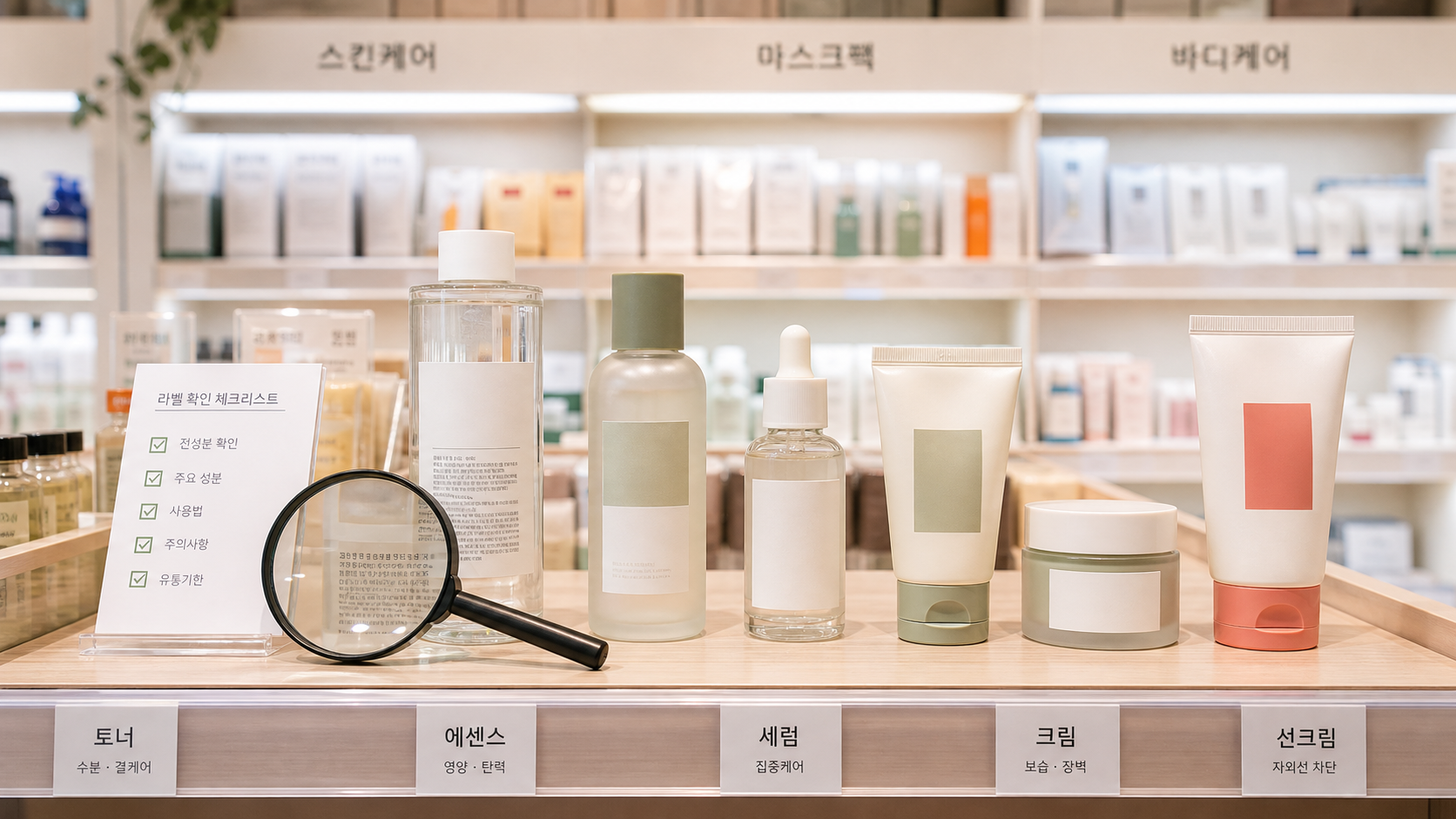
Korean skincare label English guide: Start by finding the product type, 사용법 (directions), 주의사항 (precautions), 전성분 (full ingredients), and 사용기한 (expiration or use-by information). You do not need to translate every line before deciding whether a K-beauty product fits your routine.
A Korean skincare label can feel like a tiny exam: Hangul, English words, ingredient lists, warnings, dates, and marketing phrases all fighting for attention. Use this quick table first, then read the detailed sections only when they affect your decision.
| Korean label term | English meaning | Why it matters |
|---|---|---|
| 사용법 | Directions / how to use | Amount, timing, and application order |
| 주의사항 | Precautions | Irritation, eye-area, storage, and stop-use warnings |
| 전성분 | Full ingredients | Check ingredients you avoid or already know |
| 사용기한 | Expiration / use-by information | Check before buying backups or older stock |
| 선크림 | Sunscreen | Confirms the product category, not just the marketing name |
For product-order context, use the simple Korean skincare routine. If a package emphasizes acidity or “low pH,” read what pH-balanced means in Korean skincare before treating that phrase as proof of quality.
If the routine order still feels fuzzy, start with our Korean skincare routine guide for beginners first. This label guide makes more sense once you know what role cleanser, moisturizer, sunscreen, toner, essence, and serum usually play.
Where to look first on a Korean skincare package
Start with the front name, then move to the back or side panel. The front often tells you the marketing story; the back usually gives you more practical information such as how to use the product, precautions, manufacturer or distributor details, and date-related information.
If you are shopping online, compare the product page with the package photo. A clean routine starts with understanding what the item is meant to do, how often it is meant to be used, and whether any caution language applies to your situation.
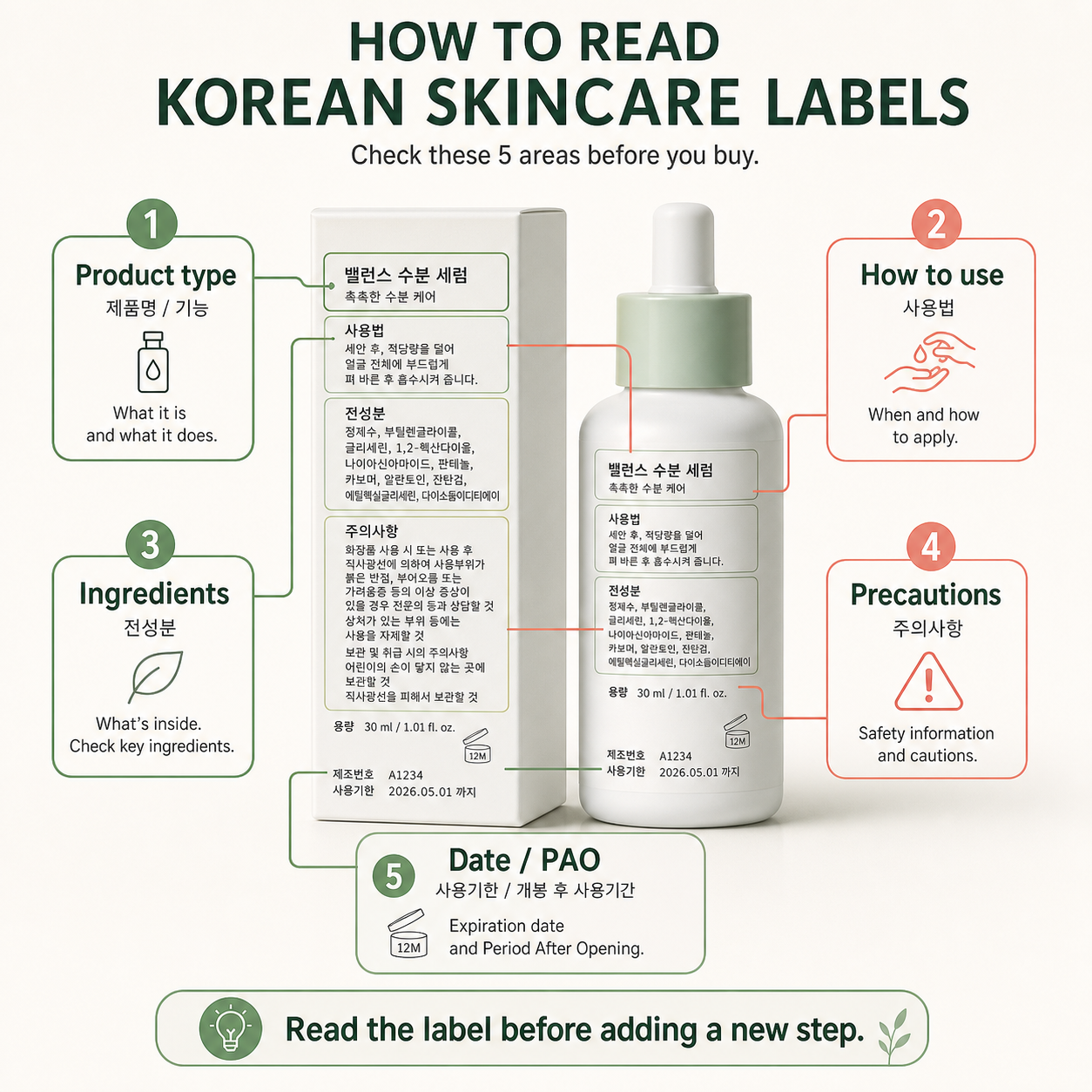
Start with these five label zones
- Product type: Is it a cleanser, toner, serum, cream, sunscreen, mask, or something else?
- How to use: Look for when, how much, and where the product should be applied.
- Ingredients: Use this to spot ingredients you already avoid or know you tolerate poorly.
- Precautions: This is where irritation, eye-area, storage, children, and damaged-skin warnings usually appear.
- Date or PAO: Check expiration or period-after-opening language before buying backups.
That is the practical order. Boring? A little. But it keeps you from buying a pretty bottle that does not fit your routine.
Common Korean words global shoppers should recognize
- 스킨 / 토너: often used for toner or skin-softening liquid.
- 에센스: essence, usually a lightweight treatment-style step.
- 세럼 / 앰플: serum or ampoule, often more concentrated in marketing language.
- 크림: cream.
- 로션: lotion or emulsion depending on product context.
- 선크림: sunscreen.
- 사용법: how to use.
- 주의사항: precautions or cautions.
- 전성분: full ingredient list.
These translations are a starting point, not a replacement for checking the actual product page. Korean beauty packaging often mixes Korean, English, and brand-specific wording, so context matters.
How to read precautions without panicking
Precaution sections can sound serious because they are written to cover many use cases. Look for warnings about irritation, damaged skin, eye area, storage, children, or stopping use if discomfort continues.
The practical takeaway is not that every product is dangerous. It is that you should treat new skincare as something to test slowly, especially if you already know your skin reacts easily.
If your skin is reactive, read the precaution section before the glow claims. If the product is a sunscreen, also check whether you would actually apply enough of it every morning. A perfect label does not help if you hate using the product.
Marketing phrases vs practical purchase decisions
K-beauty packaging may use phrases about glow, moisture, calming, barrier care, or clean-looking skin. Those phrases can describe a product direction, but they should not be treated as proof that the product will fix a skin condition.
A safer purchase decision asks three questions: What type of product is it? What step would it replace or add? What caution or usage note could affect me?
When those answers are clear, you can compare products more calmly. When they are not clear, pause. The sale price will come back. Your face only gets one first test.
A simple label-reading checklist
- Identify the product type before reading the marketing claims.
- Check how and when the product is meant to be used.
- Read the caution area, especially if your skin is reactive.
- Look for date or opening-period information.
- Avoid buying several new active products at once.
- Do not treat cosmetic packaging as medical advice.
Before buying, try saying the product’s role in one plain sentence: “This is my morning sunscreen,” or “This is an optional serum I will test slowly.” If you cannot say that yet, the label has not answered enough.
FAQ
Do Korean labels always have English?
Not always. Many export-focused products include English, but domestic packaging can be mostly Korean. Online retailer pages may also summarize details differently from the physical package.
Can I trust phrases like brightening or calming?
Treat them as shopping clues, not guaranteed outcomes. Check official product information and avoid assuming a cosmetic claim means medical treatment.
Should I buy a product if I cannot read the label?
For a beginner, it is better to pause until you understand the product type, usage, cautions, and whether it fits your routine.
Next in K-beauty
If you are still building the routine itself, start with the beginner Korean skincare routine guide before comparing too many labels. A simple routine makes label reading much easier.
Sources and editorial notes
- Easy Law Korea cosmetic label standards was used for Korean label basics such as readable Korean display, standardized ingredient names, ingredient-order framing, and expiration or period-after-opening wording. Checked on 2026-05-06 before public review.
- MFDS cosmetic precaution labeling regulation was used as a caution and label-safety framing source. Checked on 2026-05-06 before public review.
- MFDS cosmetic labeling and advertisement regulation was used as a marketing-claim caution guardrail. Checked on 2026-05-06 before public review.
If you are shopping in person, pair this label-reading guide with Korean shopping phrases for skincare and souvenirs so you can ask for testers, samples, and sensitive-skin options.
Choosing where to buy is a separate decision from reading the package. Use the Korea-versus-online skincare buying guide to compare seller traceability, final cost, returns, and travel limits.