Short answer: Most travelers in Korea should get a transportation card such as T-money if they will use subway or bus more than once. Buy one at a convenience store, subway station, airport counter, or tourist information point, add enough balance for a few rides, tap in and tap out, and keep some Korean won cash available for recharging or small transit problems.
A T-money card is not a sightseeing pass by itself. Think of it as a prepaid transit wallet that makes buses, subways, some taxis, and selected convenience-store payments easier. It removes the need to buy a single ticket every ride, and it helps with transfer discounts when you use the card correctly.
If you have not learned the subway flow yet, read How to use the Seoul subway as a first-time visitor first. For planning where to ride, read Seoul neighborhoods for first-time K-culture travelers.
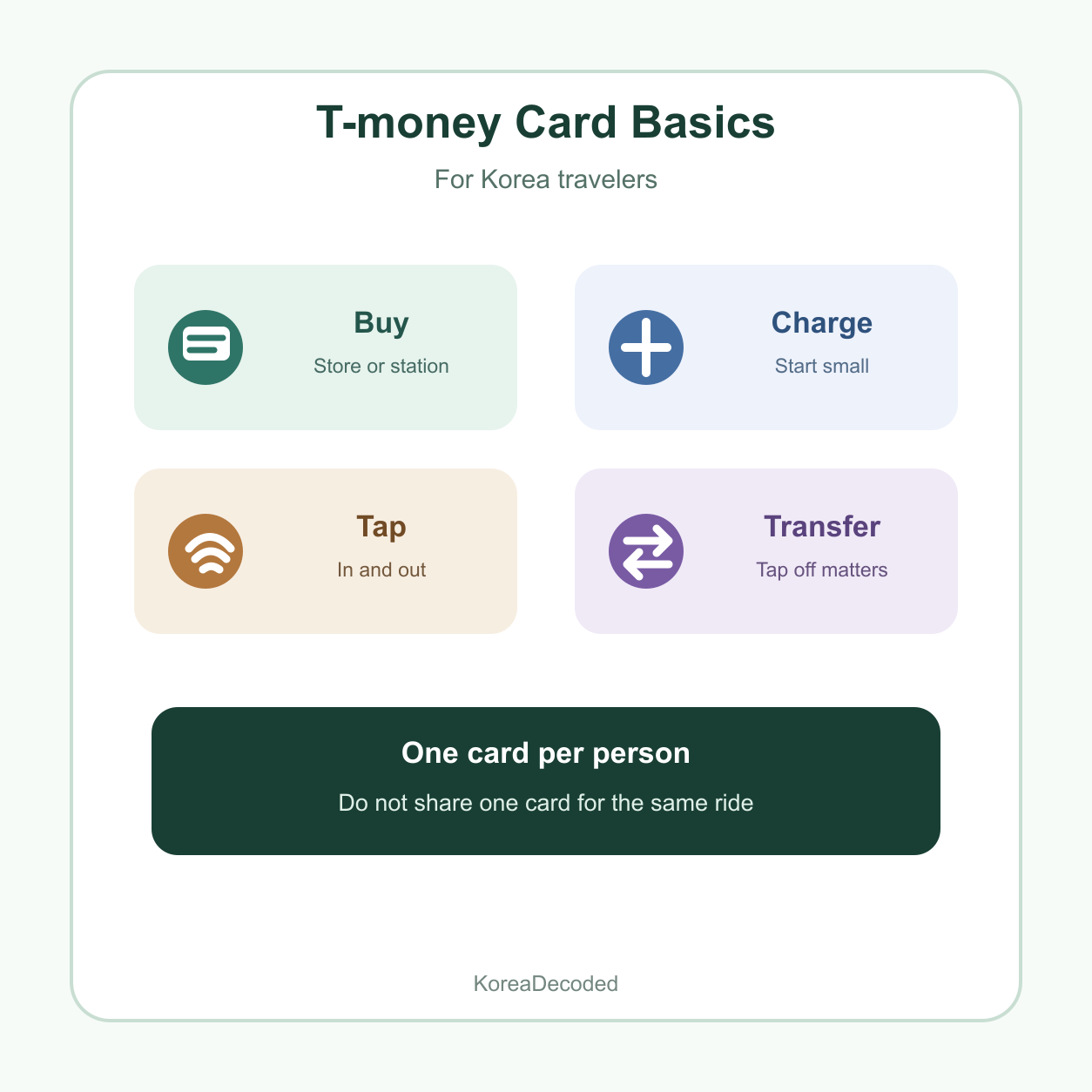
T-money rules as a quick webtoon
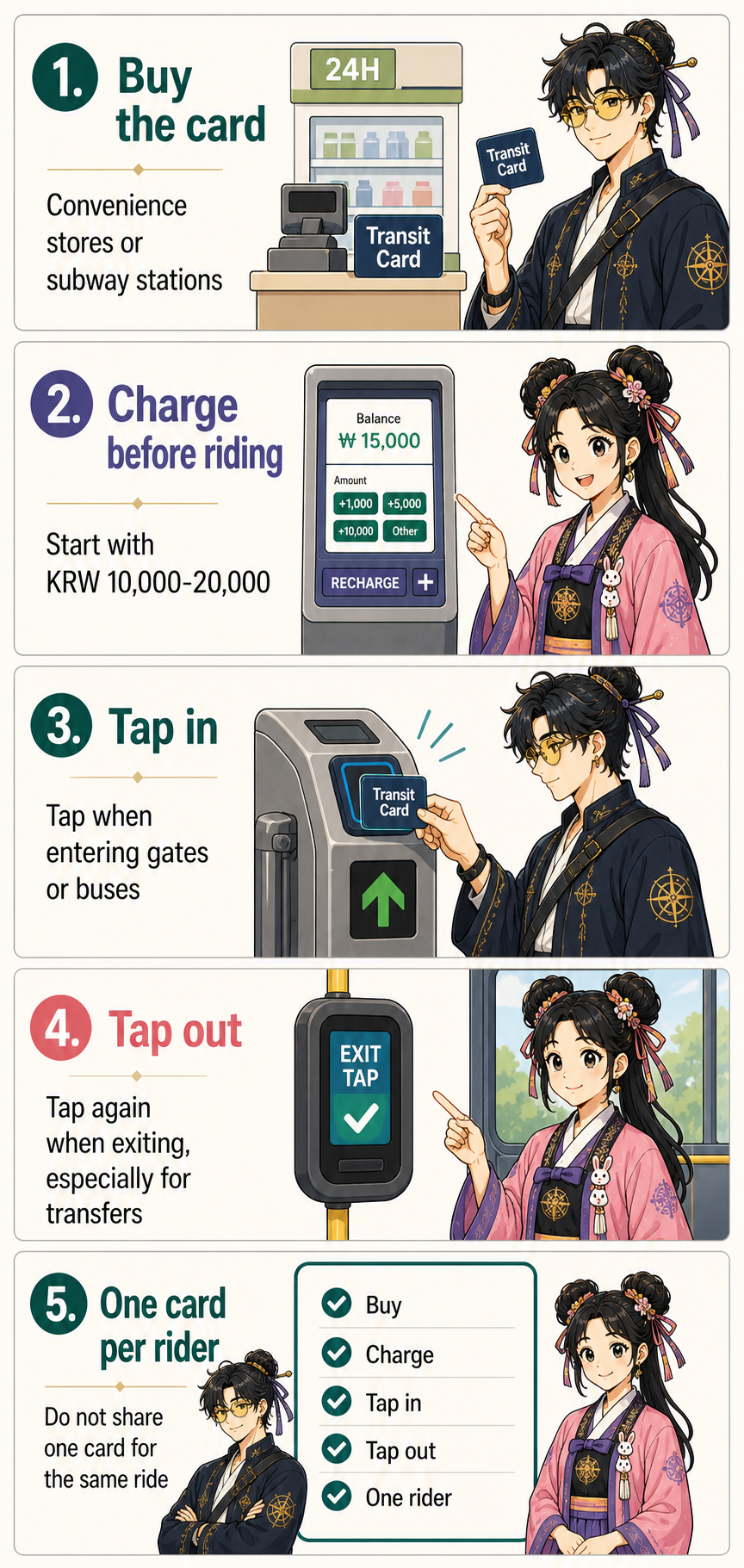
What is a T-money card?
T-money is a rechargeable transportation card system used in Korea. Travelers usually use the word “T-money card” to mean a prepaid transit card they can tap at subway gates and bus readers. Korea also has other transportation card brands and tourist payment cards, but T-money is one of the most familiar names.
The main benefit is simplicity. You do not need to buy a subway ticket every time, count coins on a bus, or re-check basic fare math for every short ride. You tap the card, the fare is deducted, and your remaining balance stays on the card.
Where travelers can buy one
Visit Seoul says TMoney cards can be purchased and charged at most convenience stores, subway stations, and tourist information centers. In practice, visitors usually buy one at places such as CU, GS25, 7-Eleven, emart24, airport convenience stores, subway station machines, or tourist information points.
Some cards are plain transportation cards. Others are tourist-branded cards or payment cards that include a transportation card function. Do not buy only by the card design. Ask whether the card works for public transportation and whether it comes with any starting balance. Many physical cards are sold empty, so you still need to add money before riding.
How much money should you add first?
For a short Seoul trip, do not load a huge amount on day one. Add enough for several rides, then top up later when you understand your pace. As a simple starting point, KRW 10,000 to 20,000 is easier to manage than overloading the card with money you may need to refund later.
As of the Seoul Metropolitan Government subway fare page checked on 2026-05-22, the adult Seoul subway base fare is KRW 1,550 by transportation card after the June 28, 2025 fare change. Longer distance, bus routes, and other regions can change the total fare, so treat this as a Seoul base reference, not a universal Korea trip budget.
How to use it on the subway
- Tap the card on the gate reader when entering.
- Ride to your station or transfer inside the paid area.
- Tap again when leaving through the exit gate.
Do not skip the exit tap. The system needs the entry and exit information to calculate the fare correctly. If your card does not work at the gate, step aside and ask station staff instead of blocking the reader.
How to use it on buses
On buses, tap when boarding and tap again before getting off. The exit tap is especially important if you plan to transfer. Seoul’s official transportation information says the integrated fare applies only when passengers tap the card when boarding and getting off each transport mode.
When the bus is crowded, move toward the door before your stop and have the card ready. Do not wait until the last second to find the card in your bag.
Transfers: the habit that saves money
The most important habit is simple: tap every time. Seoul’s official subway fare page notes that transfer discounts generally require tagging when getting on and off each mode of transport. It also notes transfer time windows, generally within 30 minutes, or within 60 minutes from 9 PM to 7 AM.
For travelers, the practical version is this: if you move subway to bus, bus to subway, or bus to bus, always tap off before leaving the first vehicle or station. If you forget, the system may not treat the next ride as a transfer.
Can one card pay for multiple people?
Use one card per person. That is the cleanest rule for tourists because it keeps entry, exit, transfer, and fare calculation simple. Paying for multiple people with one card can create transfer confusion and is not the beginner-friendly method.
If you are traveling with children, ask at purchase whether age-based registration or a child card setting is needed. Do not assume a child fare applies automatically just because the rider is young.
Physical card or mobile T-money?
A physical card is still the easiest recommendation for first-time tourists because it is simple, visible, and easy to lend to yourself across the trip. It also avoids phone battery, app setup, region, NFC, or payment-method issues.
Tmoney’s English site describes Mobile Tmoney as a phone-based payment service for public transportation, taxis, convenience stores, and other partner merchants, and notes Android/Samsung Wallet-related options. Mobile setup can be convenient, but tourists should confirm device compatibility and setup steps before depending on it for the first airport-to-city ride.
T-money vs Climate Card
Use T-money if you want the simplest flexible card for subway, bus, and broader Korea travel. Consider the Climate Card if you will take many Seoul public transportation rides in the pass period and your routes stay within the card’s service range.
The Climate Card can be great for heavy Seoul transit use, but it is not automatically the best card for every tourist. T-money is usually easier for mixed travel, light transit use, occasional taxi or convenience store payment, and trips beyond central Seoul.
Can you use T-money outside Seoul?
In many cases, yes, transportation cards are used beyond Seoul, but exact acceptance can depend on the city, transport type, and card product. Do not assume every intercity bus, airport bus, train, or taxi will work the same way. For long-distance travel, check the operator’s payment method before boarding.
This matters for tourists going to Busan, Jeju, or smaller cities. The card may still be useful, but the “tap and go” habit should be paired with local route and payment checks.
Refunds and leftover balance
Try not to leave a large balance on the card. Refund rules can vary by card type, balance amount, and refund location. Some convenience stores can process smaller balance refunds, while larger or unusual cases may require a T-money service location or a different process.
The easiest tourist strategy is boring but effective: top up in small amounts, use the remaining balance on final transit rides or accepted small purchases, and ask about refund rules before your departure day. Do not wait until the airport gate area to solve a large leftover balance.
Common tourist mistakes
- Loading too much money: add more later instead of creating a refund problem.
- Not tapping off buses: this can affect transfer discounts and fare calculation.
- Using one card for a group: one card per person is clearer.
- Assuming mobile setup will be instant: physical cards are safer for first arrival.
- Forgetting cash: some recharge situations are still easier with Korean won cash.
A simple traveler checklist
- Buy one transportation card per person.
- Ask whether the card is empty or already loaded.
- Add a modest starting balance.
- Tap when entering and exiting subway gates.
- Tap when boarding and getting off buses.
- Top up in smaller amounts as the trip continues.
- Use or refund leftover balance before the final travel day.
FAQ
Do I need a T-money card for only one subway ride?
No. A single journey ticket can work for one subway ride. But if you will ride several times or transfer to buses, a transportation card is usually easier.
Can I use a credit card directly at Seoul subway gates?
Do not rely on foreign credit-card tap payment as your main plan. For a first-time visitor, a transportation card or clearly supported mobile transit setup is safer.
Is T-money better than WOWPASS or tourist cards?
It depends on what you need. T-money is simple for transit. Other tourist cards may combine shopping payment, exchange, or benefits. Choose based on the problem you want to solve, not only on the card brand.
Sources and editorial notes
- Visit Seoul transportation page was used for TMoney purchase and charging location context. Checked on 2026-05-22.
- Seoul Metropolitan Government subway fare page was used for base fare and transfer-tap rules. Checked on 2026-05-22.
- Seoul Metropolitan Government public transportation guide was used for public transportation card and route-planning context. Checked on 2026-05-22.
- Tmoney Mobile Tmoney page was used for mobile Tmoney service context. Checked on 2026-05-22.
Once you know how the card works, choose a base that reduces your daily rides with the Seoul stay guide for K-pop and K-drama fans.