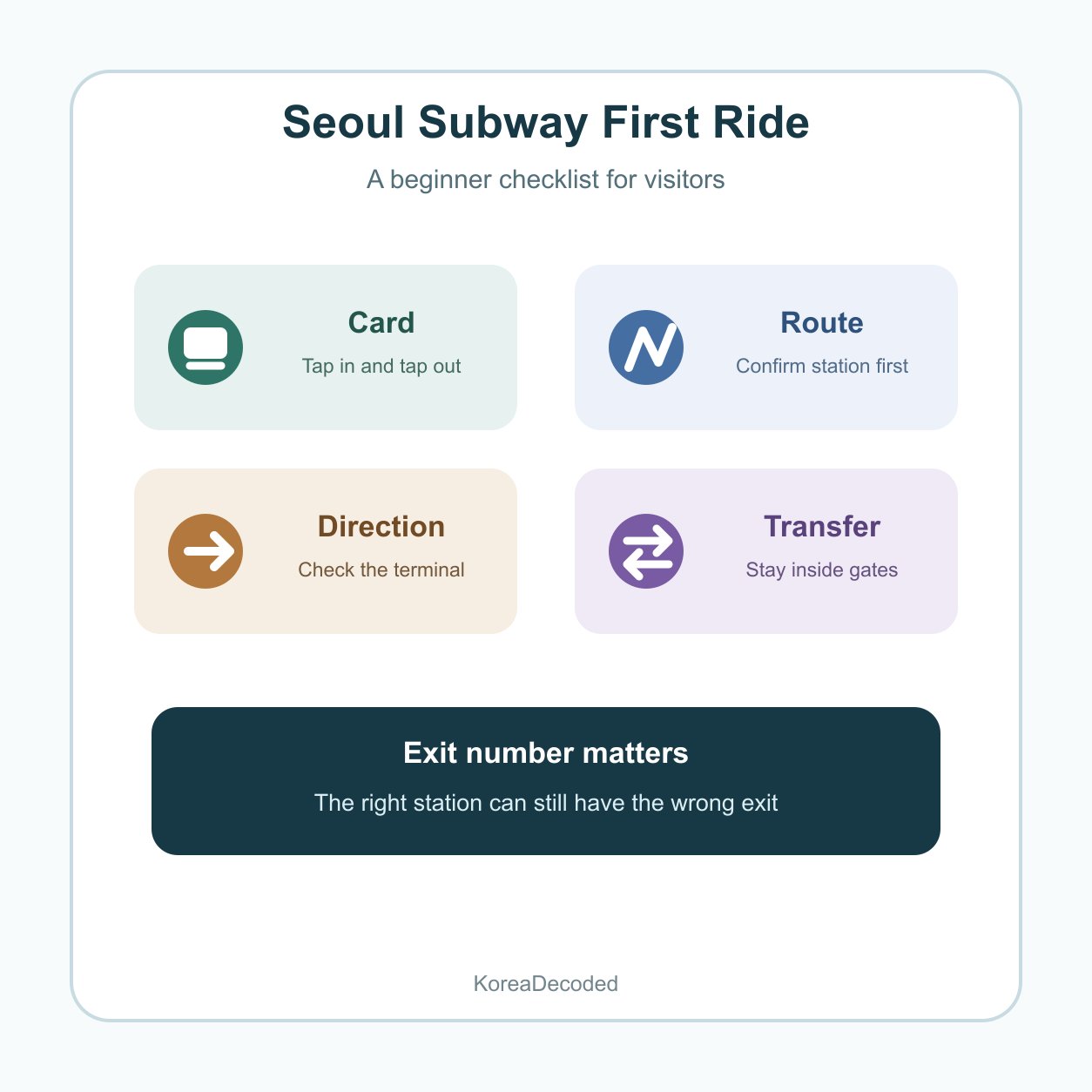
Short answer: First-time visitors should use Seoul subway with a transportation card if they will ride more than once. Plan the route in an app, follow the line color and direction, tap in and tap out, and check the exit number before leaving the station. The system looks complex, but most mistakes come from choosing the wrong direction or the wrong exit.
Seoul subway is one of the easiest ways to move between neighborhoods once you know the pattern. The map can look intimidating because many lines cross the city, but the daily routine is simple: choose a station, choose a direction, transfer if needed, and leave through the correct exit.
If you are still planning where to stay, read Seoul neighborhoods for first-time K-culture travelers. If you want food phrases for station-area snacks, read Korean street food terms for travelers.
What to prepare before your first ride
You need a payment method and a route. For most visitors, the simplest setup is a prepaid transportation card such as Tmoney, Cashbee, Rail+, or another supported card. Seoul also has single journey tickets for subway-only rides, but they are less convenient if you will transfer or ride several times.
As of the Seoul Metropolitan Government fare table checked on 2026-05-22, the adult subway base fare is KRW 1,550 by transportation card after the June 28, 2025 fare change. A single ride ticket costs KRW 100 more than the transportation card fare, and the single journey ticket has a KRW 500 deposit that is refunded at the destination station’s deposit refund machine.
Card or single journey ticket?
Use a transportation card if you will ride the subway more than once, use buses, or transfer between subway and bus. You tap the card at the gate when entering and again when exiting. Keeping one card per person is the cleanest habit for subway travel.
Use a single journey ticket only if you truly need one subway ride and do not want a reusable card. Seoul’s public transportation guide says single journey tickets can be bought at subway station kiosks with foreign language settings. Remember that they are subway-only and require the deposit refund step after arrival.
When to consider the Climate Card
The Climate Card can be useful if you will take many Seoul public transportation rides in a short period. Seoul’s official Climate Card page lists short-term passes such as 1-day, 2-day, 3-day, 5-day, and 7-day options, plus longer 30-day options.
Do not assume it is always cheaper. If you only take a few subway rides, a normal transportation card may be simpler. The Climate Card also has service-area rules, especially for routes outside Seoul, so check the official range before relying on it for airport or outer-area trips.
Step 1: choose the destination station
Search for the destination by place name first, then confirm the station. Seoul attractions, shops, restaurants, and hotels often list the nearest station and exit number. The exit number is important because large stations can have many exits that place you on very different streets.
For route planning, use a subway or map app that supports English station names. Seoul says its Seoul Subway app provides route information, location-based route recommendations, directions inside stations, passenger density information, and exit/restroom location information.
Step 2: check the line color and direction
Each subway line has a number or name and a color. After you enter the station, signs usually guide you toward the platform by line and direction. Direction is often shown by the terminal station or a major station on that side of the line.
This is where visitors make mistakes. Do not just follow the line color. Check which direction your train is going. If your app says to ride Line 2 toward City Hall, follow signs for that direction, not just any Line 2 platform.
Step 3: tap in, ride, and listen for stops
Tap your card at the gate and keep moving after the gate opens. On the platform, stand behind the safety line and let passengers exit first. Inside the train, screens and announcements usually show the current and next station in Korean and English.
If the train is crowded, move away from the door when possible. Keep bags close to your body, and avoid blocking exits when the train stops. Small etiquette choices make the ride much easier during rush hours.
Step 4: transfer without leaving the paid area
Transfers usually happen inside the paid station area. Follow signs for the next line rather than exiting through the gate. Large transfer stations can involve long walks, stairs, and multiple escalators, so allow extra time if you have luggage.
For subway and bus transfers, tapping matters. Seoul’s official transport information says the integrated fare applies only if the passenger taps the card when boarding and getting off each mode of transport. It also notes transfer time limits: generally within 30 minutes, or 60 minutes from 9 PM to 7 AM.
Step 5: choose the right exit
Do not relax too early when you arrive at the correct station. The exit number may decide whether you appear in front of your hotel, across a major road, or several blocks away. Check your map app for the exit number before leaving the paid area.
If you leave by the wrong exit, it is usually not a disaster, but it can turn a two-minute walk into a fifteen-minute loop. In stations like Hongdae, Gangnam, Seoul Station, City Hall, and Express Bus Terminal, exit choice matters a lot.
Common first-time mistakes
- Only checking the line color: always check direction too.
- Ignoring exit numbers: the same station can open onto very different streets.
- Leaving the gate during a transfer: follow transfer signs first.
- Forgetting to tap out: tapping out matters for fare calculation and transfers.
- Overpacking the route: allow extra time for large stations and stairs.
Traveling with luggage
The subway can work with luggage, but it is not always pleasant during rush hour. Look for elevator signs if you have a heavy suitcase. Some stations have long walking sections, and transfer routes are not always short.
If your route includes Seoul Station, Hongdae, Gangnam, or Express Bus Terminal, give yourself more time. Airport routes, hotel check-in times, and luggage all make small route mistakes feel larger.
Rush hour and timing
Weekday commuting hours can be crowded, especially on major lines and transfer stations. If your schedule is flexible, avoid dragging luggage through peak commuter periods. A slightly slower route with fewer transfers may be better than the technically fastest route.
Also remember last-train risk. Late at night, check the final train time in an app before assuming the subway is still the best option. If you miss the last train, you may need a taxi or a different bus route.
A simple first ride checklist
- Prepare one transportation card per person, or buy a single journey ticket.
- Search the destination and confirm the nearest station.
- Check the subway line, direction, transfer station, and exit number.
- Tap in at the gate and follow platform signs.
- Transfer inside the paid area when needed.
- Tap out and leave through the correct exit.
FAQ
Can I use Seoul subway without a Tmoney card?
Yes. You can buy a single journey ticket at subway station kiosks, but it is subway-only and includes a deposit refund step. A transportation card is easier for repeated rides and transfers.
Is the Seoul subway hard for English speakers?
It is manageable. Station names, maps, train screens, and apps often support English. The key is checking direction and exit number, not memorizing the whole network.
Should I buy a Climate Card for a short trip?
Maybe. It can make sense if you will ride public transportation many times within the pass period. For light subway use, a normal transportation card may be simpler. Check the official service range and pass prices before deciding.
Sources and editorial notes
- Seoul Metropolitan Government subway fare page was used for base fare, single ride, early morning discount, and transfer rules. Checked on 2026-05-22.
- Seoul Metropolitan Government public transportation guide was used for single journey ticket, subway app, and route-planning notes. Checked on 2026-05-22.
- Seoul Metropolitan Government Climate Card page was used for Climate Card service range and pass-type context. Checked on 2026-05-22.
If you are choosing a hotel around a concert or fan itinerary, compare the route in the Seoul stay guide for K-pop and K-drama fans before booking.