
Aegyo meaning: In Korean, aegyo (애교) means cute charm, affectionate playfulness, or intentionally cute behavior. It can describe a naturally endearing style or a deliberate cute performance. It is not a personality trait shared by everyone in Korea, and its meaning changes with relationship, tone, setting, and whether the other person welcomes it.
If you searched for “aegyo meaning,” the closest short translation is cute or endearing behavior. The Korean idea is more social than the English word “cute”: it often describes how someone uses voice, expression, wording, or gestures with another person. In real life it may feel sweet, playful, embarrassing, forced, or unwelcome depending on the context.
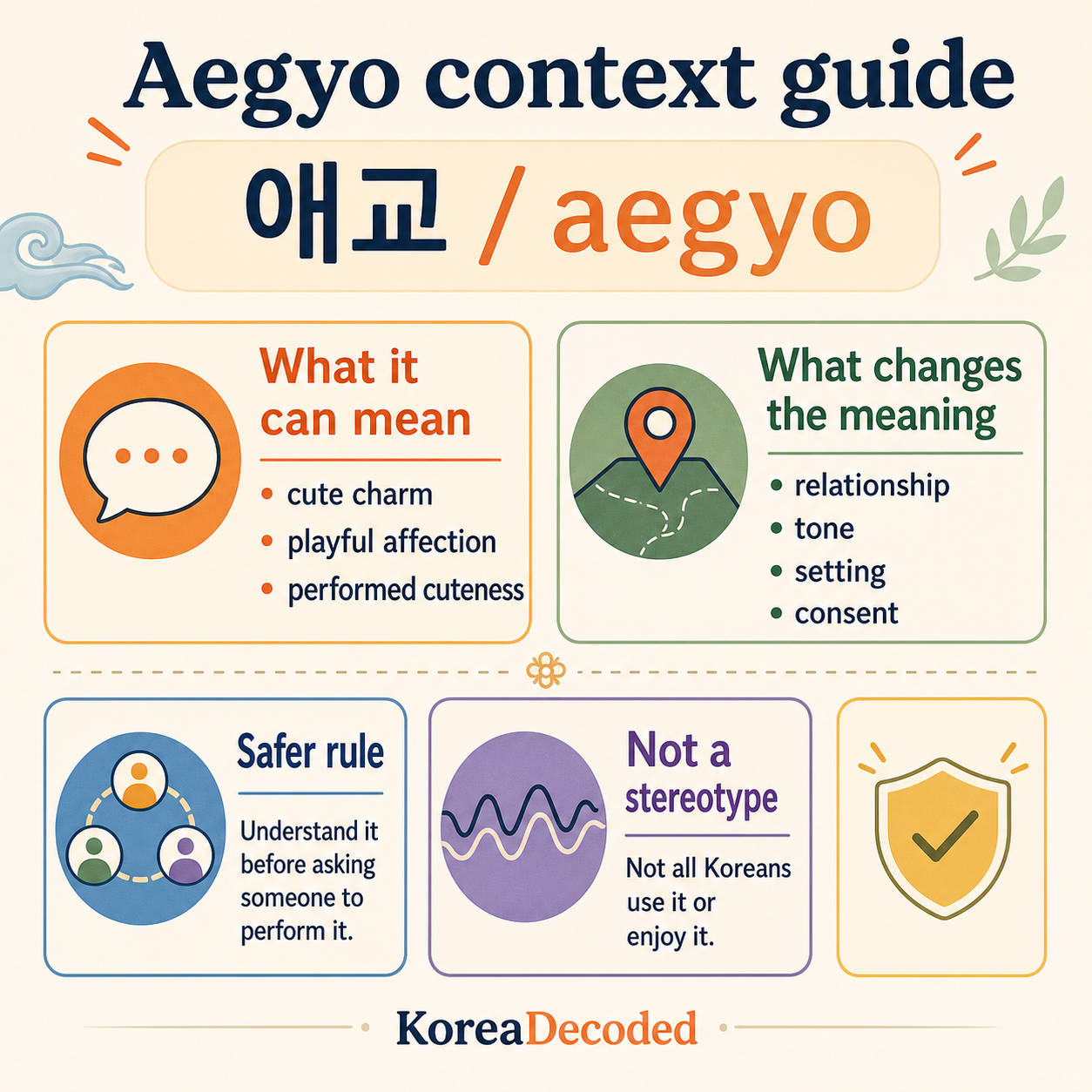
What 애교 means in ordinary Korean
애교 / aegyo can describe cute charm, a playful way of speaking, affectionate behavior, or a deliberately cute gesture. In English, people often translate it as “cuteness,” but that is too flat. A baby can be cute. A cartoon can be cute. Aegyo usually points more toward social charm: how someone acts with another person.
The Korean phrase 애교가 있다 can mean someone has a charming or endearing style. 애교를 부리다 means to act cute or show aegyo. Those phrases are useful because they show that aegyo can be a trait, a mood, or a performance depending on context.
Why global fans often misunderstand aegyo
Many global fans meet the word through entertainment, where aegyo is edited to be visible. A variety show may turn it into a quick challenge. A drama may use it for comedy or romance. A fan clip may repeat the most exaggerated moment because that is what travels online.
That does not mean everyday Korean interaction works like a variety-show segment. Aegyo can be playful, affectionate, strategic, awkward, or unwanted. The difference is not the gesture alone. It is the relationship around the gesture.
Aegyo is not only romantic
Aegyo can appear in romantic situations, but it can also show up between friends, in families, in entertainment, or in a joking moment with someone close. Treating it as only flirting misses the bigger picture.
A safer way to think about it is this: aegyo is a social style that tries to feel endearing. Whether it succeeds depends on the people involved. Cute to one person can feel forced to another. That tension is part of the word.
애교를 부리다 vs 애교해줘
애교를 부리다 describes someone acting cute or showing aegyo. It can be descriptive: “that person is being playful,” “that child is being charming,” or “that celebrity is doing a cute performance.”
애교해줘 is closer to “do aegyo for me.” You may hear a request like that in entertainment or between people who are already close. But outside that context, it can sound pushy, awkward, or disrespectful. If you are learning Korean, understand the phrase before trying to use it.
How to recognize aegyo without copying it
The useful questions are simple: Is the tone playful or performative? Are these people close enough for this to land naturally? Is the setting entertainment, a private joke, family interaction, or a formal situation?
Then look at the reaction. Does the other person seem amused, comfortable, embarrassed, or annoyed? Aegyo is not just what one person performs. It is also how the other person receives it, and whether the moment gives them room to opt out.
When not to use the word
- Do not assume people in Korea automatically like aegyo.
- Do not use aegyo to mock Korean speech or behavior.
- Do not ask strangers or casual acquaintances to “do aegyo.”
- Do not treat entertainment clips as a complete guide to real-life Korean interaction.
Quick checklist
- Am I describing a concept, or am I asking someone to perform it?
- Is this a close relationship, public entertainment, or a formal setting?
- Would the person being asked have an easy way to say no?
- Am I describing what I observed, or am I generalizing from one clip or moment?
FAQ
Is aegyo always fake?
No. Sometimes it is performed for fun. Sometimes it is part of someone’s natural style. Calling it simply fake misses the social nuance.
Is aegyo only for women?
No. Entertainment often presents gendered versions of aegyo, but the word itself is not limited to women. The expectations around it can still be gendered, which is one reason context matters.
Can foreigners use the word aegyo?
Yes. It is fine to use the word when discussing Korean language or culture. It is usually safer to talk about the concept than to ask someone to perform it.
Sources and editorial notes
- National Institute of Korean Language: 애교 usage Q&A was used for Korean-language nuance around 애교 and related phrasing.
- Google Search Central: Using generative AI content on your website was used as an automation, usefulness, and accuracy guardrail.
If you are also sorting out K-drama language, read the oppa meaning guide next; it explains why oppa is an address term, not simply a romance word.