Short answer: Korean sheet masks can be a fun, lightweight souvenir, but tourists should buy them like cosmetics, not like miracle treatments. Check the expiration date, skin type fit, instructions, claims, and pack condition before buying a large bundle. If your skin is reactive, buy fewer pieces first and test slowly.
Sheet masks are easy to overbuy in Korea because they are small, colorful, and often displayed in multi-pack promotions. A wall of options can make every mask look harmless. The smarter move is to treat the sheet mask as a short-contact skincare product that still touches your face directly.
If you are still building a basic routine, start with Korean skincare routine explained for beginners. If you are reading product labels in-store, also use How to read Korean skincare labels before comparing ingredient lists.
What a sheet mask is actually for
A sheet mask is usually a single-use face sheet soaked with cosmetic liquid. It can make skin feel temporarily hydrated, cooled, or comfortable, depending on the formula. It is not a replacement for cleansing, moisturizer, sunscreen, or medical care.
That difference matters because some marketing language can feel bigger than the product category. When a mask talks about glow, soothing, barrier, pore, brightening, elasticity, or calming, read it as positioning first. Then check whether the instructions and cautions fit your skin and travel situation.
Check the expiration date before bulk buying
Tourists often buy sheet masks in sets because the price per mask looks low. Before you do that, check the date information on the package. If you cannot confidently understand the date, ask staff or buy fewer pieces.
Do not assume you will use 30 masks quickly just because they were cheap. A sheet mask is not useful if it sits unopened until after its useful period, or if you forget why you bought that formula in the first place.
Do not buy only by ingredient trend
Common sheet mask words include cica, tea tree, hyaluronic acid, collagen, vitamin, ceramide, snail, peptide, rice, and propolis. These words can help you compare products, but they do not tell the whole story. The base formula, fragrance, texture, instructions, and your own skin history still matter.
If your skin is sensitive-feeling, avoid buying a large bundle just because the front label says calming. Buy one small pack first, keep the rest of your routine stable, and see how your skin feels after use.
Match the mask to your skin situation
- Dry-feeling skin: look first for moisture, hydration, cream, or barrier-positioned masks.
- Oily-feeling skin: avoid assuming every rich or sticky mask will feel good just because it is popular.
- Sensitive-feeling skin: choose simpler claims and avoid testing multiple new masks in the same week.
- Travel-tired skin: keep expectations modest. A mask may feel refreshing, but sleep, sunscreen, and gentle cleansing still matter.
If you are also choosing moisturizer, read How to choose a Korean moisturizer for your skin type. A comfortable moisturizer usually matters more than a drawer full of occasional masks.
Read the instructions, not just the front design
Many sheet masks tell you how long to leave them on. Longer is not automatically better. If the package says a time range, follow that range instead of waiting until the sheet is fully dry on your face.
Also check whether the mask is intended for face, eye area, sleeping use, wash-off use, or another format. Korea has many mask-like products, and they are not all used the same way.
Be careful with dramatic claims
Cosmetic products should not be treated as medicine. Be cautious when a product page or seller makes a sheet mask sound like it can treat acne, heal skin damage, replace dermatology care, or solve a long-term condition. That is a reason to slow down, not a reason to buy more.
A practical tourist rule: if the claim sounds too medical, too instant, or too certain, return to basics. Check the product category, usage directions, cautions, and seller reliability.
Inspect the package condition
- Do not buy masks with leaking, puffed, torn, or sticky packaging.
- Avoid loose single masks if you cannot tell where they came from.
- Check that multi-packs are sealed and not mixed from unrelated products.
- Keep masks away from heat while traveling.
This is boring advice, but it is useful. Sheet masks are cheap enough that skipping suspicious packaging is the better choice.
How many should a tourist buy?
If you already know the product and your skin likes it, a set can make sense. If it is new to you, buy a small number first. A simple starting point is one to three masks from a category you understand, not a 20-piece bundle of random formulas.
Bulk buying makes more sense after you know the texture, fragrance level, fit, and how your skin feels the next day. The best deal is not the cheapest mask. It is the mask you can actually use without regret.
Packing sheet masks for the flight home
Sheet masks are wet cosmetic products, so packing rules can depend on your airline, route, and airport security rules. If you are carrying many masks in hand luggage, check liquid and gel rules before travel. When in doubt, put larger quantities in checked luggage and keep receipts or packaging together.
Also think about heat and pressure. Do not force masks into a bag so tightly that packets bend, leak, or burst. Cheap souvenirs become annoying fast when serum leaks into clothing.
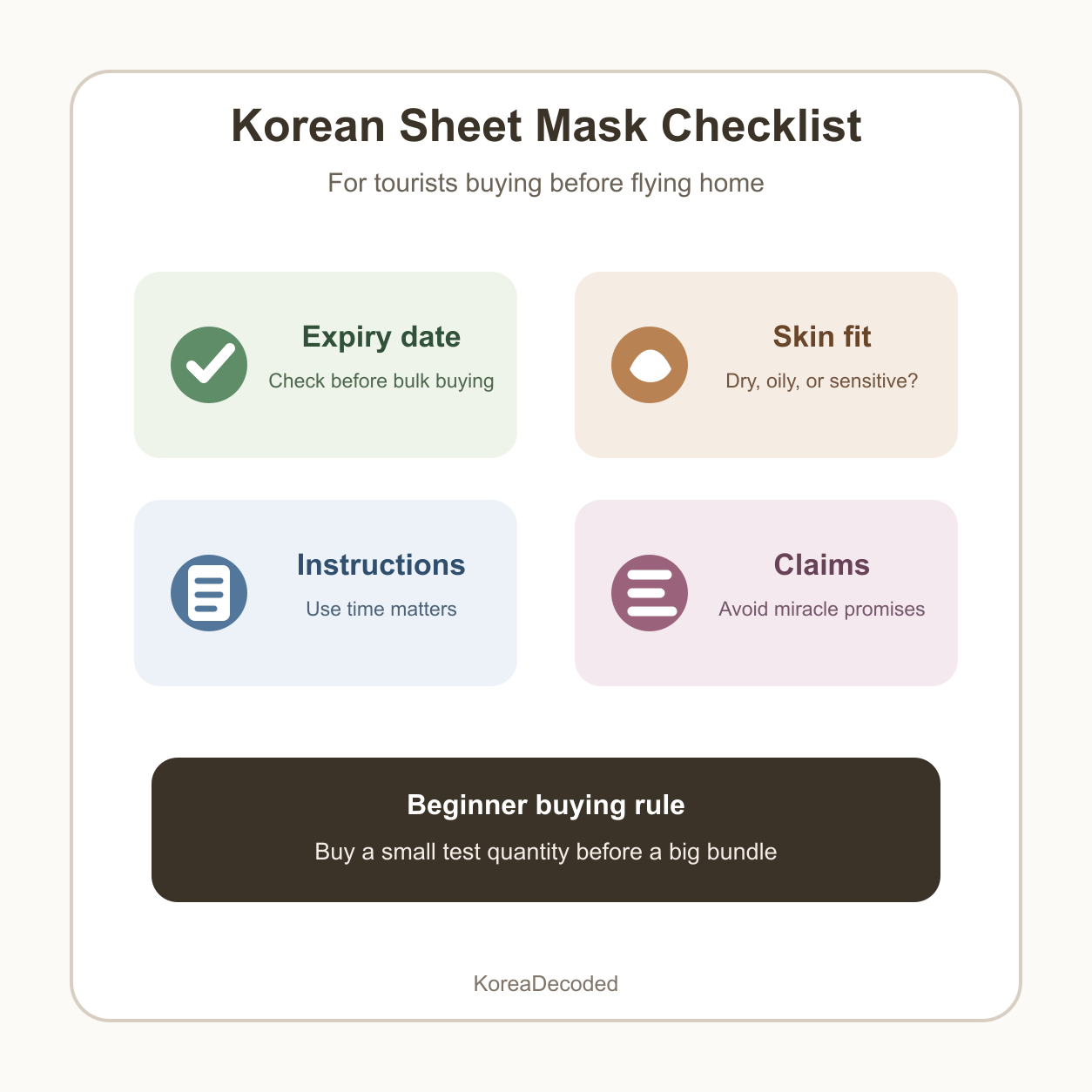
A simple tourist checklist
- Choose the skin situation first: dry, oily, sensitive-feeling, or travel-tired.
- Check expiration or use-by information.
- Read the usage time and cautions.
- Inspect the package for leaks or damage.
- Buy a small test quantity before buying a large bundle.
- Check flight packing rules if you will carry many masks home.
FAQ
Can I use a Korean sheet mask every day?
Some people enjoy frequent masking, but beginners should not start by adding a new mask every day. Use one product at a time and watch how your skin responds.
Are expensive sheet masks always better?
No. Price can reflect brand, packaging, fabric, or formula complexity, but it does not guarantee that the mask fits your skin. A modest mask that suits your routine can be better than an expensive one that irritates or feels unpleasant.
Should I choose cica, collagen, or hyaluronic acid?
Choose by your skin situation first, then use ingredient words as secondary clues. Hydration, comfort, and clear instructions matter more than chasing the most famous front-label word.
Sources and editorial notes
- Korea Easy Law cosmetic labeling overview was used as a product-label checking guardrail. Checked on 2026-05-22.
- Korea Easy Law cosmetic labeling and advertising overview was used as a claims-safety guardrail. Checked on 2026-05-22.
- U.S. FDA cosmetics labeling resources were used for general cosmetic-label reading context for international readers. Checked on 2026-05-22.
For the broader purchase-channel decision beyond sheet masks, use the Korea-versus-online skincare buying guide.