Restaurant planning in Korea can feel strangely difficult for first-time visitors. A place may look casual from the outside, but the line might be managed by an app, a kiosk, a QR code, or a reservation system that expects a Korean phone number.
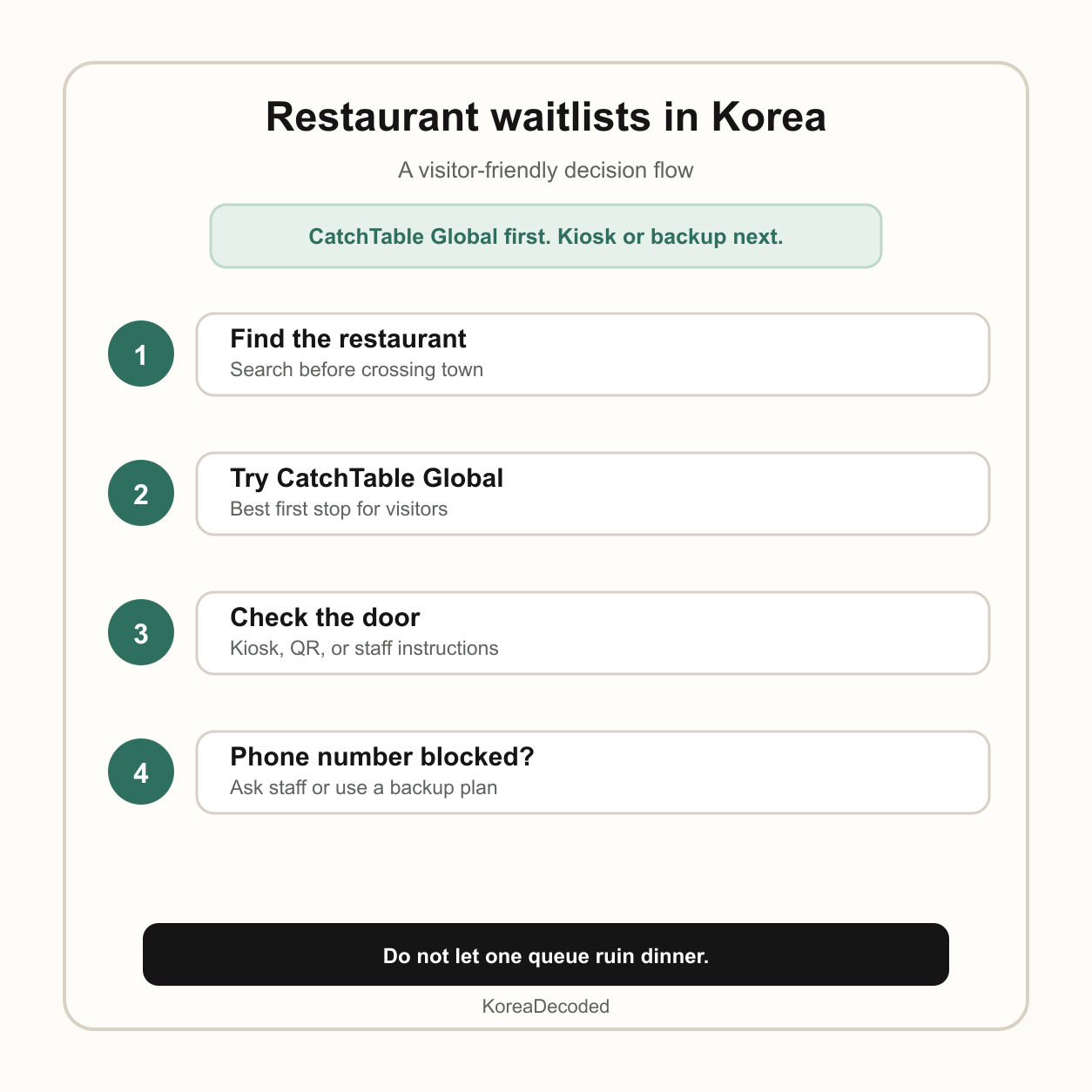
The short version is this: try CatchTable Global first for popular restaurants that support it. Treat Tabling as an important local Korean waitlist app that you may see at restaurants, but not as a guaranteed tourist-friendly solution. If the app route fails, check the on-site kiosk or ask staff before giving up.
Why restaurant waitlists feel confusing in Korea
In busy areas like Hongdae, Seongsu, Myeongdong, Gangnam, Jeju, or popular cafe streets, the old idea of simply standing in a visible line is not always how things work. Some restaurants use reservations. Some use remote waitlists. Some use a kiosk at the entrance. Some still take walk-ins. Some use more than one method depending on the day.
That is why the useful question is not “Which app should I download?” The better question is: “What is the lowest-friction way for a foreign visitor to get a table at this specific place today?”
Start with CatchTable Global
For visitors, CatchTable Global is usually the first app to check because it is designed around foreign users. Korea Tourism Organization materials describe it as a service for restaurant reservations and waitlists that can work without a Korean phone number, using email and an international credit card. Its app listings also emphasize real-time reservations, remote waitlists, and multi-language search.
That does not mean every restaurant in Korea is on CatchTable Global. It means that if the restaurant is supported there, the experience is more likely to fit a traveler who does not have a Korean resident account or local phone verification.
What CatchTable Global can help with
- Reservations: some restaurants let you choose a date, time, and party size before you go.
- Remote waitlists: some restaurants let you join a line before physically arriving.
- Restaurant discovery: the app can help you find restaurants by location, cuisine, theme, or availability.
- Notifications: you may need to watch app or email notifications so you do not miss your turn.
For high-demand places, check before traveling across Seoul. If the restaurant page only gives on-site waiting instructions, do not assume you can join remotely. Plan extra time or pick a backup nearby.
Understand what Tabling is
Tabling is a major Korean restaurant app for finding places, remote line-up, reservations, takeout, seat availability, and wait-time information. You may see the Tabling name or a Tabling-style waiting flow at popular restaurants.
The important caution is that Tabling should not be treated as the same thing as CatchTable Global for foreign visitors. Its Korean app listings focus on local restaurant waiting and reservations, while user feedback on Google Play has reported that Korean resident phone verification can be a barrier. Requirements can change, and access can vary by app version or store flow, so the safest wording is this: Tabling is common locally, but short-term visitors should be ready for Korean-language or phone-verification friction.
What to do at the restaurant door
If you arrive and see a kiosk, tablet, QR code, or sign near the entrance, pause before joining a physical line. In Korea, the real queue may be digital. Look for these signals:
- Language button: some kiosks or QR pages may offer English, Chinese, or Japanese.
- Phone field: if it requires a Korean mobile number, look for an overseas-user option before entering random numbers.
- Party size: you may need to enter how many people are eating.
- Notification method: check whether your turn is shown on a screen, sent by text, or called by staff.
- Arrival rule: if you are not there when called, the restaurant may skip your turn.
If the kiosk flow is blocked by phone verification, do the simple thing: ask staff. A short English sentence is enough: “Can I join the waitlist without a Korean phone number?” If that does not work, do not let one restaurant consume the entire evening.
Deposits and no-show rules
Some reservation-only restaurants may require a deposit to prevent no-shows. Do not treat that as a scam by default. It is common for high-demand restaurants, especially places with limited seats or course menus. Before paying, check the cancellation deadline, refund rule, party size, date, time, and restaurant address.
Waitlists are different from reservations. Korea Tourism Organization material says waiting through CatchTable Global does not require a deposit, but you still need to watch your turn and arrive on time. Treat every restaurant’s current page as the final rule.
A simple restaurant plan for travelers
- Search the restaurant name in CatchTable Global.
- If it appears, check whether it has reservation, remote waitlist, or on-site waiting only.
- If it does not appear, search the restaurant on maps and check recent reviews for waiting notes.
- At the door, look for a kiosk, QR code, or staff instructions before standing in line.
- Have one backup restaurant within a 10-minute walk.
This is especially useful in food-heavy neighborhoods. For example, if you are planning a first night in Hongdae, dinner can go much more smoothly if you choose one restaurant, check the waiting method first, and keep a nearby cafe or second restaurant as backup.
When you do not need an app
Not every meal in Korea needs a reservation app. Small neighborhood restaurants, casual noodle shops, food courts, markets, convenience-store meals, and many cafes still work perfectly well as walk-ins. Apps matter most when the restaurant is famous, newly viral, reservation-only, or located in a high-traffic neighborhood.
If you are tired, hungry, or traveling with family, do not gamble the whole night on one famous line. Korea has enough good food that a realistic backup plan often beats a stressful “must-visit” plan.
Useful links before you go
- What to eat in Hongdae on your first night
- How to order Korean street food without speaking Korean
- VISITKOREA: CatchTable Global guide
- VISITKOREA: CatchTable member benefits
- Google Play: CATCHTABLE Global
- Tabling official website
- Google Play: Tabling
If the restaurant is a Korean BBQ spot with a long line, use this waitlist guide together with the Korean BBQ etiquette guide for first-time visitors.