Short answer: Korean BBQ is not hard if you understand the table rhythm. Order a manageable meat, let the staff set up the grill, use the tongs and scissors they give you, wait until the meat is ready, make small one-bite wraps, and ask for help when the grill feels confusing.
The nervous part is not the food. It is the moment when raw meat, a hot grill, side dishes, sauces, lettuce leaves, scissors, and a server all arrive at once. This guide keeps it simple: what to do before you sit, what to do while the meat cooks, and what not to overthink.
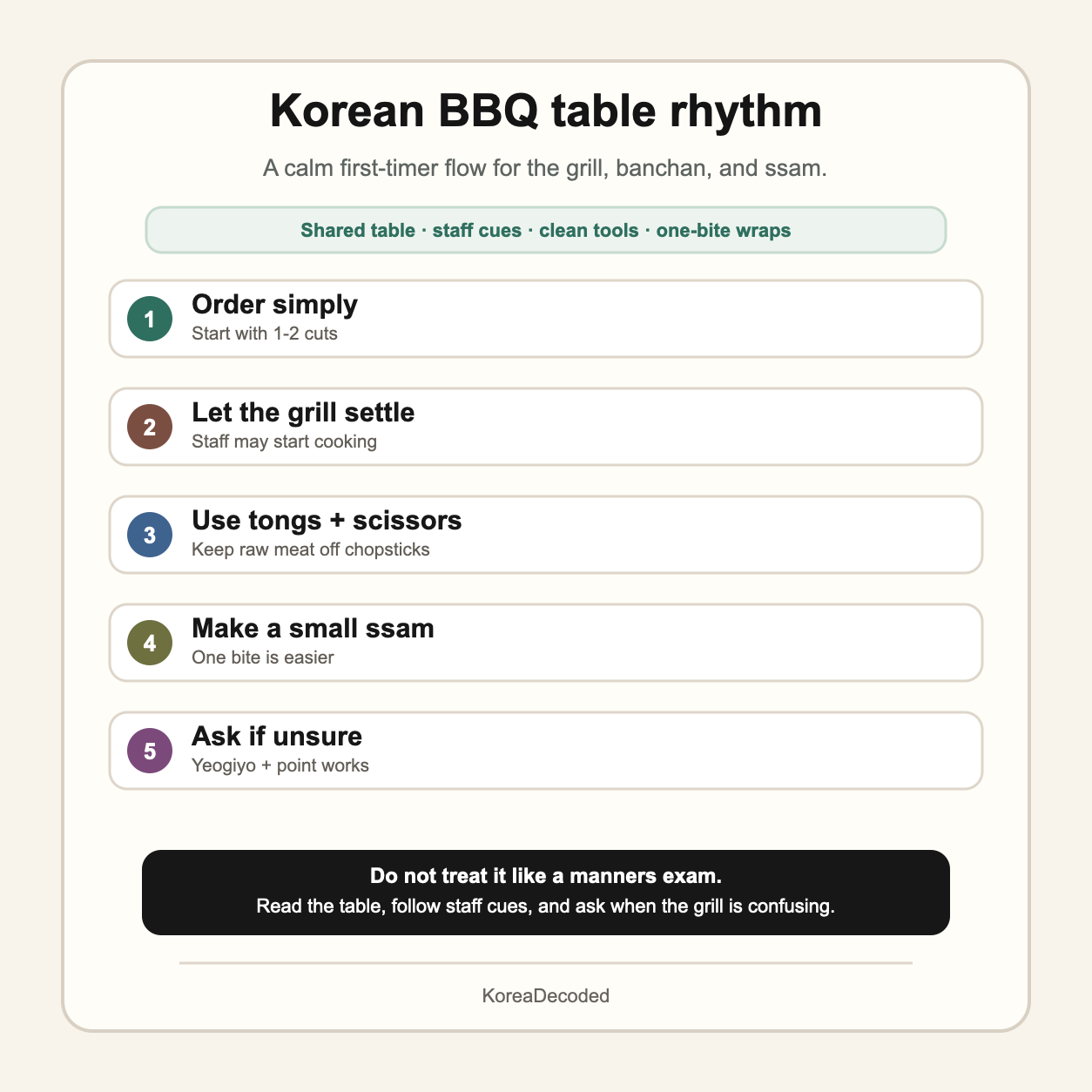
The basic table rhythm
Most first-time visitors do better when they stop asking, “What are all the rules?” and start asking, “What is the table doing now?” Korean BBQ usually moves like this:
- You order meat, often by portion.
- Staff bring banchan, sauces, lettuce or perilla leaves, tongs, and scissors.
- The grill heats up, and the first meat goes on.
- Staff may cook, start the cooking, or leave you to manage it.
- The meat is cut into bite-size pieces.
- You eat it plain, with sauce, or wrapped as ssam.
- You ask for help, water, or banchan refills when needed.
That is the real system. It looks busy because everything is visible on the table, but the meal is built to be shared and adjusted as you go.
Before you sit down
Korean BBQ is usually easier with two or more people. Some places may have minimum portions, and some busy restaurants are not built around solo diners. That does not mean solo BBQ is impossible, but it does mean you should check the menu or ask before assuming one person can order one tiny plate and take a grill table.
If the restaurant is famous, check whether it uses a waitlist app, kiosk, or walk-in line before crossing Seoul for it. The practical backup is simple: choose a nearby second option so the night does not collapse if the first place has a long queue.
Also dress like you will be near smoke and heat. Many Korean meat restaurants have strong ventilation, and some have storage chairs for coats or bags, but your clothes may still pick up a grilled-meat smell. This is normal, not a sign that you did something wrong.
What the table items mean
| Item | What it is for | First-timer note |
|---|---|---|
| Tongs | Moving meat on the grill | Use the restaurant’s tools; avoid grabbing raw meat with your eating chopsticks. |
| Scissors | Cutting meat into bite-size pieces | This is normal at Korean BBQ, not rude. |
| Banchan | Small side dishes | Share them, try them, and ask politely if you need more. |
| Ssam leaves | Lettuce or perilla leaves for wraps | Make small one-bite wraps instead of huge overloaded bundles. |
| Ssamjang | Savory wrap sauce | Use a little first; it is salty and flavorful. |
| Grill plate | Cooking surface | If it burns, smokes heavily, or looks stuck, ask staff. |
Who cooks the meat?
It depends on the restaurant. In some places, staff will place the meat, flip it, cut it, and tell you when to eat. In other places, staff may start the first pieces and then leave you to continue. In casual restaurants, your group may handle most of the grill.
The easiest rule is this: if staff are actively cooking, let them lead. Do not keep moving the meat while they are managing the grill. If they step away and nothing is happening, watch the meat and flip or move it when it browns. If you are unsure, call staff and point at the grill.
Pork belly, or samgyeopsal, should be cooked through before you eat it. Beef cuts may be served and cooked differently depending on the restaurant and cut, so follow the staff’s cue. If you are nervous, it is completely fine to ask for help rather than pretending you know the grill.
Use raw and cooked tools sensibly
At many BBQ tables, tongs and scissors touch raw meat first and then cooked meat later. Restaurants have their own setup, and staff may manage the tools. As a visitor, you do not need to turn the meal into a lab procedure, but you should keep one habit: do not use your personal chopsticks to handle raw meat.
If the restaurant gives separate tongs, use one for raw meat and one for cooked pieces. If there is only one set and staff are cooking, follow their lead. If you are cooking yourself and feel unsure, ask for another pair of tongs or let the meat cook longer before moving cooked pieces to the side.
This is both practical and polite. It keeps the table cleaner, and it helps everyone feel comfortable eating from the shared grill.
How to eat ssam without making a mess
Ssam means a wrap. The basic version is a lettuce or perilla leaf, one piece of meat, a little ssamjang, and maybe garlic, pepper, kimchi, rice, or another small side. The mistake is trying to build a giant wrap that needs three bites. A good ssam is small enough to eat in one bite.
- Put one leaf in your hand or on your plate.
- Add one piece of cooked meat.
- Add a small amount of sauce.
- Add one or two extras if you want.
- Fold it and eat it in one bite if possible.
You can also skip the wrap and eat the meat with sauce or side dishes. Korean BBQ is flexible. The point is to enjoy the combinations, not to perform a perfect ritual.
Banchan etiquette
Banchan are the small side dishes around the table. They are usually shared, and many restaurants will refill common side dishes if you ask. But “refillable” does not mean “waste as much as possible.” Take what you will eat, share the table, and ask for more only when the dish is actually getting low.
If a restaurant has a self-service banchan area, bring back small amounts first. If staff handle refills, you can say banchan deo juseyo, meaning “more side dishes, please.” If that feels like too much Korean, point at the empty dish and smile. Most staff understand the situation.
Ordering more meat
Do not order every cut at once on your first visit. Start with one or two familiar choices, such as samgyeopsal for pork belly or galbi if you want ribs. If your group is still hungry, order more after you understand the pace of the grill.
Some restaurants also offer stews, noodles, rice, or fried rice as a finish. You do not have to do every ending. If you are full, stop. If everyone still wants something warm, a stew or rice finish can make the meal feel complete.
What to say when you are confused
You do not need fluent Korean to survive BBQ. A few tiny phrases help:
| Moment | Phrase | Meaning |
|---|---|---|
| Call staff | Yeogiyo | Excuse me / over here |
| Point at menu | Igeo juseyo | This, please |
| Ask for water | Mul juseyo | Water, please |
| Ask for banchan | Banchan deo juseyo | More side dishes, please |
| Ask if ready | Igeo meogeodo dwaeyo? | Can we eat this? |
If your pronunciation is not perfect, pointing is allowed. Show the menu, point at the grill, or gesture to the empty side dish. Restaurants are practical places. Clear, calm communication works better than memorizing a long script.
Common mistakes and the easier version
| Mistake | Do this instead |
|---|---|
| Moving the meat constantly while staff are cooking | Let staff lead, then continue when they step away. |
| Using personal chopsticks on raw meat | Use the tongs and scissors provided for the grill. |
| Building an enormous ssam | Make a small one-bite wrap. |
| Filling up on banchan immediately | Taste slowly and save room for meat. |
| Assuming every restaurant works the same way | Watch staff, read the table, and ask if unsure. |
| Traveling far with no backup plan | Check waitlists and choose a nearby second option. |
Useful next links
If you want phrases for the table, read Korean restaurant phrases for travelers. If the restaurant is popular, check how restaurant waitlists and CatchTable work in Korea. If you are eating with friends and the dish is shared, pair this with Korean shared dishes explained.
For food-route planning, use what to eat in Hongdae on your first night, Korean street food terms, and how to order Korean street food without speaking Korean.
Sources checked
- VISITKOREA: About Korean Food, checked on 2026-06-12 for Korean meal tables, banchan, ssam, gogi-jip, samgyeopsal, restaurant service notes, call bells, grills, and storage-chair context.
- National Institute of Korean Language Korean-English Learners’ Dictionary, checked on 2026-06-12 as the official language reference for Korean terms and phrase handling.
- Serious Eats food-safety expert article on raw-meat utensils, checked on 2026-06-12 for current cross-contamination framing around tabletop cooking such as Korean BBQ and hot pot.
If the meat menu feels hard to read, start with the Korean restaurant menu words guide before choosing BBQ cuts and add-ons.