Ordering Korean street food can feel intimidating when the menu is fast, the line is moving, and you do not speak Korean. The good news is that most street-food ordering is not a conversation. It is a short sequence: choose the item, show the quantity, confirm the price, pay, and step aside.
This guide is for travelers who want a practical method, not a full Korean lesson. Use it at market stalls, food alleys, festival booths, and busy tourist areas where the food is visible or photographed.
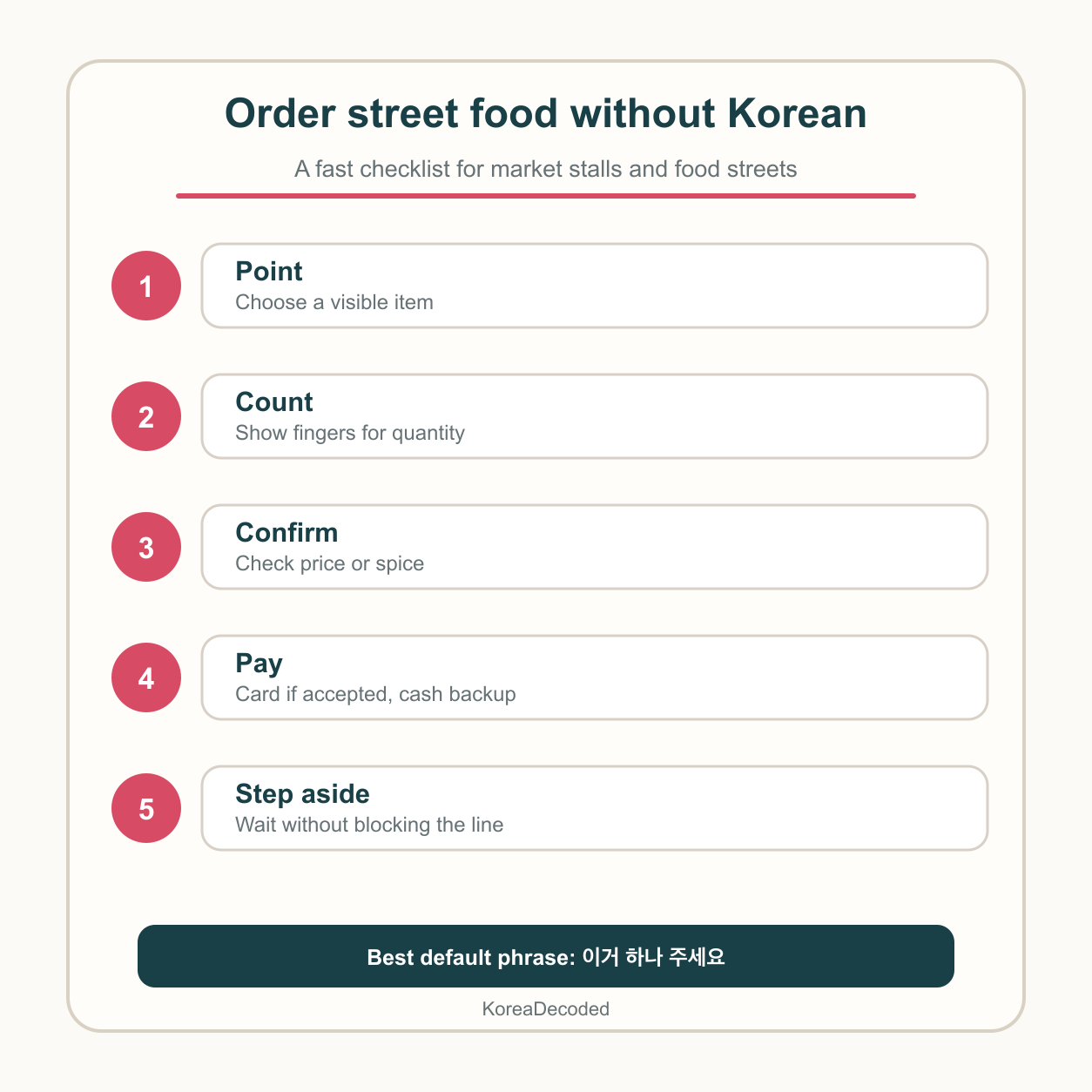
The easiest ordering script
Do this in order:
- Look for the food you want, a photo menu, or a tray already being served.
- Point to the item and show the number with your fingers.
- If the vendor asks a question, listen for quantity, spice, or “for here / to go.”
- Pay only after the vendor confirms the order or starts preparing it.
- Move to the side while waiting, especially in a narrow market line.
If you remember only one phrase, use igeo hana juseyo: “this one, please.” The Hangul is 이거 하나 주세요. It is polite enough for a quick stall order and simple enough to pair with pointing.
Useful phrases that do not require a conversation
| What you want to do | Korean | How to use it |
|---|---|---|
| This one, please | 이거 주세요 igeo juseyo | Point at the food or menu photo. |
| One of these, please | 이거 하나 주세요 igeo hana juseyo | Best default phrase for one item. |
| Two, please | 두 개 주세요 du gae juseyo | Show two fingers at the same time. |
| How much is it? | 얼마예요? eolmayeyo? | Use if no price is visible. |
| Not spicy, please | 안 맵게 해주세요 an maepge haejuseyo | Only works when spice level can be adjusted. |
| To go, please | 포장해 주세요 pojanghae juseyo | Use if the stall offers takeaway. |
Do not worry about perfect pronunciation. Pointing, showing quantity, and using a polite ending does most of the work.
Payment: card, cash, or transit card?
Card payment is common in Korea, but small stalls can vary. Some vendors accept cards, some prefer cash, and some temporary booths may be simpler with small bills. For street food, carry a small amount of cash even if you plan to use a card most of the trip.
Do not assume a T-money card works as a general payment card at every food stall. Treat it mainly as a transport and convenience tool unless a specific cashier says it is accepted. For transport basics, see T-money card in Korea: what travelers need to know.
What to order first if you are nervous
Start with foods that are easy to see and count. That makes ordering less ambiguous.
- Hotteok: usually ordered by piece, easy to point at.
- Gimbap: often visible in rolls or slices, easy to choose from a tray.
- Tteokbokki: common, but confirm spice if you are sensitive.
- Eomuk: fish cake skewers are often simple to count.
- Bindaetteok: a mung bean pancake associated with traditional markets such as Gwangjang Market.
For more food-name vocabulary, use Korean street food terms for travelers before you go.
How to avoid holding up the line
Busy street-food stalls move quickly. The most respectful thing you can do is decide before you reach the front, keep your order simple, and move aside after paying.
- Stand back for a moment and watch how locals order.
- Have cash or card ready before you speak.
- Do not ask a long question while a line is forming behind you.
- If you need to translate a menu, step aside first.
- After receiving food, check where people are eating and where trash goes.
If you have allergies or dietary restrictions
Be careful. Street-food stalls may not be able to explain every ingredient or avoid cross-contact during busy service. If an allergy is serious, use a translated allergy card and choose a place where staff can clearly confirm ingredients. Do not rely on a single memorized phrase for medical-level safety.
Where this method works best
This method works best where the food is visible: markets such as Gwangjang Market, popular food streets, festival stalls, and tourist-heavy shopping areas. It works less well at restaurants where you need to choose options from a long menu, split bills, or explain dietary restrictions.
If you get stuck, official tourism help such as Korea’s 1330 travel information service can be useful for broader travel questions. For a fast stall order, though, the best tool is usually simpler: point, show quantity, confirm, pay, and step aside.
Quick field checklist
- Pick one visible item.
- Point and say 이거 하나 주세요.
- Show the number with your fingers.
- Check the price before paying.
- Carry small cash as backup.
- Move aside while waiting.
- Use a translated allergy card for serious restrictions.
Sources and further reading
- Seoul Metropolitan Government: Gwangjang Market
- VISITKOREA official travel information
- KoreaDecoded: Korean street food terms for travelers
For sit-down restaurants after street food, keep the Korean restaurant menu words guide open so you can recognize dish formats quickly.
For a practical example of what to order, use the tteokbokki taste and ordering guide with these street-food ordering scripts.