Short answer: Choose a Korean moisturizer by matching texture to your skin type before you chase trendy ingredients. Oily skin usually does better with light gel or lotion textures, dry skin often needs richer cream, combination skin may need different amounts by area, and sensitive skin should prioritize simple instructions and low-drama claims over long ingredient wish lists.
Korean moisturizer pages can look gentle and scientific at the same time. You may see words like barrier, cica, panthenol, gel cream, water cream, balm, intensive, calming, pore, sebum, and glass skin. Some of those clues are useful. Some are just mood. A beginner needs a buying method that is less emotional than the product page.
If you have not built the base routine yet, read Korean skincare routine explained for beginners. If you are adding layers before moisturizer, compare Korean toner vs essence and what a Korean ampoule is first.
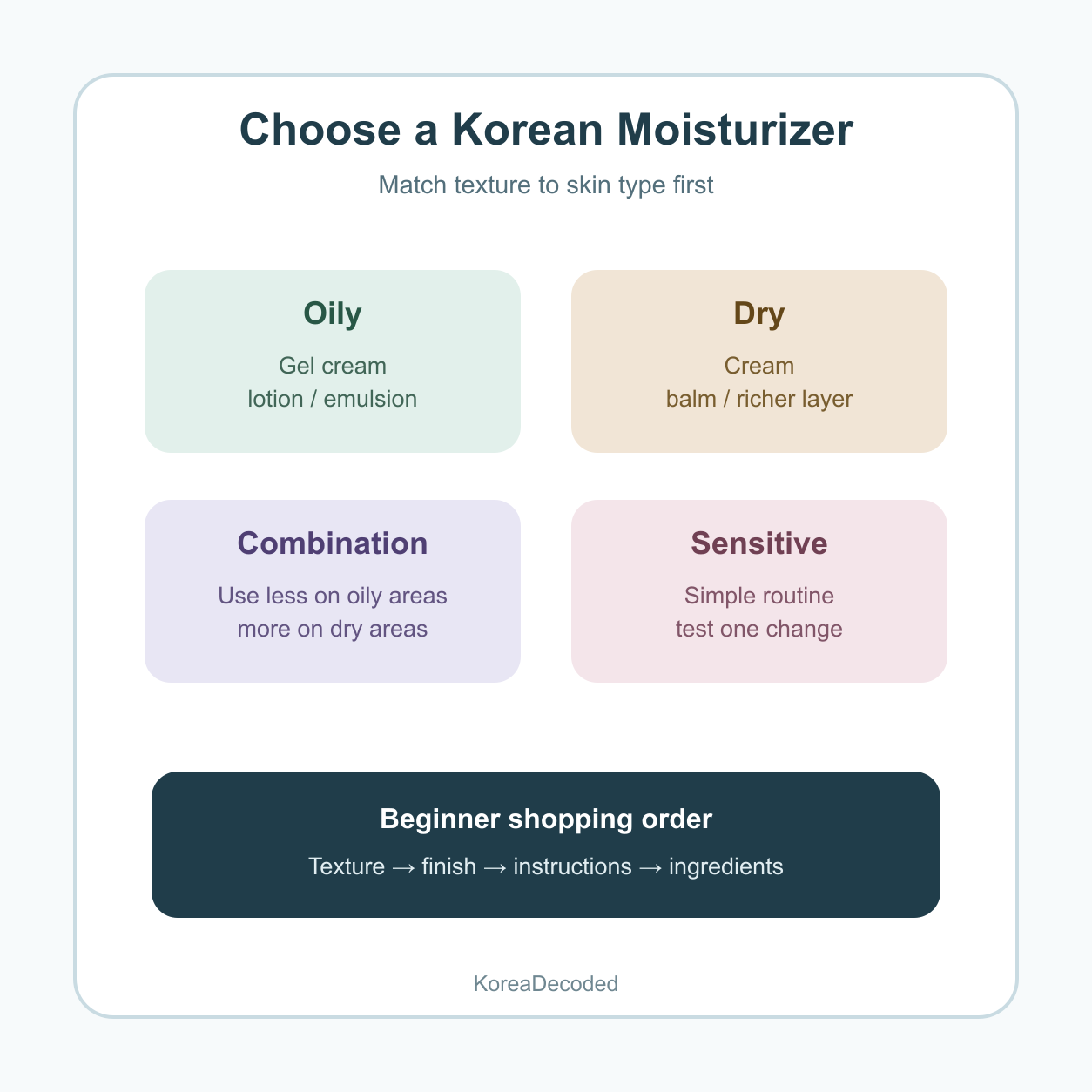
The beginner rule: texture first
A moisturizer is supposed to make your routine easier to use consistently. If it feels too heavy, too sticky, too shiny, or too light, you will start using less than you need or skip it completely. That is why texture comes before trend.
Korean product names often give texture clues. Gel cream, water cream, lotion, emulsion, cream, balm, and sleeping pack all point to different weight and finish expectations. They are not perfect categories, but they are more practical than buying only because a product says “barrier” or “glow.”
For oily skin
Oily skin usually needs moisture without a heavy sealed feeling. Look first at lightweight textures: gel cream, water cream, lotion, or emulsion. Product pages may also mention fresh finish, sebum care, non-greasy, or oil-free feeling.
Be careful with the phrase “for oily skin” if the product still looks very rich or occlusive. Oily skin can be dehydrated, but that does not mean every heavy cream will feel comfortable. A moisturizer you can use every day is better than a dramatic cream you avoid.
For dry skin
Dry skin often needs a richer texture. Cream, balm cream, intensive cream, or moisture cream may be more useful than a very light gel. Look for products that explain when and how much to use, not just products that promise deep hydration in pretty language.
If your skin still feels tight after moisturizer, the product may be too light, your cleanser may be too stripping, or your sunscreen may be drying. Do not assume the moisturizer alone is the entire problem. Routine context matters.
For combination skin
Combination skin is not one uniform skin type. Your T-zone may feel oily while cheeks feel dry or tight. That means one moisturizer can work if you adjust the amount by area, but sometimes two textures are easier: a lighter product where you get shiny and a richer product where you feel dry.
Beginners should try amount control before buying multiple products. Use a small amount on oilier areas and a little more on dry areas. If that still feels wrong, then consider changing texture.
For sensitive-feeling skin
Sensitive-feeling skin needs fewer surprises. Look for clear usage instructions, cautions, and a texture you can test slowly. Words like mild, calming, cica, panthenol, hypoallergenic, or low irritation may be helpful clues, but they are not guarantees.
When testing a new moisturizer, keep the rest of your routine stable. Do not add a new exfoliant, vitamin C product, ampoule, and moisturizer in the same week. If your skin reacts, you need to know what changed.
Ingredient words beginners often see
- Hyaluronic acid: often used in hydration-focused products.
- Ceramide: often used in barrier-focused products.
- Panthenol: often appears in calming or barrier-supporting formulas.
- Cica or Centella: often appears in soothing-positioned products.
- Niacinamide: often appears in brightening, barrier, or tone-focused products.
These words can help you compare products, but they should not replace basic fit. A famous ingredient in the wrong texture may still be the wrong moisturizer for you.
When a moisturizer is too heavy
- Your face feels coated for hours in a way you dislike.
- You start using a tiny amount just to avoid shine or stickiness.
- Your sunscreen pills or slides on top of it.
- You avoid using it in the morning because it feels like too much.
If this happens, try a lighter texture before assuming your skin “does not need moisturizer.” Oily and combination skin can still need a comfortable moisturizer.
When a moisturizer is too light
- Your skin feels tight again soon after applying.
- Dry patches show through makeup or sunscreen.
- You keep adding layers but still feel uncomfortable.
- Your nighttime routine feels unfinished even with correct use.
If this happens, look at richer creams or consider whether another routine step is causing dryness. A gentle cleanser and a comfortable sunscreen can change how your moisturizer performs.
A simple shopping checklist
- Choose the texture category first: gel, lotion, cream, or balm.
- Match the finish to your skin type and climate.
- Check product instructions and cautions.
- Look at ingredient highlights only after texture makes sense.
- Test one new moisturizer at a time.
This checklist keeps the purchase grounded. It also makes it easier to compare products later because you know why one worked and another did not.
FAQ
Is Korean moisturizer different from regular moisturizer?
Not in a magical way. Korean moisturizers often offer many textures and marketing categories, but the basic job is still to help your skin feel comfortable and reduce dryness in your routine.
Should oily skin skip moisturizer?
Usually no. Oily skin may dislike heavy cream, but a light gel, lotion, or emulsion can still be useful, especially if cleanser or sunscreen leaves the skin feeling tight.
Can I use the same moisturizer morning and night?
Yes, if it feels comfortable in both routines. Some people prefer lighter moisturizer in the morning under sunscreen and richer cream at night.
Sources and editorial notes
- MFDS cosmetic labeling items was used as a product-label and usage-checking guardrail.
- MFDS cosmetic labeling and advertising guidance was used as a claims-safety guardrail. Checked on 2026-05-21.
- Korea Cosmetics Act was used for general cosmetic regulation context. Checked on 2026-05-21.
If you are choosing a moisturizer in store, the Korean shopping phrase guide gives simple skin-type and texture phrases.