Short answer: Korean sunscreen terms are easiest to read if you separate three things: SPF for UVB-related sunburn protection, PA for UVA protection, and texture words such as tone-up, mild, watery, or sun stick that describe how the product may feel or look. SPF and PA are the protection clues. Texture words are shopping clues.
Korean sunscreen pages can feel crowded because they mix regulation-style numbers, beauty marketing, skin type language, and texture promises in one place. A beginner may see SPF50+, PA++++, non-nano, tone-up, reef-friendly, no white cast, sebum care, soothing, and waterproof all on the same screen. The trick is not to memorize every term. The trick is to know which terms matter first.
If you are still building a basic routine, start with Korean skincare routine explained for beginners. If product labels in general feel confusing, use how to read Korean skincare labels as your label-reading base.
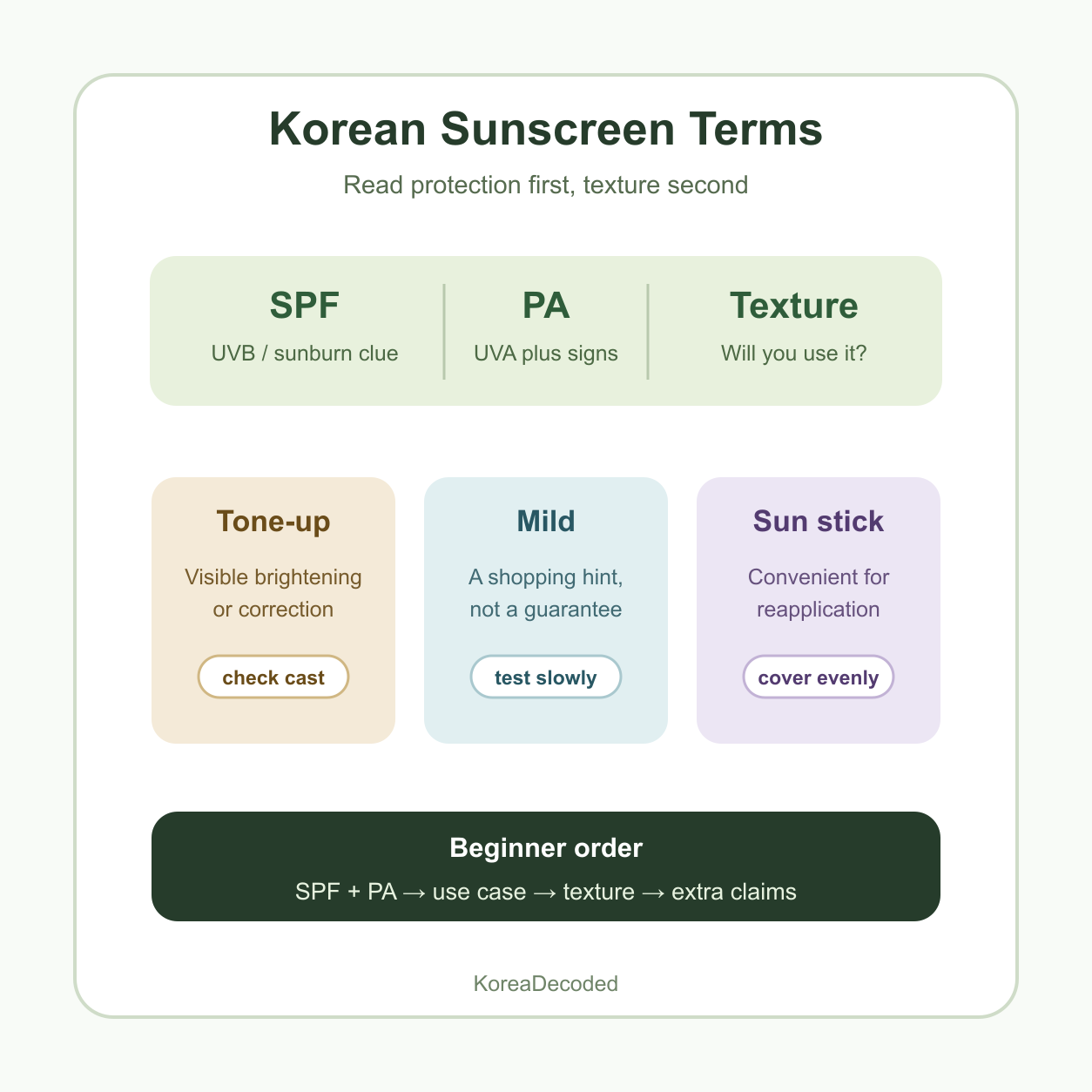
SPF: the number most beginners notice first
SPF is the most visible sunscreen number. In practical shopping terms, it tells you the product is making a tested sun-protection claim rather than only saying it feels good on skin. Korean sunscreens commonly show SPF50+ because many daily-use products are built around that familiar high-protection label.
Do not treat a higher-looking number as permission to apply less. Sunscreen performance depends heavily on using enough product, applying it evenly, and reapplying when needed. A beautiful SPF label cannot help much if the layer on your face is too thin.
PA: the plus signs next to SPF
PA is the rating many beginners skip because it looks less intuitive than SPF. On Korean sunscreen pages, PA is usually written with plus signs, such as PA+, PA++, PA+++, or PA++++. More plus signs signal a higher UVA protection grade under that labeling system.
A simple beginner reading is: SPF tells you one side of the protection story, PA tells you another side. If you are buying a daily Korean facial sunscreen, do not read SPF by itself. Read SPF and PA together.
UVA and UVB: why there are two protection clues
UVA and UVB are types of ultraviolet radiation. You do not need a science lecture before buying sunscreen, but you should understand why product pages mention both. UVB is commonly associated with sunburn. UVA is commonly discussed in relation to longer-term skin exposure. That is why sunscreen pages often pair SPF language with UVA or PA language.
When a product page says “broad spectrum” or highlights both UVA and UVB, it is trying to communicate wider protection coverage. Still, the practical beginner move is the same: check the SPF, check the PA, then check whether the texture is one you will actually use every day.
Tone-up sunscreen
Tone-up usually means the sunscreen is designed to make the skin look brighter, more even, or slightly corrected after application. It may be useful if you want a sunscreen-makeup hybrid feeling. It may be annoying if you want an invisible finish.
For darker skin tones or anyone who dislikes a visible cast, tone-up products deserve extra caution. “Tone-up” is not automatically bad, but it is not the same promise as “no white cast.” Check swatches, reviews from people with similar skin tone, and return policies if you are buying online.
Mild, calming, and sensitive-skin language
Korean sunscreen pages often use words such as mild, calming, soothing, cica, panthenol, sensitive skin, or low irritation. Treat these as shopping hints, not guarantees. A product can be marketed as gentle and still bother your skin, especially around the eyes or on irritated areas.
If your skin reacts easily, keep the rest of your routine stable when testing a new sunscreen. Do not test a new cleanser, exfoliant, serum, and sunscreen in the same week. A boring test routine gives you clearer information.
Chemical, mineral, and hybrid sunscreen
Shopping pages may describe sunscreens as chemical, mineral, physical, inorganic, organic, or hybrid. These words refer to the type of UV filters used. For a beginner, the most useful question is not “which category is always best?” The better question is “which one will I apply enough of without hating the finish?”
- Mineral or physical: often associated with zinc oxide or titanium dioxide and may leave more visible cast depending on formula.
- Chemical or organic: often associated with a lighter or more transparent finish, though eye sting and comfort vary by formula.
- Hybrid: uses a mix of filter types and may try to balance protection, finish, and comfort.
Filter type can matter, but real-world daily use matters more. The best sunscreen is usually the one you can apply generously and consistently.
Sun cream, sun gel, sun stick, and sun cushion
Korean sunscreen names often include the format. These words mostly help you predict texture and use case.
- Sun cream: a classic cream or lotion format.
- Sun gel: often positioned as lighter, fresher, or more watery.
- Sun stick: portable and convenient, often used for reapplication, but even coverage can be harder.
- Sun cushion: compact-style format that may feel closer to makeup touch-up.
Do not choose format only because it looks convenient. For the first application of the day, many people find a cream, lotion, or gel easier to apply evenly than a stick. Sticks and cushions can be useful, but they should not become an excuse for a patchy layer.
Waterproof and water-resistant claims
Water-resistant language is useful when you will sweat, swim, or spend time outdoors. It does not mean “apply once and forget.” If water, sweat, towel drying, or long outdoor exposure is involved, reapplication becomes more important, not less.
For daily city use, texture may matter more than a dramatic outdoor claim. For beach, hiking, sports, or summer travel, look for water-resistance information and practical instructions on the package.
A beginner shopping order
- Check SPF and PA first.
- Check whether it is meant for daily city use, outdoor use, or water exposure.
- Choose a texture you will actually apply enough of.
- Watch for tone-up if you want an invisible finish.
- Read usage instructions and cautions before judging the marketing claims.
This order keeps you from getting distracted by every trendy word. Protection rating comes first. Daily usability comes second. Extra claims come last.
FAQ
Is SPF50+ always better than SPF30?
Not if you hate the texture and apply too little. SPF50+ is common in Korean facial sunscreens, but consistent, generous use matters more than chasing a number while underapplying.
What does PA++++ mean?
PA++++ is a high UVA protection grade in the PA labeling system. For daily Korean sunscreens, read it together with the SPF number rather than treating SPF as the whole story.
Should beginners avoid tone-up sunscreen?
No, but beginners should understand what it is. Tone-up sunscreen is designed to visibly brighten or correct the look of skin. If you want an invisible finish, choose carefully.
Sources and editorial notes
- Korea Cosmetics Act Enforcement Rule was used for functional cosmetic and package-labeling context. Checked on 2026-05-21.
- Korean sunscreen SPF and UVA/PA testing standard attachment was used as protection-rating context. Checked on 2026-05-21.
- MFDS cosmetic labeling items was used as a product-label and usage-checking guardrail.
When buying sunscreen in Korea, the shopping phrase guide helps you ask for non-sticky, sensitive-skin, and card-payment basics.