Short answer: A Korean ampoule is usually a concentrated, serum-like skincare product used as an optional treatment step. It is not automatically stronger in a medical sense, and it is not required for a beginner routine. Use one only when you can explain what it is supposed to add, how often to use it, and why your current cleanser, moisturizer, and sunscreen are not enough.
Ampoule is one of those K-beauty words that sounds more technical than it needs to. In shopping pages, it often sits near words like serum, essence, concentrate, intensive care, barrier, calming, glow, or hydration. That can make it feel like a serious upgrade. Sometimes an ampoule is useful. Sometimes it is just another small bottle with big promises.
If you are still unsure about basic routine order, read Korean skincare routine explained for beginners first. If you are comparing watery layers, read Korean toner vs essence before adding an ampoule.
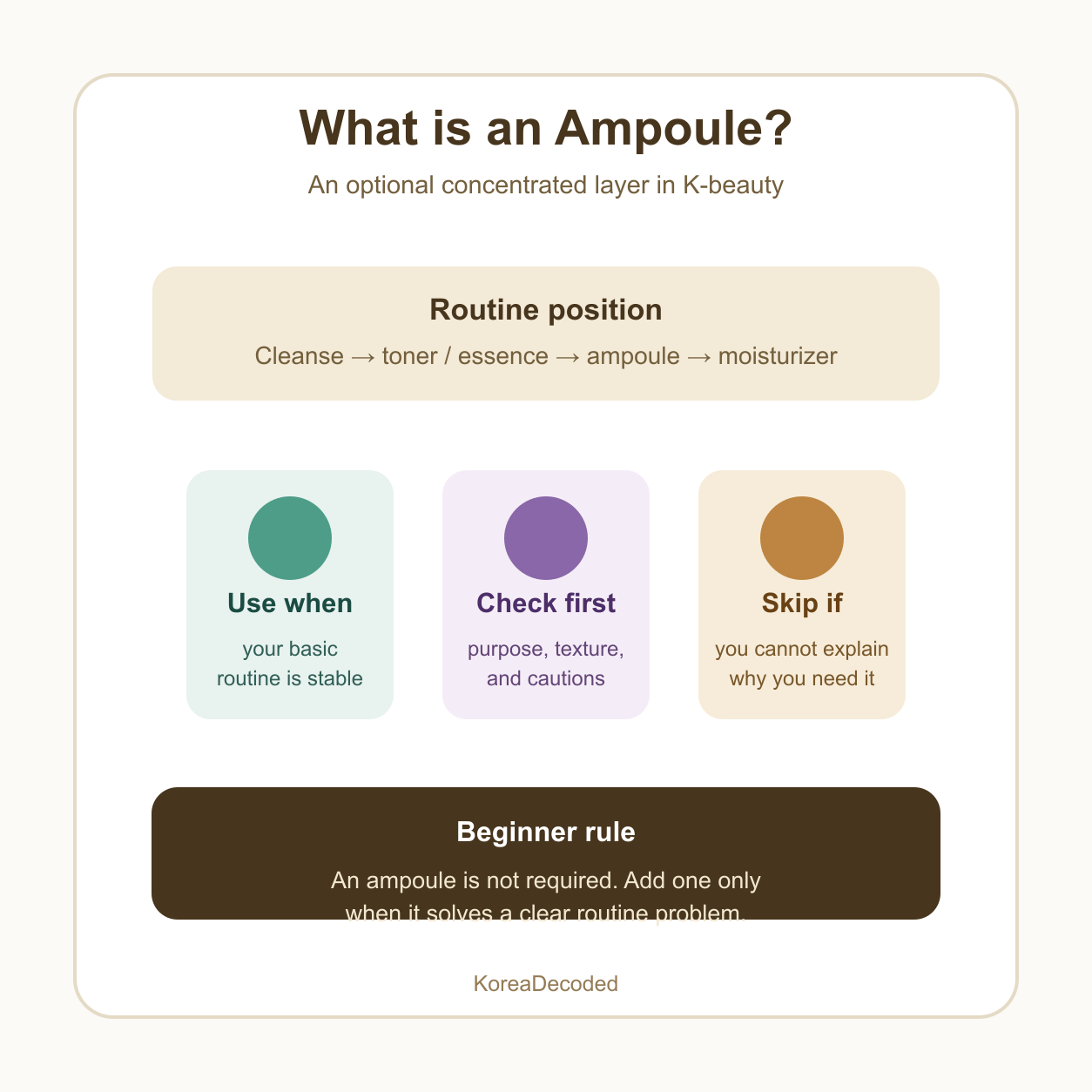
Where an ampoule fits in the routine
In a common Korean skincare order, an ampoule usually goes after cleansing and watery steps such as toner or essence, then before moisturizer. A simple order might look like this: cleanse, toner or essence if you use one, ampoule, moisturizer, and sunscreen in the morning.
That order is flexible because texture matters. Lighter products usually go before thicker products. If an ampoule feels very watery, it may sit earlier. If it feels closer to a serum or gel, it may sit later. Product instructions should win over generic routine charts.
Ampoule vs serum vs essence
There is no universal global rule that makes every ampoule stronger than every serum or every essence. Brands use these words as product categories and marketing signals. A practical comparison is better than a strict dictionary.
- Essence: often a light hydrating or treatment-style layer.
- Serum: often a targeted product with a featured ingredient or concern.
- Ampoule: often marketed as more concentrated, intensive, or focused than a basic watery step.
The problem is overlap. One brand’s essence may feel richer than another brand’s ampoule. One ampoule may be gentle and hydrating, while another may include exfoliating or more active-feeling ingredients. The name alone does not tell you how your skin will react.
When an ampoule makes sense
An ampoule can make sense when your basic routine is already stable and you want one specific optional layer. For example, you may want a light hydrating layer before moisturizer, a calming-feeling product after a long day, or a featured ingredient you already know your skin tolerates.
The key phrase is “already stable.” If your skin is currently irritated, if you just changed cleanser, or if you bought several new products at once, an ampoule may make troubleshooting harder. If something goes wrong, you will not know which product caused it.
When to skip an ampoule
- Skip it if your beginner routine already works and you do not know what problem you are solving.
- Skip it if the product claims sound dramatic but the usage instructions are unclear.
- Skip it if your skin is irritated or you are testing another new product.
- Skip it if you are buying it only because “ampoule” sounds more advanced than “serum.”
- Skip it if the price pushes you to expect results the product cannot fairly promise.
This is not anti-ampoule advice. It is anti-confusion advice. A good skincare routine is understandable. If a product makes the routine harder to explain, slow down.
How to read an ampoule product page
Before you buy, look for practical information, not just glow language.
- Use instruction: How much, when, and how often?
- Texture: watery, gel-like, oily, sticky, or creamy?
- Featured ingredients: are they familiar to you?
- Precautions: any warnings about irritation, damaged skin, eye area, or stopping use?
- Routine role: does it replace a serum, or add another layer?
If the product page cannot answer those questions, do not let the word “ampoule” do the work. Read the label and instructions the way you would for any other cosmetic product.
A beginner-safe way to test one
Use one new ampoule at a time. Keep the rest of your routine boring. Apply a small amount according to the product instructions, and watch how your skin feels over several uses. If you notice persistent stinging, burning, redness, or discomfort, stop using it.
Do not add an ampoule, exfoliant, new cleanser, and new moisturizer in the same week if you are trying to learn what works. A slower routine gives you better information.
Quick checklist before buying
- Can I explain what this ampoule does in one sentence?
- Do I know where it goes in my routine?
- Am I already comfortable with my cleanser, moisturizer, and sunscreen?
- Am I adding only one new product at a time?
- Am I treating cosmetic claims as shopping clues, not medical promises?
FAQ
Is an ampoule stronger than a serum?
Not always. Ampoules are often marketed as concentrated or intensive, but brand usage varies. Check the actual ingredients, texture, and instructions.
Can I use an ampoule every day?
Only if the product instructions and your skin tolerance support daily use. Some ampoules are gentle daily hydration layers, while others should be used more carefully.
Do beginners need an ampoule?
No. Beginners should first understand cleanser, moisturizer, and sunscreen. Ampoule can come later if it solves a specific routine need.
Sources and editorial notes
- MFDS: cosmetic labeling items was used as a product-label and usage-checking guardrail.
- MFDS cosmetic labeling and advertising guidance was used as a claims-safety guardrail. Checked on 2026-05-21.
- Korea Cosmetics Act was used for general cosmetic regulation context. Checked on 2026-05-21.