Short answer: In Korean skincare shopping, a toner is usually the first watery step after cleansing, while an essence is usually a light treatment-style hydration step. The confusing part is that brands use these words flexibly. Do not buy both just because a routine graphic says so. Ask what the product does, where it fits, and whether your skin actually needs another layer.
If you are new to K-beauty, toner and essence can feel like two bottles trying to do the same job with different names. Sometimes they do overlap. Sometimes one is mainly a refreshing prep step, and the other is meant to be a more targeted hydrating layer. The useful answer is not “toner first, essence second, always.” The useful answer is understanding the role before you spend money.
For the broader routine order, start with Korean skincare routine explained for beginners. If you are looking at a physical bottle or online product page, pair this with how to read Korean skincare labels.
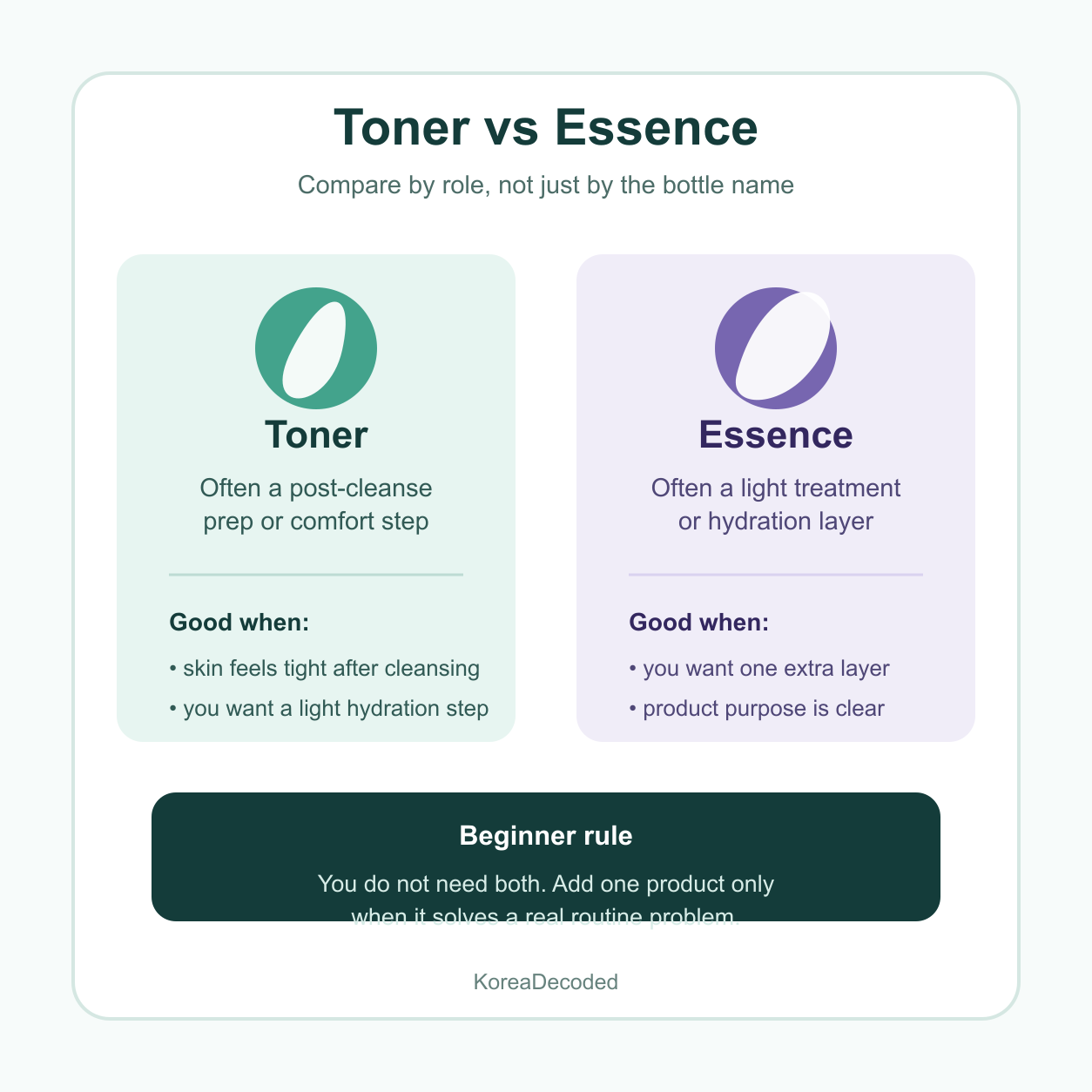
What toner usually means in a Korean routine
In many Korean skincare routines, toner is a watery product used after cleansing. Depending on the product, it may feel refreshing, lightly hydrating, softening, or calming. Some people use it with cotton pads. Others press it into the skin with their hands. Some skip it completely.
The important thing is that toner is not one fixed formula. A “toner” can be very light and watery, or it can be thicker and more moisturizing. Some are gentle daily products. Some include exfoliating ingredients and should be used more carefully. The label and ingredient list matter more than the English category name.
A beginner-friendly way to think about toner is this: it is a possible comfort step after cleansing. If your skin feels fine after washing and your moisturizer works well, you may not need one right away.
What essence usually means in K-beauty
An essence is often described as a lightweight treatment-style step. In practice, many essences focus on hydration, skin feel, texture, glow, or a particular featured ingredient. They are usually thinner than a cream and often lighter than a serum or ampoule, although this is not a strict rule.
Essence became one of the words global shoppers associate with Korean skincare because it fits the layered-routine idea: cleanse, add watery hydration, then moisturize. But the word itself does not guarantee that the product is necessary, gentle, or better than a toner. It is still just a cosmetic product that needs to fit your skin and your routine.
If a product page says an essence will hydrate, soften, support a “glow,” or help the skin feel smoother, treat that as a product direction, not a medical promise. KoreaDecoded’s rule is simple: cosmetics can support appearance and comfort, but they should not be framed as treatments for medical skin conditions.
The real difference: role, texture, and purpose
The easiest comparison is not dictionary-based. It is practical.
- Toner: often the first light step after cleansing, used for refreshing, softening, or light hydration.
- Essence: often a light treatment-style layer, used for hydration, skin feel, or a featured ingredient focus.
- Overlap: some hydrating toners feel like essences, and some essences feel like toners.
- Decision point: choose by what your routine is missing, not by the category name.
This overlap is why shopping can feel so slippery. One brand’s toner may be richer than another brand’s essence. One essence may be almost water-like, while another feels closer to a serum. The product’s instructions, texture, ingredients, and your skin response tell you more than the label word alone.
Do you need both toner and essence?
No. Many beginners do not need both. A simple routine with cleanser, moisturizer, and morning sunscreen can be enough. A toner or essence becomes useful when it solves a specific routine problem: your skin feels tight after cleansing, your moisturizer alone does not feel comfortable, or you want one gentle hydrating layer before cream.
If you already use several products and cannot tell which one helps, adding both toner and essence may make your routine harder to understand. Add one product at a time. Use it long enough to notice whether your skin feels better, worse, or unchanged. Boring tracking beats an expensive shelf.
How to choose between them
Use the questions below before buying.
- What step is missing? If your skin feels tight right after cleansing, a gentle hydrating toner may make sense.
- What is the product promising? If the product focuses on hydration or a featured ingredient, it may be closer to an essence-style step.
- How heavy is the texture? If your skin dislikes layers, choose the lighter product or skip both.
- Does it contain exfoliating or active ingredients? If yes, treat it with more caution than a plain hydrating layer.
- Can you explain its job in one sentence? If not, pause before buying.
A useful beginner sentence sounds like this: “This toner makes my skin feel less tight after cleansing,” or “This essence is my one extra hydrating layer before moisturizer.” If the sentence is only “everyone online uses it,” that is not enough.
When to skip both
Skip toner and essence if your skin is irritated, if you are testing another new product, if your routine already feels comfortable, or if you are buying only because the bottle looks like part of a “complete” K-beauty routine.
Also be careful if the product makes dramatic claims. Cosmetic labels and ads should not be treated as medical advice. If you are dealing with persistent acne, eczema, painful irritation, or another medical concern, a skincare shopping guide cannot replace a qualified professional.
Simple routine examples
Very simple morning: cleanse or rinse, moisturize if needed, sunscreen.
Hydration-focused morning: cleanse, hydrating toner or essence, moisturizer if needed, sunscreen.
Simple evening: cleanse, moisturizer.
Layered evening: cleanse, toner, essence, moisturizer. This is optional, not a beginner requirement.
Quick buying checklist
- Is this product a toner, essence, serum, ampoule, or something else?
- What does the product page or label say about how to use it?
- Is it mainly hydrating, exfoliating, soothing, or ingredient-focused?
- Will it replace a step or add another layer?
- Can you test it slowly without changing three other products at the same time?
FAQ
Which comes first, toner or essence?
Usually toner comes first because it is often the lighter post-cleansing step. Then essence comes next if you use one. But texture matters. In general, apply lighter, more watery products before thicker products.
Can I use essence instead of toner?
Yes, if the essence gives you the light hydration or comfort you wanted from a toner. You do not need both categories just to make a routine look complete.
Is toner necessary in Korean skincare?
No. It is common, but not mandatory. A routine can still be Korean-inspired and practical without a toner.
Is essence better than serum?
Not automatically. Essence is often lighter, while serum is often marketed as more concentrated, but brands use these terms differently. Compare the product purpose and ingredient profile rather than assuming one category is better.
Sources and editorial notes
- MFDS: cosmetic labeling items was used as a Korean cosmetic label-reading guardrail for product information, usage, and package details.
- MFDS cosmetic labeling and advertising guidance was used as a claims-safety guardrail. Checked on 2026-05-21.
- Korea Cosmetics Act was used for general cosmetic regulation context. Checked on 2026-05-21.