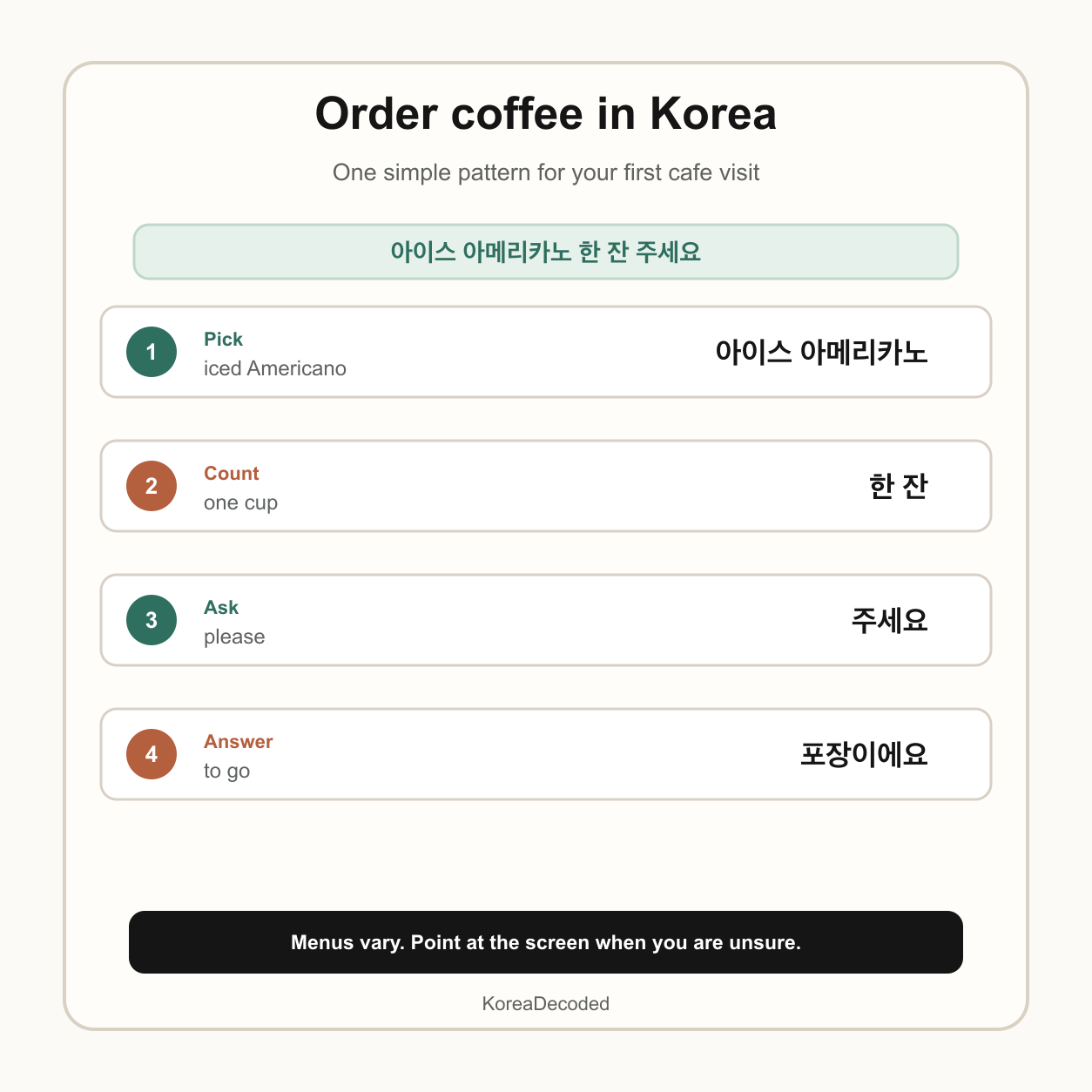
Ordering coffee in Korea is easier when you stop trying to memorize a full conversation. You usually need four core decisions: the drink, hot or iced, the quantity, and whether you will stay or take it away. Some menus also ask you to choose a size.
Cafes vary. A large chain, a neighborhood roastery, and a small Yeonnam cafe may use different menus, size names, kiosks, and customization options. Use this as a simple order pattern, then follow the menu and staff at the cafe in front of you.
The one sentence to remember
아이스 아메리카노 한 잔 주세요.
Aiseu americano han jan juseyo.
Please give me one iced Americano.
The reusable pattern is simple:
[hot or iced] + [drink] + [quantity] + 주세요
If you can say only one Korean cafe sentence, use that one. You can also point at the menu while saying it.
Hot or iced
- 아이스 (aiseu): iced
- 따뜻한 (ttatteuthan): hot or warm
For example, say 따뜻한 카페라테 한 잔 주세요 for one hot cafe latte. Menu spellings for imported words can vary slightly, so pointing at the drink is a perfectly good backup.
How many cups?
- 한 잔 (han jan): one cup
- 두 잔 (du jan): two cups
The polite ending 주세요 (juseyo) means “please give me.” It is useful far beyond cafes.
Choose a size without guessing the system
Size names differ by cafe, so read or point at the actual menu. If staff ask 사이즈는 어떤 걸로 하시겠어요? (saijeuneun eotteon geollo hasigesseoyo?, “What size would you like?”), you can say the displayed size name or point and answer 이 사이즈로 주세요 (i saijeuro juseyo, “This size, please”).
For here or to go?
After you order, staff may ask whether you will drink it at the cafe or take it away. Exact wording varies. Common questions include 여기서 드실 거예요? (“Will you have it here?”) and 가지고 가실 거예요? (“Will you take it to go?”). These short answers are enough:
- 포장이에요. (pojang-ieyo): To go, please.
- 매장에서 마실게요. (maejang-eseo masilgeyo): I will drink it here.
Some cafes use a kiosk or a screen. Do not assume every kiosk looks the same or supports the same languages. If the screen is confusing, ask staff or point at your choice.
When staff ask if you want anything else
You may hear 더 필요하신 거 있으세요? (“Do you need anything else?”). If your order is complete, answer 아니요, 괜찮아요 (aniyo, gwaenchanayo, “No, I am okay” or “No thanks”). Adding 아니요 makes the beginner response clearer than relying on 괜찮아요 alone.
Optional customizations
Customization depends on the cafe. Large chains may offer more options than small cafes. One useful phrase is 샷 추가 (syat chuga), meaning an extra espresso shot. Starbucks Korea’s official Americano page, for example, states that an extra espresso shot can be added.
Do not assume every cafe has decaf, every milk alternative, or the same size system. Check the actual menu first. This keeps the interaction simple and avoids turning one chain’s options into a rule for all Korean cafes.
A first-visit ordering routine
- Look at the menu and choose one drink.
- Decide whether you want it hot or iced.
- Say the drink, quantity, and 주세요.
- Answer 포장이에요 for takeaway or 매장에서 마실게요 for dine-in.
- Point at the menu when pronunciation or spelling gets in the way.
That is enough for most first cafe visits. If you are planning a casual Hongdae evening, pair this with the Hongdae first-night food plan. If dessert names are the confusing part, use the Korean cafe dessert guide. For late-night drinks and small emergencies, read the Korea convenience store tips guide.
What a self-order kiosk may ask
Kiosk order varies by chain and store, but the decision order is usually more important than translating every word. Look for the drink, temperature, size, quantity, dine-in or takeaway, optional changes, payment, and receipt. A machine that offers English may still keep product names or payment notices in Korean, so confirm the final cart before paying.
| Screen decision | What to check | Safe fallback |
|---|---|---|
| Hot or iced | 아이스 or a hot-cup option | Return to the drink page before payment if the cup icon looks wrong. |
| Size | Use the exact names shown by that cafe. | Choose the default or ask staff; do not assume every chain uses tall, grande, and venti. |
| Dine-in or takeaway | 매장 or 먹고 가기 versus 포장 or 가져가기 | Point to the seat area or takeaway cup and ask staff. |
| Payment | Check whether the kiosk accepts the card or wallet you have. | Move to the staffed counter if the machine rejects an overseas card. |
Two recovery phrases are enough
- 이거 주세요. (igeo juseyo) — “This one, please.” Point to the menu item while you say it.
- 다시 말해 주세요. (dasi malhae juseyo) — “Please say it again.” Use it when the follow-up question was too fast.
If the question is still unclear, showing the order on your phone or returning to the menu is better than guessing. The goal is a correct order, not proving that you can finish the exchange without help.
Three complete order examples
| You want | Say or show |
|---|---|
| One iced Americano, takeaway | 아이스 아메리카노 한 잔 주세요. 포장이에요. |
| Two hot cafe lattes, dine-in | 따뜻한 카페라테 두 잔 주세요. 매장에서 마실게요. |
| The item shown on the menu | 이거 한 잔 주세요, then point to the drink. |
Read the lines as modular choices rather than one fixed script. If a cafe uses different product or size names, keep 주세요 and replace only the part shown on the live menu.