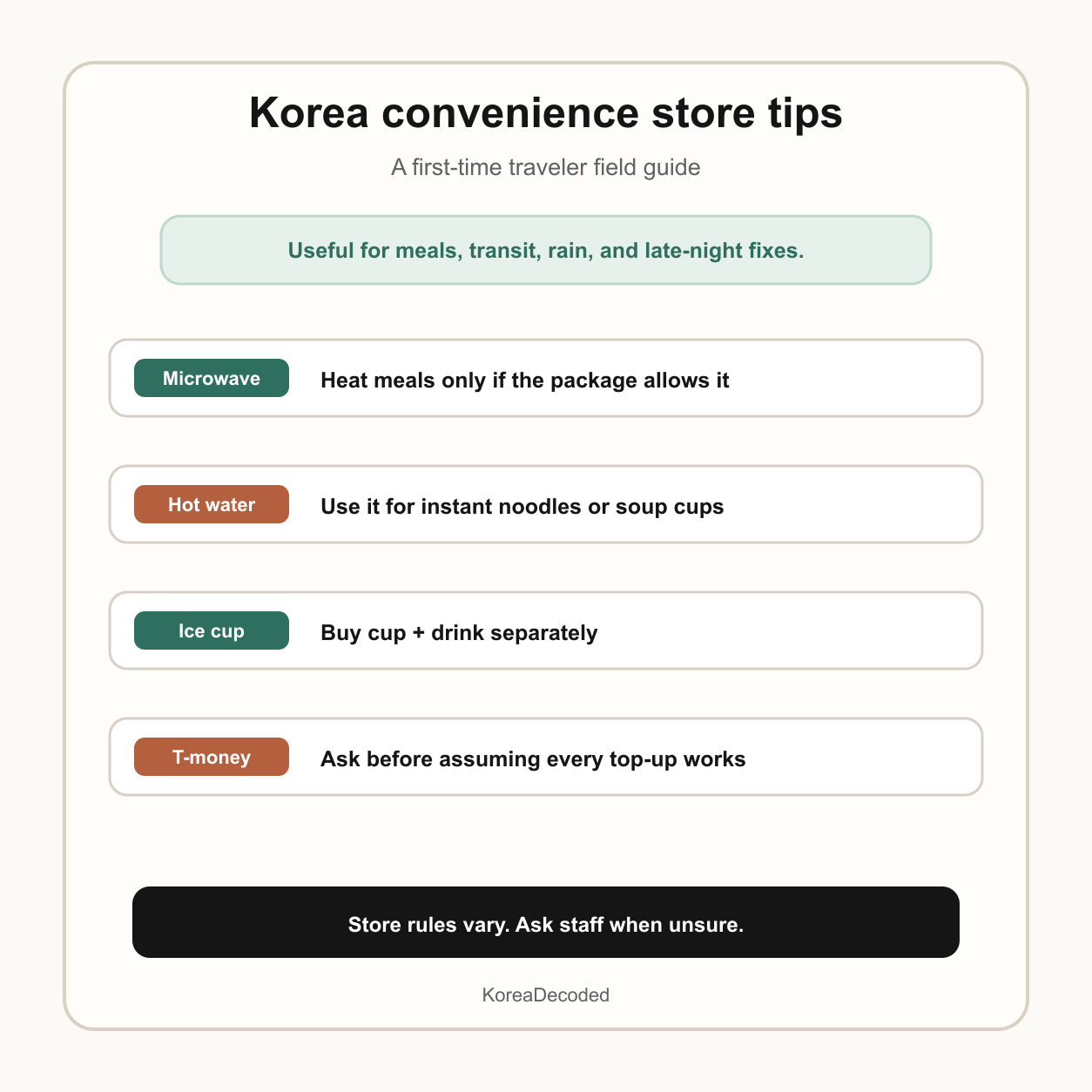
Korean convenience stores are not just snack shops. For travelers, they can be a small survival system: breakfast, coffee, rain gear, instant noodles, T-money help, phone chargers, medicine-adjacent basics, and late-night food when restaurants are closed.
The trick is knowing how to use them. A first-time visitor can walk into CU, GS25, 7-Eleven, or emart24 and still feel confused by the microwave area, hot water machine, ice cups, seating, trash rules, and transport-card counter.
Do not treat every store as identical
Korea has many convenience stores, but each location can be slightly different. Some have seating. Some do not. Some are open 24 hours. Some are not. Some are good for T-money help. Some are too small or too busy to solve every traveler problem.
Use this guide as a practical pattern, not a guarantee. If a sign, staff instruction, or store layout says something different, follow the local store first.
Microwave meals: check the package first
Many Korean convenience stores have a microwave area. This is useful for lunch boxes, rice dishes, dumplings, sausages, or other ready-to-heat foods. Before heating anything, check whether the package is microwave-safe and whether any sauce packet, lid, or wrapper should be removed.
If you are unsure, do not guess with sealed plastic. Ask staff or choose a food that clearly shows microwave instructions. Convenience-store meals are easy, but melted packaging is a bad travel memory.
Instant noodles: use the hot water area
Cup noodles are a classic Korean convenience-store meal. Stores that support in-store eating often have a hot water machine nearby. Add the seasoning, pour hot water to the line, close the lid, and wait for the time on the package.
Be careful when carrying hot noodles to a seat or counter. Space can be tight, and spilling hot soup in a crowded store is unpleasant for everyone.
Ice cups are usually a separate item
In Korea, convenience-store iced coffee or drinks often use a separate ice cup. You buy the ice cup and then add a bottled, carton, pouch, or machine drink. The cup may be in a freezer near the drinks, not next to the cashier.
This is normal. If you pick up only the drink but not the ice cup, you may end up with warm coffee or no cup. Look for the matching drink type and cup size before paying.
T-money help: useful, but not unlimited
Convenience stores are often useful for buying or recharging transit cards, including T-money. But do not assume every store can solve every card issue, every card type, or every payment method. If you are setting up transit for the first time, read the T-money card guide before you go.
For subway basics, pair that with the Seoul subway guide. Convenience stores can help with transit, but they are not a full transit information center.
Alcohol and tobacco may require age checks
If you buy alcohol or tobacco, staff may ask for ID or refuse the sale if age verification is unclear. Bring a passport or accepted ID if you plan to buy age-restricted items. Do not argue with staff about it; they are following store policy and Korean law.
Trash and recycling matter
Convenience stores may have separate bins for general trash, plastics, cans, bottles, or food waste. Use the bins the way the store labels them. If there is no public bin, do not leave outside trash on tables, shelves, or near the entrance.
This is one of the easiest ways to be a better visitor. Eat neatly, clear your space, and leave the table ready for the next person.
Good things to buy in a Korean convenience store
- Breakfast: kimbap, rice balls, sandwiches, yogurt, fruit cups, or coffee.
- Rain fixes: umbrellas or simple rain ponchos when the weather turns suddenly.
- Transit basics: transport-card top-up help where available.
- Late-night food: instant noodles, lunch boxes, snacks, drinks, and heat-and-eat meals.
- Small emergencies: tissues, wet wipes, masks, charging cables, basic toiletries, or bandages depending on the store.
Payment tips
Many stores accept cards, but travelers should still keep a backup payment method. Foreign-card acceptance can vary by card, terminal, and network. If one card fails, try another card or cash if you have it.
Self-checkout can be convenient, but it may be confusing if you do not read Korean or if you are buying age-restricted items. When in doubt, use the staffed counter.
A simple first-visit routine
- Walk around once before grabbing items so you understand the store layout.
- Check whether your food needs the microwave, hot water, or an ice cup.
- Pay first unless the store layout clearly suggests otherwise.
- Use the eating area only if the store has one.
- Sort trash according to the store bins before leaving.
Once you understand the pattern, Korean convenience stores become one of the easiest parts of travel. They are especially useful on your first night, between subway rides, or when restaurant plans fail. For restaurant backup planning, read the restaurant waitlist app guide and the street food ordering guide.
Sources checked
- Korea.net: Korean convenience store food culture
- VisitKorea: transportation card and travel basics
- Visit Seoul: Seoul travel basics
For small purchases in Korea, the shopping phrase guide helps with card, receipt, bag, and price questions.