Korean cafe desserts can look easy to choose because the display case is beautiful. The surprise is usually texture, sweetness, size, or toppings. Before you order one dessert per person, it helps to know which sweets are cold and shareable, which are dense and traditional, and which are familiar cafe desserts with Korean flavors.
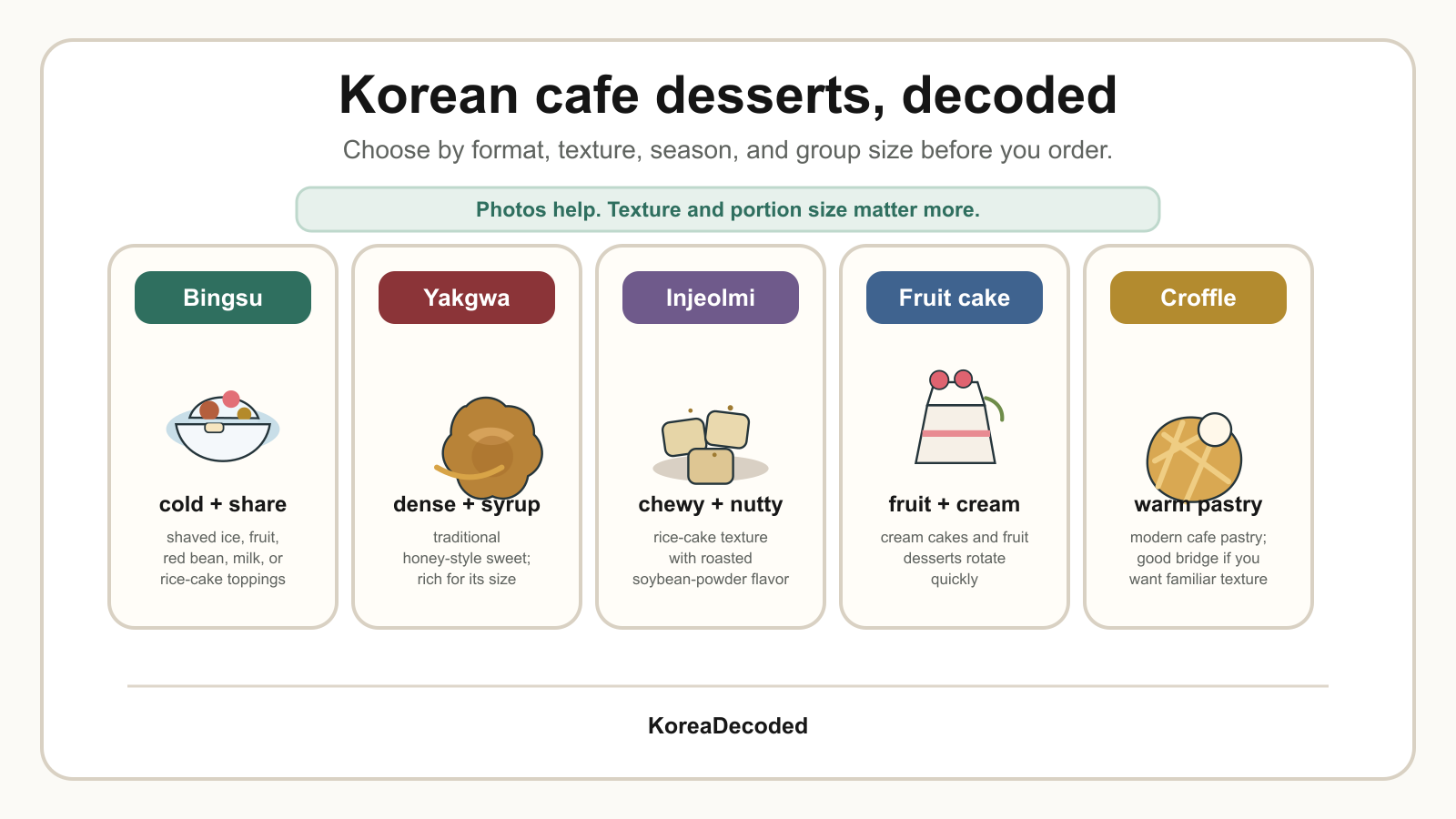
This Korean cafe desserts guide is for first-time Korea visitors who want to stop guessing from photos. Bingsu, yakgwa, tteok, injeolmi, fruit cream cake, croffles, and bakery sweets all belong to different decision categories. Once you know what each one usually feels like, ordering becomes much less mysterious.
Quick Answer: Which Korean Cafe Dessert Should You Try First?
| If you want… | Try… | What to expect | Best with |
|---|---|---|---|
| Cold and shareable | Bingsu | Shaved ice with toppings; often large, but check the size first | Friends, a warm afternoon, or a light meal before dinner |
| A traditional sweet | Yakgwa | Dense, syrupy, fried-cookie-like sweetness | Coffee, tea, or one small dessert after a meal |
| Chewy and nutty | Tteok or injeolmi desserts | Rice-cake texture, roasted soybean powder, and sometimes cream or shaved ice | Texture-curious eaters |
| An easy-to-predict first order | Fruit cream cake | Familiar cake format with fruit and cream; seasonal styles rotate | Iced coffee, tea, or a shared cafe break |
| Modern bakery comfort | Croffle, scone, financier, madeleine, tart, or cheesecake | Familiar pastry format, sometimes with Korean flavors | Travelers who want dessert without red bean or chewy rice cake |
What Counts as a Korean Cafe Dessert?
A Korean cafe dessert does not have to be a traditional Korean dessert. Modern cafes in Korea often mix Western-style cakes, bakery items, espresso drinks, seasonal fruit, red bean, rice cake, black sesame, mugwort, matcha, and other flavors into one dessert case.
That is why it is better to read the menu by format. Ask yourself: is this cold shaved ice, a syrupy traditional sweet, a chewy rice-cake dessert, a fruit cream cake, or a modern pastry? The answer tells you more than the photo alone.
Bingsu and Patbingsu: Korean Shaved Ice
Bingsu is the cold dessert many travelers notice first: Korean shaved ice with toppings. The classic red-bean version is patbingsu, because 팥 means red bean and 빙수 means bingsu or shaved ice dessert.
Patbingsu may include sweetened red beans, milk or condensed milk, rice cake, fruit, or other toppings. Modern bingsu can also move away from red bean entirely, with fruit, injeolmi, coffee, chocolate, tea, melon, watermelon, strawberry, or other seasonal directions. Treat those as possibilities, not promises for every cafe.
Choose bingsu when you want something cold, visual, and easy to share. It is often large enough for two people, but not always. Before ordering one per person, check the photo, look at nearby tables, or ask staff if the size is unclear.
Bingsu may be too much if you are alone, already full, or not in the mood for hidden toppings. Red bean, rice cake, cream, syrup, fruit, and ice cream can sit under the surface, so the top photo does not always tell the full story.
Yakgwa: The Syrupy Traditional Sweet
Yakgwa is a traditional Korean sweet that is richer than it looks. A practical first-timer description is “a syrup-soaked fried honey cookie,” though that is only an analogy. In traditional preparation, yakgwa is commonly made with wheat flour, honey, and sesame oil, then fried and soaked in syrup.
The texture is the main point. Yakgwa can feel dense, sticky, soft, slightly chewy, and syrupy, with a fried-cookie richness. It works well as a small coffee or tea pairing because one piece can feel satisfying.
In modern cafes, you may see plain yakgwa, mini yakgwa, yakgwa cookies, or yakgwa-inspired desserts paired with cream or ice cream. Read those as cafe interpretations unless the menu clearly says it is traditional yakgwa. Do not assume every Korean cafe carries it.
Tteok and Injeolmi: Rice Cake Desserts
떡, or tteok, means Korean rice cake. In cafe desserts, rice cake can appear as chewy topping pieces, a side sweet, part of bingsu, or a flavor inspiration. The biggest first-time surprise is texture: tteok is chewy and can be sticky.
인절미, or injeolmi, usually points you toward a nutty roasted-soybean-powder flavor direction and may include actual rice cake. Injeolmi bingsu, injeolmi toast, rice-cake toppings, and soybean-powder desserts are all cafe-friendly ways this flavor shows up.
Choose this category if you are texture-curious and want something that feels more Korean than a plain slice of cake. Skip it for your first order if you strongly dislike chewy desserts, powdery toppings, or hidden fillings.
Fruit Cream Cakes and Modern Cafe Cakes
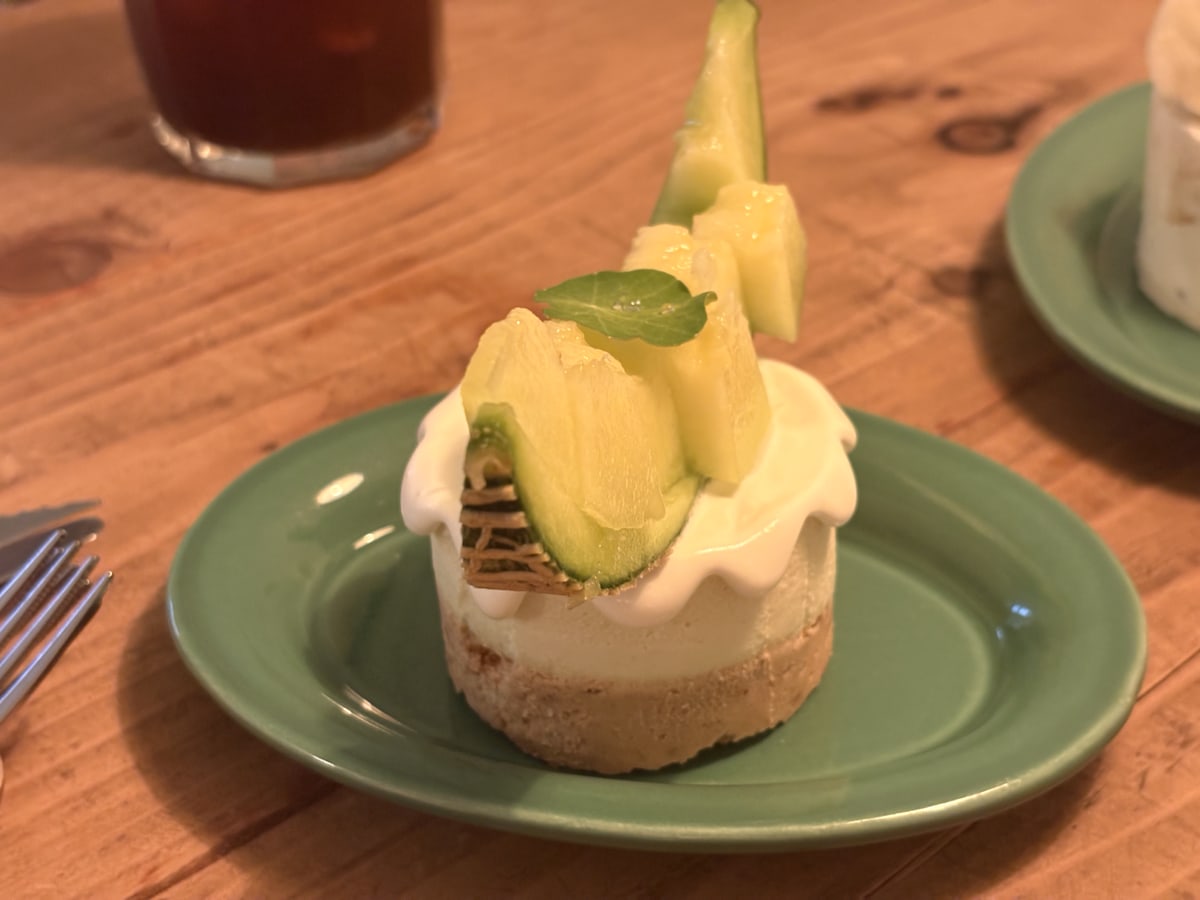
If you want the most predictable first order, a slice of fruit cream cake or cheesecake is usually easier to read than a chewy rice-cake dessert. Many Korean bakery and cafe menus include cakes, cream cakes, roll cakes, cheesecake-style slices, tarts, scones, financiers, and other familiar formats.
Fruit cream cake is not a single fixed Korean dessert. Think of it as a modern cafe category: sponge or cake layers, cream, and fruit that may rotate with the season or the cafe’s style. Strawberry, mango, melon, peach, chestnut, black sesame, mugwort, and matcha can all appear in Korean dessert contexts, but no one cafe is guaranteed to have a specific flavor on the day you visit.
This guide is about choosing Korean cafe desserts in general. If you already know you want a Seoul cafe stop near Hongdae, use the Yeonnam-dong cafe dessert guide as a specific neighborhood example.
Croffles, Scones, and Bakery Sweets
Croffles are not traditional Korean desserts, but they are part of the modern Korean cafe dessert scene. A croffle is a croissant-waffle style pastry: buttery, crisp-edged, and it can be served with cream, syrup, fruit, powder, chocolate, or ice cream.
This is the familiar bridge category. If red bean, rice cake, or yakgwa feels like too much for your first cafe stop, a croffle, scone, financier, madeleine, tart, or cheesecake can still feel like a Korea cafe experience without forcing you into a new texture immediately.
The caution is richness. A croffle with ice cream may be heavier than it looks, and delicate plated desserts may not travel well as takeout. If you are ordering before dinner, share first and add another dessert later if you still want more.
How to Choose by Taste, Season, and Group Size
- If you want something cold: start with bingsu, especially on a warm afternoon. Share unless the portion clearly looks small.
- If you want something traditional: try yakgwa, tteok, or a tea-friendly sweet, but expect richer textures than a light cake.
- If you do not like very sweet desserts: avoid assuming any category is automatically mild. Ask first, or choose plain tea, coffee, a small pastry, or a shared cake slice.
- If you are ordering for two or more people: one bingsu or two different desserts to share can be better than one large sweet per person.
- If you want an easy-to-predict first order: fruit cream cake, cheesecake, scones, or a familiar baked good with one Korean flavor is the easiest landing place.
If dessert is part of a Hongdae evening, keep it flexible. The Hongdae first-night food plan can help you place a cafe stop around dinner without turning the whole night into a dessert chase.
Useful Korean Dessert and Cafe Words
| Korean | Romanization | Meaning | What to know |
|---|---|---|---|
| 빙수 | bingsu | Shaved ice dessert | Often topped; size varies |
| 팥 | pat | Red bean | Sweet bean may be inside or on top |
| 팥빙수 | patbingsu | Red bean bingsu | The classic red-bean version |
| 약과 | yakgwa | Traditional syrupy sweet | Dense, rich, and usually small |
| 떡 | tteok | Rice cake | Chewy or sticky texture |
| 인절미 | injeolmi | Rice cake with roasted soybean powder | Nutty flavor direction; check for texture |
For ordering, keep it simple. 이거 하나 주세요 means “one of this, please.” 많이 달아요? means “is it very sweet?” 나눠 먹을 거예요 means “we are going to share it.” These phrases help, but pointing at the display case is also normal in many cafes.
For drink words and cafe ordering patterns, use the Korean cafe ordering terms guide. For broader menu reading beyond cafes, pair this with the Korean menu words guide.
What Not to Assume from a Cafe Menu Photo
- Do not assume size. Bingsu and plated desserts can be bigger than they look online.
- Do not assume ingredients. Cream, red bean, rice cake, nuts, coffee, chocolate, syrup, or fruit filling may be hidden.
- Do not assume a seasonal dessert is still available. Photos can outlive the menu that created them.
- Do not assume takeout is easy. Shaved ice, ice cream toppings, cream cakes, and delicate pastries may be best eaten in the cafe.
- Do not assume “traditional” means light or healthy. Some traditional sweets are rich, sweet, fried, or syrup-soaked.
Where This Fits in a Korea Trip
A Korean cafe dessert stop works best as a reset: between shopping and dinner, after a museum, during a rainy afternoon, or when you need a low-pressure place to practice one Korean phrase. You do not need to cross Seoul for a single dessert unless that cafe is already the point of your day.
In Seoul, cafe areas can fit naturally around Hongdae, Yeonnam, Myeongdong, Gangnam, Seongsu, Ikseon-dong, and many other neighborhoods. Outside Seoul, cafe desserts are also part of travel days in places like Busan and Jeju. The useful habit is the same anywhere: check the display, choose by texture, and avoid ordering from a photo alone.
If you are still choosing your base, the guide to where to stay in Seoul for first-time visitors can help you decide whether cafe-heavy neighborhoods should be part of your lodging plan. If you want more low-pressure Korean for travel interactions, start with basic Korean greetings.
FAQ
What is the most popular Korean cafe dessert?
Bingsu is one of the most recognizable Korean cafe desserts, especially in warm weather. Cafe menus may also include fruit cakes, rice-cake-inspired desserts, yakgwa-style sweets, scones, financiers, and other modern sweets, so the best choice depends on season, cafe style, and your taste.
Is bingsu one person or sharing size?
Bingsu is often large enough to share, but size depends on the cafe. If you are not sure, look at nearby tables, check the menu photo, or ask staff before ordering one per person.
What does yakgwa taste like?
Yakgwa is usually sweet, dense, syrupy, and slightly chewy, with honey or syrup richness and a fried-cookie feel. Modern cafe versions may be smaller, softer, crispier, or paired with cream, ice cream, or coffee.
Are Korean cafe desserts very sweet?
Some are very sweet, but not all. Bingsu, cream cakes, and yakgwa can feel rich, while tea-friendly sweets, plain scones, or black sesame and injeolmi flavors may feel more balanced. If unsure, ask 많이 달아요?, which means “is it very sweet?”
What should I order if I do not like red bean?
Look for fruit bingsu, injeolmi bingsu, fruit cream cake, cheesecake, scones, or other baked goods. Red bean is common in Korean desserts, but many modern dessert cases also show options where red bean is not the main feature.
Can I order Korean cafe desserts if I cannot read Korean?
Yes. Many cafes use display cases, photos, or simple menus. You can point and say 이거 하나 주세요, meaning “one of this, please.” You can also use screenshots or translation apps when a dessert name is unclear.
Sources checked
- Korea Tourism Organization / VISITKOREA, Korean Cafe Culture, checked June 30, 2026, for broad cafe-culture context.
- Korea Tourism Organization / VISITKOREA, Korean food overview, checked June 30, 2026, for broad food and bakery context.
- Korea Tourism Organization / VISITKOREA archived bingsu guide via the Internet Archive, checked June 30, 2026, used for bingsu definition and variety context only, not current venues, menus, or prices.
- Korean Food Promotion Institute / Hansik, foreign-language Korean menu notation page, checked June 30, 2026, for menu-term handling context.
- Ah-lee, Kyung, Food Science and Biotechnology paper on yakgwa preparation terminology, checked June 30, 2026, used for preparation and texture context, not health claims.
- Paris Baguette Korea official cake and dessert/snack product pages, checked June 30, 2026, used only as examples of bakery and dessert category formats.
- Hollys official bakery menu, checked June 30, 2026, used only as an example of modern cafe bakery and croffle-style dessert categories.