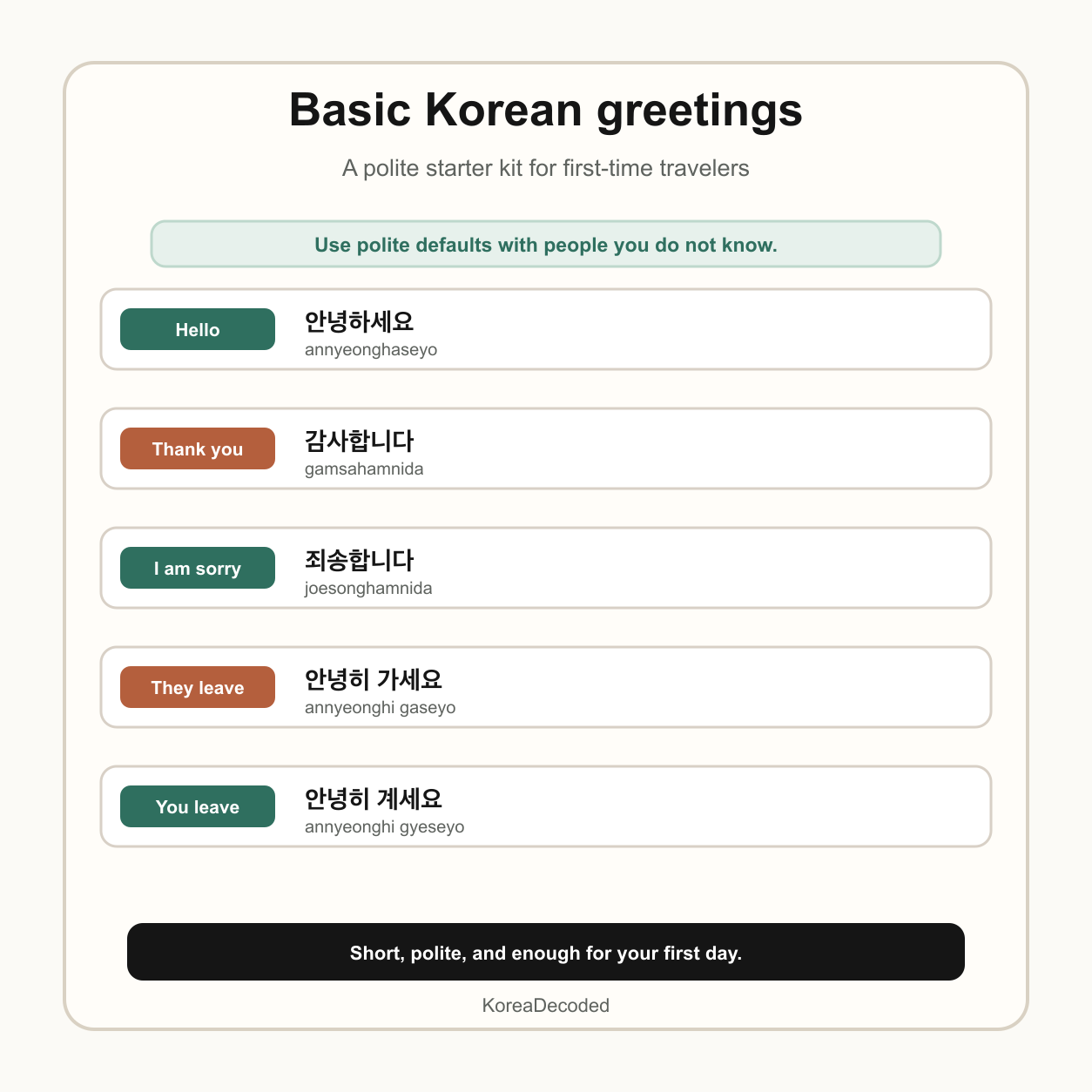
You do not need to memorize a textbook before visiting Korea. A small polite starter kit is more useful: hello, thank you, sorry, goodbye, yes, and no.
These expressions are designed for first-time travelers speaking with hotel staff, restaurant workers, shop staff, or people they do not know well. They are not a complete lesson in Korean speech levels. They are the phrases most likely to make your first day smoother.
Start with 안녕하세요
안녕하세요
annyeonghaseyo
Hello.
This is the useful polite default when you greet someone you do not know. You may hear the shorter 안녕 in casual situations, dramas, or conversations between friends. Do not make that casual version your default with strangers.
Say 감사합니다 for thank you
감사합니다
gamsahamnida
Thank you.
Use it after someone helps you, hands you your order, or explains something. Even when the rest of the conversation happens through pointing or a translation app, this closing phrase is worth saying.
Use 죄송합니다 when you make a mistake
죄송합니다
joesonghamnida
I am sorry.
This is a useful polite apology when you bump into someone, misunderstand an instruction, or need to acknowledge a mistake. You may also hear 미안합니다. The National Institute of Korean Language explains that the choice depends on context; 죄송합니다 is a practical beginner-safe option when you want to be clearly polite.
The goodbye changes depending on who leaves
This is the part worth slowing down for.
- 안녕히 가세요 (annyeonghi gaseyo): say this to the person who is leaving.
- 안녕히 계세요 (annyeonghi gyeseyo): say this when you leave and the other person stays.
For example, if you walk out of a small shop while the owner stays behind the counter, 안녕히 계세요 fits the situation. If someone leaves while you remain, use 안녕히 가세요.
Polite yes and no
- 네 (ne): yes
- 아니요 (aniyo): no
These are useful beginner responses when staff ask a simple question. Real Korean conversation can be more nuanced, especially when agreement and politeness interact, but you do not need that full lesson to get through a first trip.
A five-minute practice routine
- Say 안녕하세요 when you enter a small shop or greet someone.
- Say 감사합니다 when you receive help or your order.
- Use 죄송합니다 when you make a mistake.
- Practice the goodbye pair once: they leave, 가세요; you leave, 계세요.
- Use 네 and 아니요 for simple polite answers.
Once these feel comfortable, put them into a real transaction. The Korea cafe ordering guide shows how to combine a drink name with 주세요. For a food example, use the street-food ordering guide.
Next Korean phrase guides
Use this page as your starter hub. For a deeper look at two phrases travelers use constantly, read how to say thank you in Korean and how to say sorry in Korean without sounding rude. When you are ready to use Korean at a table, continue with Korean restaurant phrases for travelers.
A one-screen phrase card for your first day
| Moment | Show or say | Use it when |
|---|---|---|
| Greeting | 안녕하세요 | You enter a staffed shop, hotel desk, restaurant, or meet someone new. |
| Thanking | 감사합니다 | You receive an order, directions, or help. |
| Small apology | 죄송합니다 | You bump into someone, block the way, or make a mistake. |
| They leave | 안녕히 가세요 | You stay and the other person goes. |
| You leave | 안녕히 계세요 | The other person stays behind. |
| Simple answer | 네 / 아니요 | A question clearly needs yes or no. |
Save a screenshot of the Hangul column rather than relying only on romanization. If pronunciation fails, showing the Korean text while pointing to the situation is clearer than repeating an English approximation louder.
Three beginner mistakes to avoid
- Do not default to 안녕 with strangers. It is the casual form travelers often recognize from entertainment, but 안녕하세요 is the safer public greeting.
- Do not treat both goodbye phrases as interchangeable. Remember the physical direction: 가세요 for the person who goes, 계세요 for the person who stays.
- Do not let romanization become the goal. It is a memory aid, not an exact sound system. Listening to the dictionary audio and recognizing the Hangul is more useful than chasing one perfect English spelling.
Put the phrases into one real sequence
Imagine entering a small cafe. Say 안녕하세요, point to the drink, and use the order pattern from the cafe guide. When the drink arrives, say 감사합니다. If you misunderstood the pickup area, use 죄송합니다. When you leave while the worker remains, say 안녕히 계세요. That short sequence practices greeting, transaction, repair, and goodbye without memorizing a speech.
In a busy chain store, staff may move directly to the order without a long greeting or goodbye. The phrases remain polite options, not a script that every employee must answer. Match the pace of the interaction and keep the language simple.
Sources checked
- National Institute of Korean Language: Practical Korean Expressions for Learners of Korean
- National Institute of Korean Language: Practical Korean Expressions for Foreigners PDF
- National Institute of Korean Language: Korean-English Learners’ Dictionary
- Korean-English Learners’ Dictionary: 안녕히
- National Institute of Korean Language Q&A: 미안합니다 and 죄송합니다