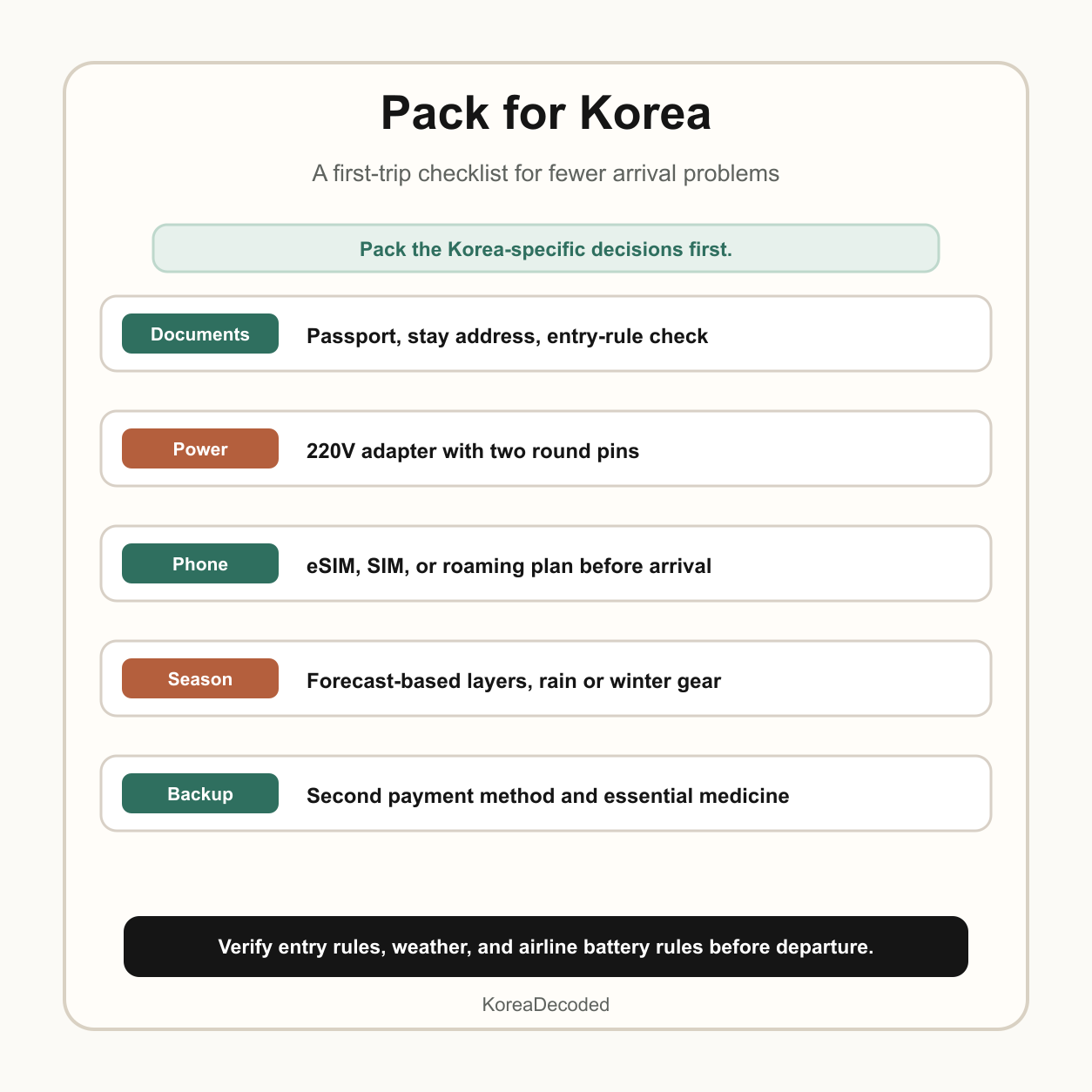
For a first trip to Korea, the most useful packing list is not a giant suitcase checklist. It is a short list of Korea-specific decisions that prevent problems during your first 24 hours: entry documents, phone service, the correct power adapter, weather-appropriate clothing, and a payment backup.
You can buy many forgotten basics after arrival. The harder problems are the ones that appear before you can comfortably use maps, transit, or hotel check-in. Pack those first.
1. Put your arrival documents in one place
- Your passport and any visa or entry document required for your nationality.
- Your accommodation name, address, and phone number in a format you can open offline.
- Your flight details and a backup screenshot of your first-night plan.
Entry rules can change, and they are not identical for every passport. Check your nationality on the official Korean government sites shortly before departure. Korea’s official e-Arrival Card site says the form is free, can be submitted within three days before arrival, and includes a navigator to check whether you need it.
Be careful with unofficial sites. The Ministry of Justice warns that fake e-Arrival Card websites exist. The official service does not ask you to pay a fee.
As one current example, the Korean Embassy in the United States states that the temporary K-ETA exemption for currently exempt countries and regions, including the United States, runs through December 31, 2026 KST. That does not mean every reader has the same rule. Confirm your own nationality on the official K-ETA site before you fly.
2. Bring the correct power adapter
Korea uses 220 volts at 60 Hertz, and the standard outlet has two round holes. If your charger does not fit that outlet, pack a compatible travel adapter before departure.
Check whether your devices support 220V input before plugging them in. Many modern phone and laptop chargers do, but do not assume every appliance is dual voltage. Hair tools and specialty devices deserve extra attention.
3. Decide how your phone will connect before landing
Your phone is your map, translator, transit helper, booking screen, and emergency contact tool. Decide before departure whether you will use an eSIM, a physical SIM, or roaming. If you choose eSIM, save the setup instructions somewhere you can access offline.
Use the Korea eSIM vs SIM card guide to choose the setup that fits your device and need for calls or SMS. Pack a charging cable and consider a power bank, but check your airline’s current battery and carry-on rules before flying.
4. Pack for the season, not for a generic Korea trip
Korea has four distinct seasons. VISITKOREA describes spring and fall as generally clear and mild, summer as hot and humid, and winter as cold and dry. A useful packing list changes sharply depending on your month of travel.
- Spring and fall: pack layers for changing temperatures and comfortable walking shoes.
- Summer: pack breathable clothing and check the forecast closely. Late June through late July partly overlaps with the rainy season.
- Winter: bring a proper outer layer, warm socks, and accessories for cold outdoor waits.
Check the forecast again shortly before departure. Weather matters more than a generic influencer packing list.
5. Carry a payment backup
Bring more than one payment method. A foreign card can fail because of the card, terminal, network, or issuer settings. Keep a second card and a small cash backup separate from your primary wallet.
You do not need to solve every transit detail before boarding the plane. After arrival, read the T-money card guide and the Seoul subway guide. That is enough to make your first transit day much calmer.
6. Pack medication carefully
Bring essential medication in its original packaging and keep prescription information available. Do not assume that medicine, supplements, food, or plant products that are ordinary at home can enter Korea without restrictions.
Korea Customs Service lists medicines that may be misused or abused among goods that must be declared and also lists several animal, plant, fruit, vegetable, and food categories. If your item is important or unusual, review the official Customs guidance and contact the relevant authority before departure.
7. Do not overpack replaceable basics
Tissues, wet wipes, umbrellas, simple toiletries, charging cables, and snacks are often easier to replace after arrival than to overthink at home. A nearby convenience store can solve many small problems. Read the Korea convenience store tips guide before your first late-night stop.
A compact Korea packing checklist
- Passport, required entry documents, accommodation address, and flight details.
- Compatible 220V adapter with two round pins.
- eSIM, SIM, or roaming plan with offline setup instructions.
- Season-aware clothing based on a recent forecast.
- Two payment methods and a small cash backup.
- Essential medication with documentation and a Customs check when needed.
- Comfortable walking shoes and a light bag for transit days.
Once those essentials are covered, keep the rest of the suitcase simple. Korea is easier to enjoy when you are carrying a plan rather than every possible object.
Sources checked
- Ministry of Justice: official Korea e-Arrival Card
- Embassy of the Republic of Korea in the USA: K-ETA temporary exemption extension through December 31, 2026
- VISITKOREA: Electricity & Communications
- VISITKOREA: Climate
- Korea Customs Service: Customs Clearance Guide for Passengers
Fan trips often involve concerts, cafes, shopping, and late-night returns; pair this packing list with the Seoul stay guide for K-pop and K-drama fans.
For shopping after arrival, save the Korean shopping phrase guide with your packing checklist.