Short answer: You do not need to read every Korean word on a menu. First look for five things: the dish format, the main ingredient, the cooking style, the spice clue, and whether the item is one serving, shared, or an add-on.
This is why a translation app can still feel confusing. It may translate every word correctly, but it does not always tell you whether you are ordering a bowl of soup, a shared hot pot, a grilled dish, a noodle meal, or an extra topping. Learn the pattern words first, and the whole menu becomes less noisy.
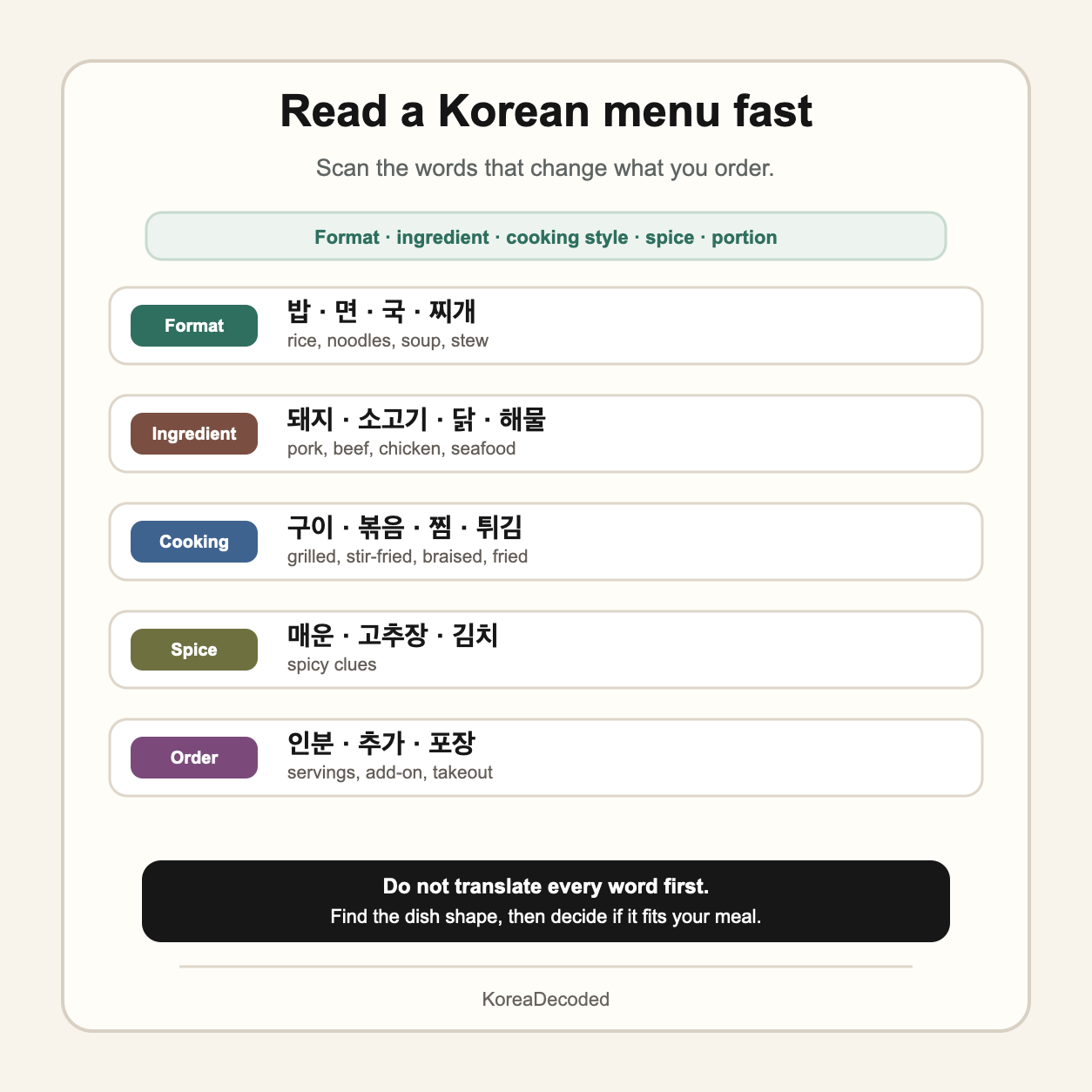
The 30-second menu scan
When a Korean menu feels overwhelming, scan in this order:
- Format: Is it rice, noodles, soup, stew, grilled food, or a shared pot?
- Ingredient: Is the main thing pork, beef, chicken, seafood, shrimp, egg, kimchi, or soybean paste?
- Cooking style: Is it grilled, stir-fried, braised, steamed, fried, or pancake-style?
- Spice clue: Does it say spicy, red pepper paste, kimchi, or mild?
- Ordering mechanic: Is it one serving, a set, an add-on, takeout, or small/medium/large?
You will still see brand names, regional names, and restaurant-specific dishes. That is normal. The goal is not perfect translation. The goal is to avoid ordering the wrong kind of meal.
Dish format words
| Korean | Simple reading | What it usually signals | Visitor note |
|---|---|---|---|
| 밥 | bap | rice / rice meal | Can be plain rice or part of a rice-based dish. |
| 덮밥 | deopbap | rice bowl | Topping over rice; often an easier solo meal. |
| 면 | myeon | noodles | Appears in many noodle names. |
| 국수 | guksu | noodles | Often noodle dishes, hot or cold depending on menu. |
| 국 | guk | soup | Often served with rice or as part of a meal. |
| 탕 | tang | soup / hearty soup | Can be a main dish; not always light. |
| 찌개 | jjigae | stew | Usually stronger, hotter, or thicker than a light soup. |
| 전골 | jeongol | hot pot | Often shared and cooked at the table. |
The most useful distinction is not dictionary-perfect. It is practical: bap and deopbap usually feel like rice meals; myeon and guksu point to noodles; guk, tang, and jjigae point to soup or stew; jeongol often means your table is sharing a pot.
Cooking-style words
| Korean | Simple reading | What it means | Example feeling |
|---|---|---|---|
| 구이 | gui | grilled | Meat, fish, or vegetables grilled or roasted. |
| 볶음 | bokkeum | stir-fried | Often saucy, hot, or pan-fried with ingredients mixed together. |
| 찜 | jjim | steamed / braised | Can be a bigger dish, sometimes shared. |
| 조림 | jorim | braised / simmered | Often cooked down in sauce. |
| 튀김 | twigim | fried | Useful if you want something crispy. |
| 전 | jeon | pancake / fritter style | Can be seafood, kimchi, green onion, or other ingredients. |
These words are clues, not contracts. A restaurant may use its own style, sauce, or naming. But if you see gui, expect a grilled direction. If you see bokkeum, expect something stir-fried or mixed in a pan. If you see twigim, think fried.
Ingredient words that change the order
| Korean | Simple reading | Meaning | Why it matters |
|---|---|---|---|
| 돼지 | dwaeji | pork | Common in BBQ, soups, cutlets, and stir-fries. |
| 소고기 | so-gogi | beef | Useful for soups, BBQ, rice bowls, and stews. |
| 닭 | dak | chicken | Appears in chicken dishes and soups. |
| 해물 | haemul | seafood | Broad word; may include mixed seafood. |
| 새우 | saeu | shrimp | Important for seafood avoiders. |
| 계란 | gyeran | egg | Common topping or ingredient. |
| 김치 | kimchi | kimchi | Often sour, spicy, or fermented flavor. |
| 된장 | doenjang | soybean paste | Deep, savory soup or stew base. |
| 고추장 | gochujang | red chili paste | Usually a spicy-sweet red sauce clue. |
If you have allergies or religious dietary limits, do not rely only on these words. Broths, sauces, and side dishes can include hidden ingredients. Use a translated allergy card, ask staff, and choose simpler restaurants when safety matters.
Spice words
The word maeun means spicy. You may see it in names like maeun-tang or on menu labels. Kimchi, gochujang, and red sauce are also common spice clues. But do not assume every red dish is painfully spicy or every pale dish is mild. Korean menus can surprise you both ways.
If you need less spice, the useful phrase is an maepge hae juseyo, meaning “please make it not spicy.” It does not work for every dish. Some foods are already prepared in a spicy base, and staff may not be able to change it. For a safer first order, choose a dish that is not built around red sauce in the first place.
Serving size and add-on words
| Korean | Simple reading | Meaning | Use it for |
|---|---|---|---|
| 인분 | inbun | serving / portion count | BBQ, shared dishes, some hot pots. |
| 추가 | chuga | extra / add-on | Extra meat, noodles, rice, cheese, toppings. |
| 세트 | seteu | set | Meal combinations or paired items. |
| 소 | so | small | Size label when used on menus. |
| 중 | jung | medium | Size label when used on menus. |
| 대 | dae | large | Size label when used on menus. |
| 곱빼기 | goppaegi | extra-large portion | Often noodle or rice portion context. |
| 포장 | pojang | takeout | Useful at casual restaurants, bakeries, and cafes. |
Inbun is one of the most important words for visitors. If a menu item says two servings minimum, you may not be able to order only one. This is common in some shared dishes and BBQ contexts. If you are not sure, show the menu and ask staff before ordering.
A quick example
Imagine you see 돼지김치찌개. You do not need to read it like a grammar student. Break it into clues:
- 돼지 = pork
- 김치 = kimchi
- 찌개 = stew
So the practical guess is: pork kimchi stew. It will likely be warm, savory, probably spicy or sour from kimchi, and eaten with rice. That is enough to decide whether it fits your meal.
Now imagine 해물파전. The clues are:
- 해물 = seafood
- 파 = green onion
- 전 = pancake/fritter style
So the practical guess is: seafood green onion pancake. This may be better as a shared dish or side than a full solo meal, depending on the restaurant.
What not to overthink
Do not try to memorize every dish before your trip. Korean menus include regional names, brand names, trendy spellings, and restaurant-specific combinations. A better strategy is to learn the repeating pieces.
Also, do not be embarrassed to point. A normal visitor strategy is to point at the menu, say igeo juseyo (“this, please”), and ask a short question if needed. Reading the menu gives you confidence before that moment.
Useful next links
For what to say after choosing, use Korean restaurant phrases for travelers. If the menu item is a grill meal, read Korean BBQ etiquette for first-time visitors. If the dish is served in the middle of the table, pair this with Korean shared dishes explained.
For casual food situations, continue with how to order Korean street food without speaking Korean, Korean street food terms, Korean cold noodles explained, and what donkatsu means in Korea.
Sources checked
- VISITKOREA: About Korean Food, checked on 2026-06-12 for Korean meal table, rice/soup/banchan, BBQ, restaurant-system, spoon, call bell, self-service, and ordering-machine context.
- National Institute of Korean Language Korean-English Learners’ Dictionary, checked on 2026-06-12 as the official language reference for Korean learner vocabulary.
- NIKL learner category search, checked on 2026-06-12 for food-ordering, food-description, and food-culture learning categories.
- NIKL Open API documentation, checked on 2026-06-12 for food, taste, ingredient, and meal/cooking semantic categories.
If a menu lists rose, cheese, rabokki, or add-ons, the tteokbokki guide explains what those choices change.