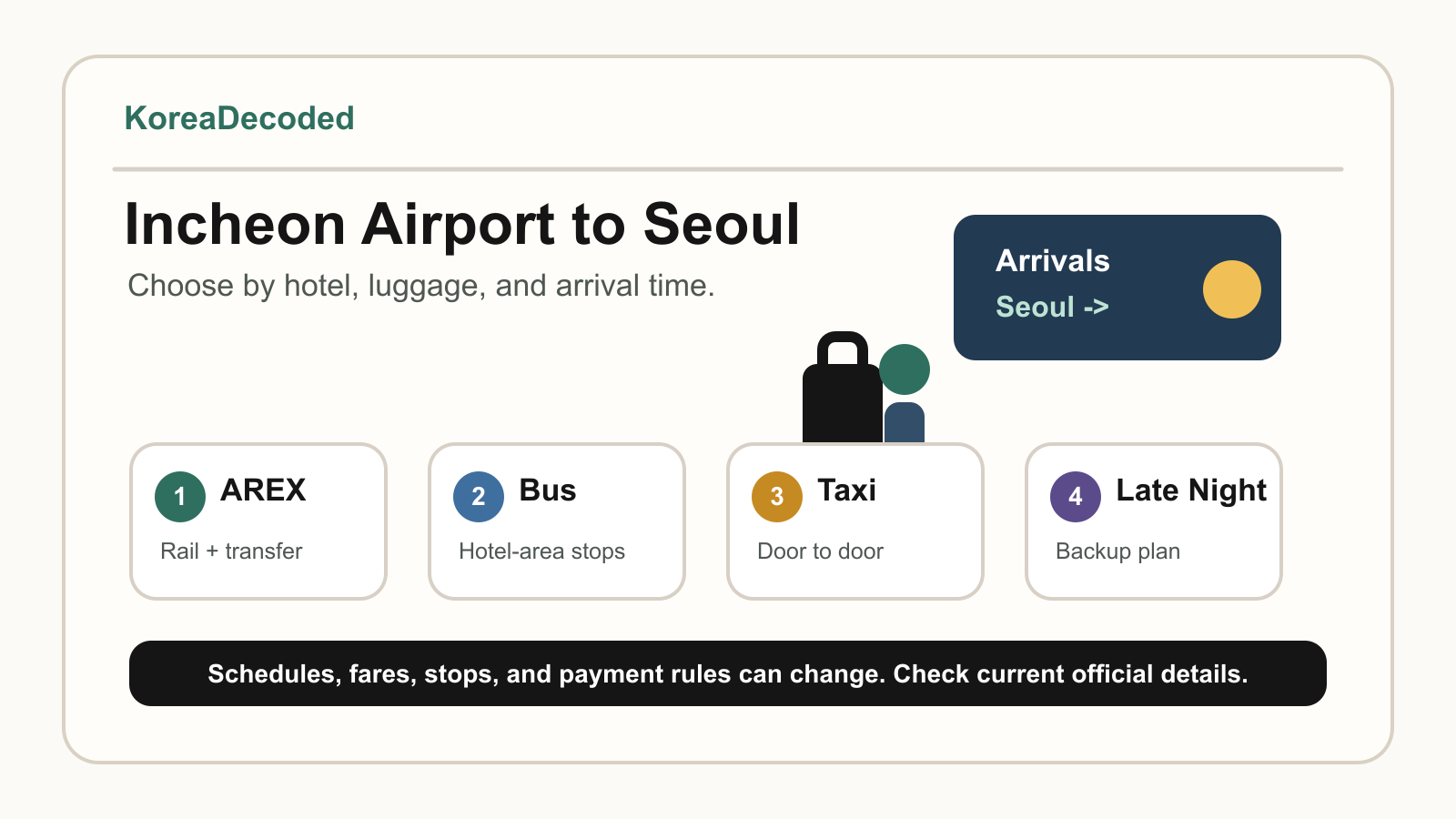
Quick answer: the easiest way from Incheon Airport to Seoul depends less on the airport and more on your hotel area, luggage, arrival time, and tolerance for transfers. Use AREX or the Airport Railroad if Seoul Station or a simple subway connection makes sense. Use an airport limousine bus if it stops close to your hotel area. Use a taxi or private transfer if you are arriving late, carrying too much luggage, traveling with family, or simply too tired to solve a multi-step route.
There is no single best Incheon Airport to Seoul transfer for every first-time visitor. A solo traveler staying near Seoul Station is solving a different problem from a family landing late at Terminal 2 with three suitcases and a hotel in Gangnam. This guide is built for that tired arrival moment: choose the least stressful option, then verify the current fare, route, stop, and departure before you commit.
Transparency note: this guide does not include paid booking buttons, sponsored rankings, or affiliate transport links. The goal is to help you choose the least stressful option for your actual arrival situation.
Current-information note: airport train schedules, bus routes, late-night departures, taxi surcharge rules, pickup counters, and private transfer terms can change. Use this article for decision logic, then recheck official pages and airport information boards on the day you travel.
Quick Answer: Which Incheon Airport Transfer Should You Choose?
- Choose AREX / Airport Railroad if you have light luggage, are staying near Seoul Station, Hongdae, or another easy rail connection, and do not mind a possible subway or taxi transfer after the airport train.
- Choose an airport limousine bus if the current route stops near your hotel area and the departure timing still works after immigration, baggage claim, and customs.
- Choose a taxi if you want door-to-door convenience, have heavy luggage, are traveling with children or older relatives, or land late enough that public transport becomes awkward.
- Choose a private transfer if you want a prearranged pickup, need a larger vehicle, feel anxious about language or late-night logistics, or are traveling as a group where the convenience may justify the cost.
- Use a late-night fallback if train or bus options no longer fit: check current night buses, taxi stands, prebooked transfer availability, airport hotel or capsule hotel options, or wait for morning service if that is safer and calmer.
If you have not sorted out phone data yet, do that before you leave arrivals. The Korea eSIM guide for tourists and eSIM vs SIM card guide explain the first-hour data decision without turning this airport transfer guide into a phone setup manual.
Incheon Airport to Seoul Decision Table
| Traveler situation | Good starting option | Why it fits | What to check before you commit |
|---|---|---|---|
| Light luggage, staying near Seoul Station | AREX / Airport Railroad | Predictable rail route and a clear city arrival point | Current train type, departure time, ticket rules, and your last-mile route from Seoul Station |
| Staying near Hongdae | Airport Railroad or airport bus | Rail can be efficient if your hotel is near a station; bus may work if the stop is closer | Exact hotel location, current stop list, and whether luggage makes a transfer annoying |
| Staying near Myeongdong or City Hall | Airport bus, taxi, or rail plus transfer | Airport buses can reduce station transfers if the stop fits your hotel | Current bus route, stop location, operating time, and walking distance with bags |
| Staying in Gangnam, COEX, or Jamsil | Airport bus, taxi, or private transfer | These areas are not solved by simply reaching Seoul Station | Traffic, current bus route, final stop, and whether a door-to-door ride is worth it |
| Family, group, mobility needs, or several suitcases | Taxi or private transfer | Door-to-door travel avoids platform, elevator, and transfer stress | Vehicle size, luggage capacity, current fare or booking terms, and pickup point |
| Budget-focused solo traveler | Airport Railroad or airport bus | Public transport can be cost-effective when the route fits | Fare on the current official page, transfer burden, and whether your arrival time still works |
| Late-night arrival | Late-night bus if it fits, taxi, private transfer, airport hotel, or waiting plan | You need a backup before you miss the practical public transport window | Current last departures, terminal differences, surcharge rules, hotel/capsule availability, and fatigue level |
| Nervous first-time visitor | Airport bus, taxi, or private transfer | Fewer transfers can be worth more than saving a little time or money | Hotel address in Korean, official taxi stand location, route stop, and payment backup |
If you are still deciding where to stay, compare the practical area trade-offs in the Hongdae, Myeongdong, and Gangnam guide. For fan-trip lodging logic, use the where to stay in Seoul guide.
Option 1: AREX / Airport Railroad
When AREX is the easiest choice
AREX, often described as the Airport Railroad, is a strong first option when you want a predictable rail route into Seoul and your onward path is simple. It is especially useful if you are staying near Seoul Station, transferring to a nearby subway line, or heading toward an area where the airport rail route lines up naturally with your hotel.
The appeal is predictability. Trains avoid road traffic, the route is visible, and you do not have to explain a destination to a driver. Incheon Airport’s official train page points travelers to the Airport Railroad for current fare and schedule details, and both Terminal 1 and Terminal 2 have airport railroad access through the transport center level.
When AREX becomes annoying
AREX is not automatically the easiest way to every Seoul hotel. “Arrive at Seoul Station” and “arrive at your hotel lobby” are not the same thing. Seoul Station can be busy, elevators may not be exactly where you want them, and a technically short subway transfer can feel much longer with a large suitcase after a transpacific flight.
If your hotel is in Gangnam, Jamsil, deep Myeongdong, or a side street far from a station exit, compare the last mile honestly. The Seoul subway guide for first-time visitors is useful if your AREX plan includes a subway transfer after Seoul Station or Hongik University.
What to verify before choosing AREX
- Whether the Express Train or All Stop Train fits your destination and timing.
- Current fare, ticketing method, and payment options on the official Airport Railroad page.
- Current first and last trains from your terminal, especially for late arrivals.
- Your route after Seoul Station, Hongik University, or another transfer point.
- Whether you are willing to manage stairs, elevators, station walking, and a possible crowded train with luggage.
Option 2: Airport Limousine Bus
When the airport bus is better than the train
An airport limousine bus can be the calmer choice when it stops near your hotel area. You put luggage under the bus, sit down, and avoid dragging bags through large stations. For many Myeongdong, City Hall, Dongdaemun, Gangnam, COEX, or Jamsil stays, a well-matched bus route may be less stressful than a rail route that requires several transfers.
The catch is that airport buses are route-specific. A bus number that works beautifully for one hotel may be useless for another hotel in the same general neighborhood. Search by your exact hotel address or nearest landmark, not just by “Seoul” or “Myeongdong.”
Why arrival timing matters
Do not reserve or plan a bus as if you will be curbside the minute the plane lands. Incheon Airport’s bus information warns travelers to account for arrival procedures and immigration time when planning public transport after landing. Immigration, baggage, customs, terminal walking, and a bathroom stop can easily change the transfer that feels practical on paper.
What to verify before choosing the airport bus
- The current route number, stop list, and destination direction on Incheon Airport’s bus search or operator page.
- Whether your stop is actually near the hotel entrance, not just in the same neighborhood.
- Current fare, ticketing method, and where to buy or reserve a ticket at your terminal.
- Departure bay, terminal sequence, and whether Terminal 1 and Terminal 2 times differ.
- Whether the bus is still operating after your realistic post-immigration arrival time.
If your route includes regular subway use after the airport day, read the T-money card guide. Payment rules vary by transport type and ticket method, so do not assume one card works for every airport train, bus, taxi, and booking flow.
Option 3: Taxi from Incheon Airport to Seoul
When a taxi is worth considering
A taxi is worth considering when the main problem is not price optimization but getting from arrivals to your hotel without more decisions. Families, travelers with heavy luggage, older travelers, people with mobility concerns, and late-night arrivals may all reasonably choose a taxi even when public transport exists.
The trade-off is cost and uncertainty. Traffic can change the ride time. Late-night rules can change the fare. Taxi categories can differ. You should also be ready with your hotel name and address in Korean, plus the phone number if your hotel lists one.
Use official taxi stands
Incheon Airport’s taxi and call van page warns travelers to use designated taxi stands and be cautious about illegal call-van solicitation or unfair fare cases. That warning is worth taking seriously. After a long flight, a confident stranger offering a ride can sound convenient; the calmer move is to follow airport signs and use official taxi areas.
How to reduce taxi confusion before getting in
- Save your hotel name, street address, and phone number in Korean and English.
- Check the current official taxi guidance and airport taxi stand information before leaving arrivals.
- Confirm your destination area out loud or by showing the address before loading luggage.
- Keep a payment backup, because payment flows and card acceptance should not be treated as universal.
- Expect tolls, traffic, and late-night surcharge rules to need current verification.
Option 4: Private Transfer or Airport Pickup
Who should consider booking ahead
A private transfer is not necessary for every visitor. It can make sense if you land late, travel with children, carry sports gear or several suitcases, need a larger vehicle, have accessibility needs, or know you will be too tired to handle rail or bus decisions after landing.
For a group of three to five people, the difference between public transport and a private pickup may be less dramatic than it looks when compared per person. Still, private transfer listings are commercial products, not official transport evidence. Compare terms carefully instead of treating a marketplace badge as proof that it is the best option.
How to compare private transfer listings safely
- Check the exact pickup meeting point for Terminal 1 or Terminal 2.
- Confirm included waiting time after flight arrival and what happens after delays.
- Match vehicle size to passengers and luggage, not just passenger count.
- Read cancellation rules, child seat terms, nighttime surcharges, and contact method.
- Do not book a listing that hides the operator, route conditions, or important extra fees.
Late-Night Arrival Fallbacks
Do not build your plan around a vague “last train”
Late-night arrivals are where airport transfer advice gets dangerous if it overpromises. Do not rely on a random screenshot, old blog post, or remembered last-train time. Check the current Airport Railroad schedule, Incheon Airport late-night bus pages, and airport information boards after you know your actual landing time and terminal.
Terminal matters. Terminal 2 and Terminal 1 can have different sequences and departure times, and a route that works from one terminal may not feel the same from the other. Your plane arrival time is also not your curbside-ready time.
A simple late-night decision order
- Check whether your intended train or airport bus is still realistic after immigration and baggage claim.
- If a late-night bus exists, confirm that its current stop is useful for your hotel area, not merely somewhere in Seoul.
- If public transport no longer fits, compare official taxi stand access with a prearranged transfer if you have one.
- If you are exhausted, traveling alone, or uncomfortable crossing the city late, check airport hotel, capsule hotel, or rest options before forcing a bad city transfer.
- If budget is tight and you feel safe waiting, consider waiting for morning service in an appropriate airport area rather than taking a ride you do not understand.
Late-night fallback checklist
- Current last train and bus information from official sources.
- Current late-night bus route list and stop locations from Incheon Airport.
- Taxi stand location and current surcharge guidance.
- Hotel front desk hours or self-check-in instructions.
- Battery level, mobile data, and saved hotel address in Korean.
First-Hour Arrival Checklist
- Connect to airport Wi-Fi or activate your Korea data plan before leaving arrivals.
- Confirm whether you arrived at Terminal 1 or Terminal 2.
- Save your hotel address in Korean and English, plus the phone number.
- Check your hotel area’s nearest station, airport bus stop, or major landmark.
- Decide how much walking and transferring is realistic with your actual luggage.
- Check official train, bus, or taxi pages instead of relying on old screenshots.
- Keep one payment backup: credit card, debit card, cash, or a transit card plan depending on the option you choose.
- Take a screenshot of your chosen route before your phone battery drops.
- If buying or using a transport card, read the T-money card guide before assuming it applies to every airport transfer method.
- If your suitcase is already annoying at baggage claim, be honest: a slightly more expensive door-to-door option may be the better first-night decision.
For packing and arrival prep, the first Korea trip packing checklist is a useful companion. Keep battery, luggage weight, medication, documents, and offline screenshots in the same mental category as transport: boring until they save your first night.
Common Mistakes First-Time Visitors Make
Choosing AREX without thinking about the last mile
AREX can be efficient, but only if the route after the airport train is reasonable. A cheap, fast airport train can become a frustrating first night if it ends with a confusing station transfer and a long walk to the hotel.
Choosing a bus without checking the stop location
“Bus to Myeongdong” or “bus to Gangnam” is not specific enough. Check the current stop list and map the stop to your exact hotel entrance. A stop that looks close on a neighborhood name can be a rough walk with luggage.
Assuming late-night service will be easy
Late-night transport exists in some forms, but it is limited and route-dependent. Build a backup plan before the flight lands. The wrong moment to start researching airport hotels, taxi stands, and night buses is after you have missed the last practical train.
Ignoring luggage and stairs
Travel forums often compare routes as if everyone carries one backpack. Suitcases change the answer. A transfer with elevators and flat walking is different from a transfer with stairs, crowds, and a long underground corridor.
Trusting old fares, screenshots, or bus numbers
Airport transport details change. Use old posts and videos only for orientation, then verify the current official page, airport board, or staffed counter before spending money or walking to a stop.
FAQ
What is the easiest way from Incheon Airport to Seoul?
The easiest option depends on your hotel area, luggage, arrival time, and comfort level. AREX is straightforward for Seoul Station access, airport buses can be easier for hotel-area stops, and taxis or private transfers are often simpler with heavy luggage or late arrivals.
Is AREX better than the airport bus from Incheon Airport?
AREX may be better if you want a predictable rail route and can handle the onward transfer from Seoul Station or another rail stop. An airport bus may be better if it stops close to your hotel and is operating when you arrive.
Should I take a taxi from Incheon Airport to Seoul?
A taxi can make sense if you have heavy luggage, are traveling as a family or group, arrive late, or want door-to-door convenience. Check current fare guidance, late-night surcharge rules, tolls, and your hotel address before leaving the airport.
What if I land late at night at Incheon Airport?
Check current train and bus departures before assuming they are available. If public transport no longer fits, compare taxi, prebooked transfer, airport hotel or capsule hotel, or waiting for morning service based on safety, budget, and fatigue.
Can I use T-money or a credit card for airport transport?
Payment options vary by transport type and ticket method. T-money is useful for many public transit situations in Korea, but airport railroad tickets, buses, taxis, and private transfers may each have different payment flows. Check the current official instructions before boarding or booking.
What is the best way from Incheon Airport to Myeongdong, Hongdae, or Gangnam?
The best option depends on your exact hotel location, not just the neighborhood name. Compare whether AREX plus subway, an airport bus stop, taxi, or private transfer gives you the least stressful final mile.
Do I need to book an Incheon Airport transfer before arriving?
Most travelers do not need to book every transfer in advance, but prebooking can reduce stress for late arrivals, families, groups, travelers with large luggage, or anyone who does not want to navigate after a long flight.
Sources Checked
- Incheon Airport official English site for the airport transport entry point and current traveler information.
- Incheon Airport airport railroad page for terminal railroad access context and official direction to Airport Railroad details.
- Incheon Airport bus stop and ticketing information for bus counter context and arrival-time caution.
- Incheon Airport bus route search page for current bus route verification.
- Incheon Airport taxi and call van page for official taxi stand and solicitation warning context.
- Incheon Airport Terminal 1 late-night bus page and Terminal 2 late-night bus page for late-night route verification.
- Airport Railroad official site and Airport Railroad passenger-facing site for current fare, schedule, train type, and ticketing checks.
- International Taxi official site for airport-Seoul taxi service context that should be rechecked before quoting any fare or reservation detail.