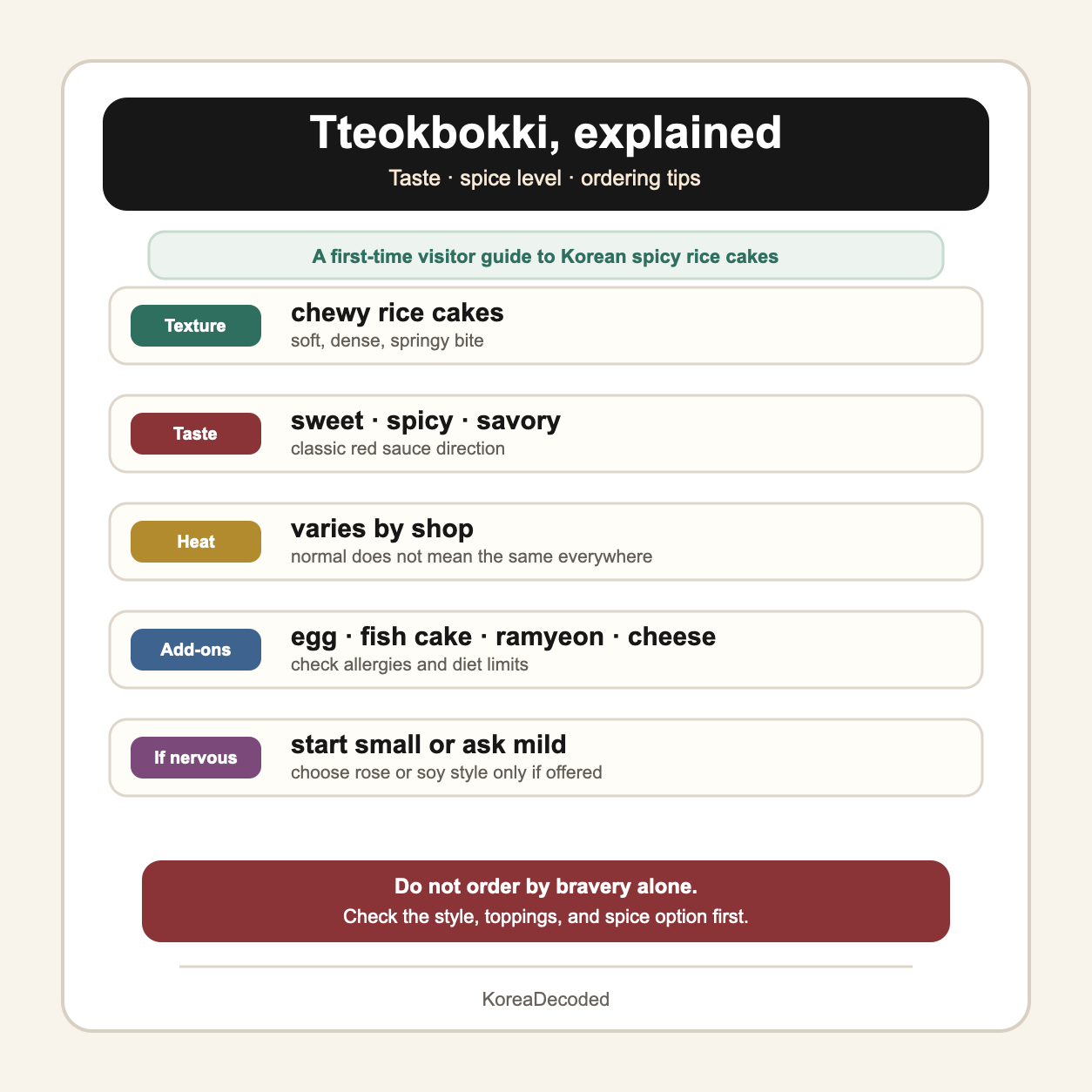
Short answer: tteokbokki is chewy Korean rice cakes in a sauce that is usually sweet, spicy, and savory. It is famous for a reason, but the heat level is not standardized. One shop’s “normal” can feel easy, while another shop’s normal can feel aggressive.
If you are trying it for the first time in Korea, do not only ask, “Is it spicy?” Ask what style it is, what add-ons are inside, and whether a milder option is actually available. That small shift saves a lot of regret.
What does tteokbokki taste like?
The main thing to expect is chew. The rice cakes are dense, springy, and soft when cooked well. They are not crispy like fried snacks and not fluffy like bread. The pleasure is in the bounce.
The classic red version usually tastes sweet, spicy, and savory at the same time. The sauce often has a gochujang-style red chili paste direction, but the exact flavor depends on the shop. Some versions are soupy and glossy. Some are thicker and more concentrated. Some are almost snack-like; others feel like a full meal.
How spicy is tteokbokki?
It varies. This is the part visitors should take seriously.
Classic red tteokbokki is usually at least mildly spicy, but there is no universal spice scale. A school-snack style shop, a market stall, a delivery brand, and a trendy restaurant can all make very different versions. Sweetness can hide the heat at first, then the spice builds after a few bites.
If you know you are sensitive to spice, treat tteokbokki like a “try a few bites first” food. Do not order the biggest portion first, and do not assume cheese automatically makes it safe.
Common tteokbokki styles
| Style | What to expect | First-time visitor note |
|---|---|---|
| Classic red tteokbokki | Chewy rice cakes in a sweet-spicy red sauce. | The default mental image. Heat varies by shop. |
| Gungmul tteokbokki | A soupier version with more sauce or broth. | Good if you like dipping fried snacks into the sauce. |
| Gireum tteokbokki | Oil-fried or less saucy style. | Less common for visitors than the red saucy version. |
| Rose or cream tteokbokki | Red sauce softened with cream or a rose-pasta style sauce. | Often milder, but not guaranteed. It can still be spicy. |
| Cheese tteokbokki | Tteokbokki topped with or mixed with cheese. | Creamier and richer, but the base sauce may still be hot. |
| Rabokki | Tteokbokki with ramyeon noodles added. | Feels more filling. Great if you want a snack-meal. |
| Jeukseok tteokbokki | Cooked at the table like a hot pot. | More of a sit-down shared meal than a quick snack. |
| Gungjung / soy sauce style | Brown soy-sauce direction instead of red chili sauce. | A better lead if you want non-red, less spicy tteokbokki, when offered. |
The important phrase is “when offered.” Not every restaurant has every style. A small street stall may only sell one red version. A dedicated tteokbokki restaurant may have many sauces, toppings, spice levels, and noodle choices.
Common add-ons
| Add-on | Korean clue | What it does | Watch out for |
|---|---|---|---|
| Fish cake | eomuk / odeng | Adds soft, savory pieces to the sauce. | Not vegetarian; seafood/fish allergy risk. |
| Boiled egg | gyeran | Balances the sauce and makes it more filling. | Egg allergy risk. |
| Ramyeon noodles | ramyeon | Turns it into rabokki-style snack-meal. | Wheat/gluten and seasoning risks. |
| Dumplings | mandu | Adds fried or boiled dumpling texture. | Filling can include pork, vegetables, seafood, or mixed ingredients. |
| Cheese | chijeu | Adds creamy, salty richness. | Dairy risk; does not always remove the spice. |
| Scallions | pa | Adds onion-like freshness. | Usually minor, but visible in many versions. |
Allergy and diet note: do not judge tteokbokki only by appearance. Even if you see only rice cakes and red sauce, the broth, sauce, fish cakes, toppings, or side items may include ingredients you cannot see.
How to order if you are nervous about spice
Start with the menu, not the bravery test. Look for words like rose, cream, cheese, or soy sauce style if the shop offers them. Then ask whether it can be made less spicy.
A simple phrase is:
An maepge hae juseyo.
Please make it not spicy / less spicy.
But use that phrase with realistic expectations. Some tteokbokki sauce is already prepared, so staff may not be able to change it much. If the shop sells fixed batches, choosing a different style is safer than asking for a custom spice level.
A safe first order
For a first try, choose a smaller portion or share one order. Add a boiled egg if available. If you are very spice-sensitive, look for rose/cream or soy-sauce style before classic red sauce. If you want it to feel like a meal, rabokki is more filling because of the noodles.
If you are ordering at a street stall, do not overcomplicate it. Point, order one portion, and try it slowly. If you are in a sit-down tteokbokki restaurant, take more time with the toppings and spice options because the portion may be larger and shared.
What not to assume
- Do not assume red sauce means the same spice level everywhere. It changes by shop.
- Do not assume rose tteokbokki is always mild. It can still have heat.
- Do not assume cheese solves spice. It softens the bite for some people but does not erase the sauce.
- Do not assume it is vegetarian. Fish cake, broth, seafood, or meat-based add-ons may be involved.
- Do not assume one order is one person’s meal. Some versions are snack portions; others are shared pot meals.
Useful next links
If you want to keep building food confidence, read Korean street food terms for travelers, how to order Korean street food without speaking Korean, and how to read a Korean restaurant menu.
For sit-down meals after street food, continue with Korean restaurant phrases for travelers, Korean shared dishes explained, what to eat in Hongdae on your first night, and Korean cold noodles explained.
Sources checked
- Tteokbokki overview, checked on 2026-06-12 for common ingredients, gochujang/soy-sauce style distinction, snack-bar/street-stall context, and variation names. Used cautiously as cross-checking, not as the basis for origin claims.
- Rabokki overview, checked on 2026-06-12 for the ramyeon-plus-tteokbokki meaning and common snack-bar framing.
- Bon Appetit tteokbokki recipe note, checked on 2026-06-12 for English-language taste/texture framing around chewy rice cakes and gochujang-based sauce.
- Epicurious tteokbokki recipe note, checked on 2026-06-12 for cross-checking rice cake texture, sauce, and optional fish cake framing.
- The Guardian Korean dishes roundup, checked on 2026-06-12 as recent international-interest context for tteokbokki as chewy rice cakes in spicy sauce.