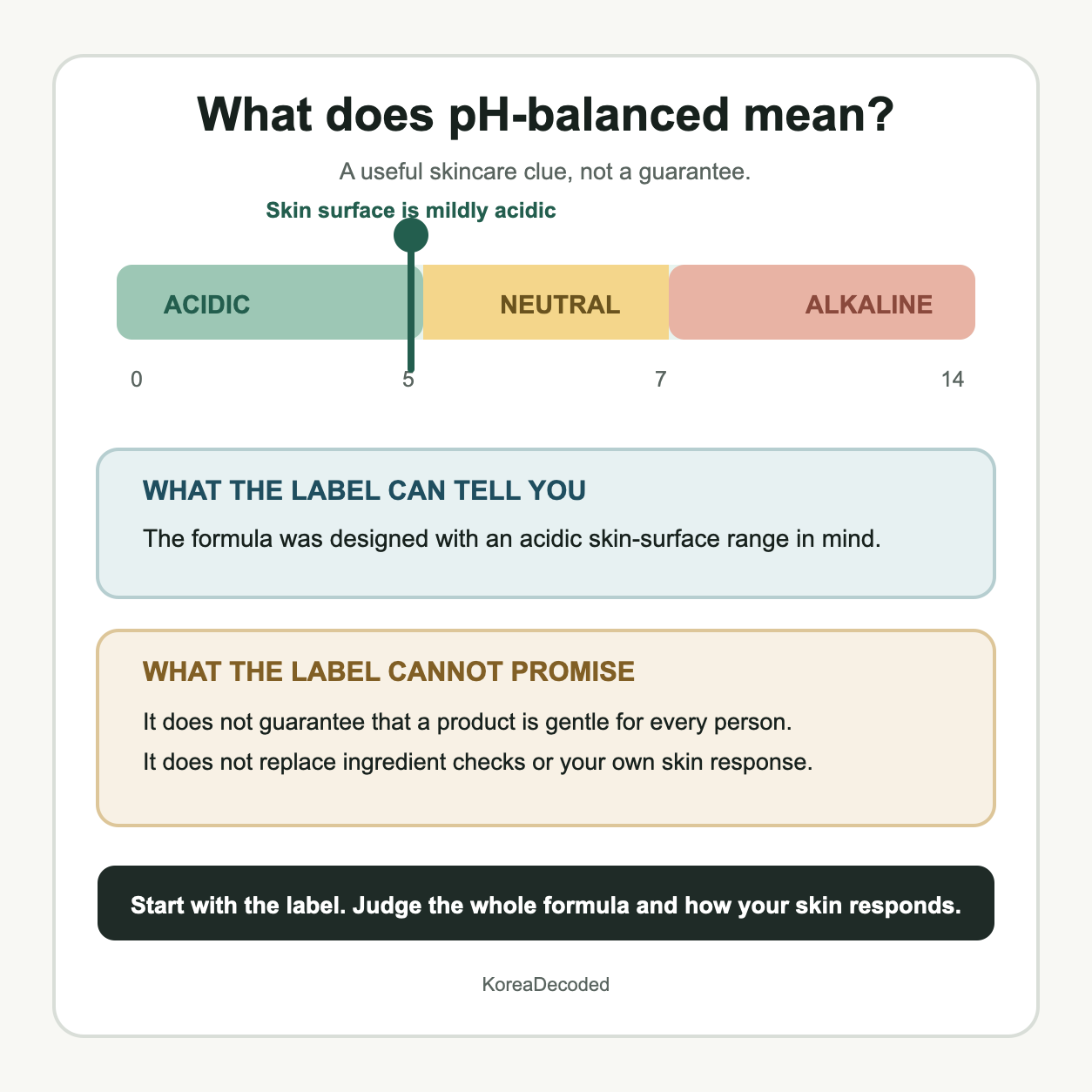
If you shop for Korean skincare, especially cleansers, you will quickly see phrases such as low pH, slightly acidic, and pH-balanced. They sound scientific, but the useful takeaway is simple: the product was designed with the skin’s mildly acidic surface in mind.
That can be a helpful clue. It is not a guarantee that the product will be gentle, non-irritating, or right for every person.
The short answer
| Label phrase | Useful reading | Do not assume |
|---|---|---|
| Low pH | The formula is on the acidic side of the pH scale | Lower is always better |
| Slightly acidic | The product is designed around an acidic range rather than an alkaline one | Every person’s skin needs one exact number |
| pH-balanced | The brand is signaling compatibility with the skin’s mildly acidic surface | The label guarantees a perfect match for your skin |
A practical beginner rule: treat pH wording as one filter when comparing products. Then look at the product type, directions, ingredient list, and how your skin actually responds.
What is pH?
pH is a scale used to describe how acidic or alkaline something is. A pH of 7 is neutral. Numbers below 7 are acidic, while numbers above 7 are alkaline.
Skin surface is generally mildly acidic, but do not turn that into one magic shopping number. A multicentre study of 330 people by Lambers and colleagues found that forearm skin surface pH dropped after participants avoided showering and cosmetic products for 24 hours. The paper estimated a natural average around 4.7 and also described a broader acidic range in the literature.
The useful lesson is not that everyone must buy a product labeled exactly 4.7 or 5.5. It is that skin surface is not neutral or strongly alkaline, and cleanser formulation can matter.
Why do cleanser labels mention pH so often?
Cleansing is where beginners are most likely to notice the term because washing changes what touches the skin surface. DermNet explains that traditional soap and synthetic detergents, often called syndets, are not the same thing. Compared with soap, syndets can be adjusted to the normal skin pH of 5.5.
That does not mean every soap is automatically bad or every low-pH cleanser is automatically perfect. It means pH wording is a reasonable clue when you are comparing daily cleansers and trying to avoid an aggressively stripped feeling.
How Korean brands use the wording
COSRX describes its Low pH Good Morning Gel Cleanser as a gel cleanser with a mildly acidic pH level. Beauty of Joseon describes its Green Plum Refreshing Cleanser as pH-friendly, slightly acidic, and pH-balanced.
These are useful examples of the label language you will encounter. They are not universal recommendations. A formula can still feel drying, irritating, or simply unhelpful for a particular person even when the front of the package sounds reassuring.
What pH-balanced does not guarantee
- It does not prove that the product is fragrance-free.
- It does not prove that the product will never irritate sensitive skin.
- It does not tell you whether you will like the texture or cleansing strength.
- It does not replace a patch test or a dermatologist’s advice for persistent skin problems.
FDA says cosmetic labeling claims do not require FDA approval before products go to market, and FDA does not maintain a list of approved or accepted cosmetic claims. Claims still need to be truthful and not misleading. For a shopper, that means a phrase such as pH-balanced is information to interpret, not an official approval badge.
A simple way to shop
- Start with the product category. A daily water-based cleanser is a clearer place to use pH wording than an optional first-cleanser step.
- Read the directions. A good product still needs to fit the routine you will actually follow.
- Use low-pH or pH-balanced wording as one useful clue, not the only reason to buy.
- Stop and reassess if a new product causes persistent tightness, irritation, or breakouts.
Where this fits in a beginner routine
If you are still choosing your cleansing steps, compare cleansing oil vs cleansing balm first. Then use the beginner Korean skincare routine to keep the full order simple. You can also choose a moisturizer for your skin type and compare toner vs essence without treating every label as another mandatory step.
Sources checked
- Lambers et al.: Natural skin surface pH is on average below 5
- DermNet: Soaps and cleansers
- FDA: Cosmetics Labeling Claims
- COSRX: Low pH Good Morning Gel Cleanser official store
- Beauty of Joseon: Green Plum Refreshing Cleanser official store
For in-store questions, use the Korean shopping phrases guide alongside this pH-balanced skincare explanation.