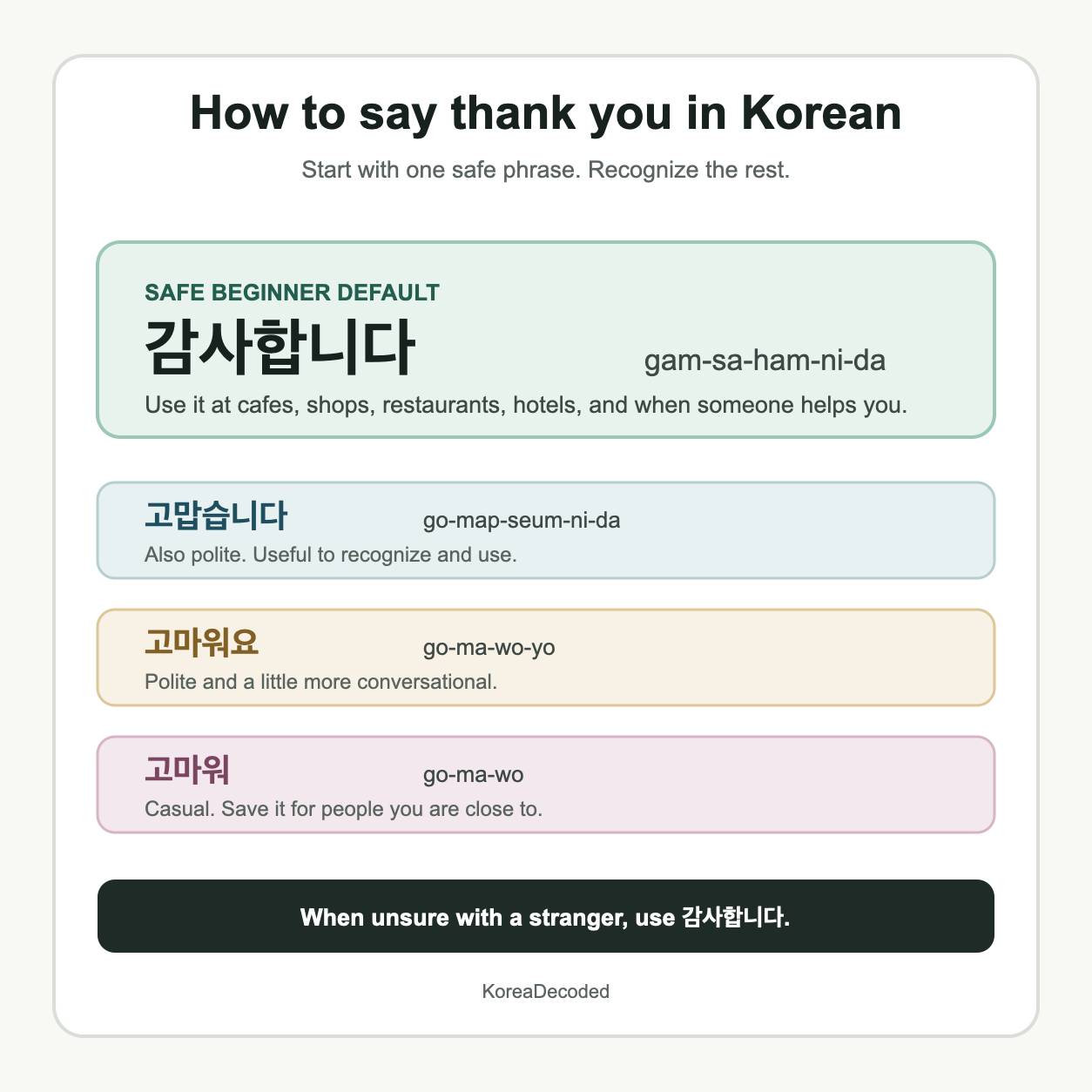
If you learn only one Korean thank-you phrase before a trip, make it 감사합니다 (gam-sa-ham-ni-da). It is polite, widely useful, and safe for the everyday moments travelers actually encounter: a cafe order, a hotel check-in, a restaurant meal, or help with directions.
You will also hear 고맙습니다, 고마워요, and 고마워. They are worth recognizing, but you do not need to memorize a complicated social chart before you can thank someone naturally.
The short answer
| Phrase | Simple reading | Beginner use |
|---|---|---|
| 감사합니다 | gam-sa-ham-ni-da | Safest public default for travelers |
| 고맙습니다 | go-map-sseum-ni-da | Also polite and useful |
| 고마워요 | go-ma-wo-yo | Polite, softer, more conversational |
| 고마워 | go-ma-wo | Casual; use with people you are close to |
The romanization is only a memory aid. The National Institute of Korean Language records 고맙습니다 as [고ː맙씀니다], which is why the simple reading above uses sseum rather than seum. Use the official dictionary entry and audio when you want to hear it, and do not wait for perfect pronunciation before thanking someone.
Start with 감사합니다
The National Institute of Korean Language Korean-English Learners’ Dictionary lists 감사하다 as “thankful; grateful” and includes the form 감사합니다. Talk To Me In Korean also teaches 감사합니다 in its first beginner lesson alongside 안녕하세요.
For a traveler, this is the cleanest default. Use it after staff hand you a drink, when someone points you toward the correct subway exit, or when a restaurant worker helps you with a kiosk.
What about 고맙습니다?
고맙습니다 is also a polite thank-you. The learners’ dictionary entry for 고맙다 describes feeling pleased and wanting to return a favor because someone did something for you. Its examples include polite forms such as 고맙습니다 and 고마워요.
You do not need to avoid 고맙습니다. It is useful, natural, and polite. For a beginner who wants one phrase to recall quickly under pressure, 감사합니다 remains an easy public default.
When 고마워요 feels natural
고마워요 is polite but more conversational. You may hear it when the situation feels warmer or less formal. It is a useful phrase to recognize and a reasonable phrase to use when you want a softer everyday tone.
Do not turn this into a rigid rule. Korean speech level choices depend on relationship, setting, age, and tone. The practical point is simply that 고마워요 is polite, while the shorter 고마워 is casual.
Save 고마워 for familiar relationships
고마워 drops the polite ending. It fits friends, close relationships, and casual contexts where that speech level makes sense. It is not the best default for a stranger helping you at a station or a staff member serving you at a shop.
Real travel situations
| Situation | Easy phrase |
|---|---|
| A cafe worker hands you your drink | 감사합니다 |
| Someone helps you find a subway exit | 감사합니다 |
| A hotel employee answers a question | 감사합니다 |
| A Korean friend helps you plan dinner | 고마워요 or 고마워, depending on your relationship |
What should you say after someone thanks you?
You do not need a perfect scripted response. A smile and a small nod are often enough in a quick service interaction. If you want a polite verbal response, 아니에요 (a-ni-e-yo, roughly “not at all”) is a useful beginner option.
Avoid treating this as the only possible reply. Natural responses change with context, and sometimes no verbal response is needed.
Use it with the phrases you already know
Start with the basic Korean greetings travelers should actually use. Then try 감사합니다 during a cafe order, after ordering street food without fluent Korean, or when staff help you with a restaurant waitlist. If the moment is not thanks but a small mistake, use the companion guide to saying sorry in Korean.
Two 15-second thank-you flows
At a cafe: staff may say 주문하신 음료 나왔습니다 (“Your drink is ready”). Take the drink, answer 네, 감사합니다, and clear the pickup area. The thank-you comes after you receive the item; no longer sentence is needed.
After asking for directions: a helper may say 3번 출구로 나가세요 (“Use exit 3”). Confirm with 네, then finish with 감사합니다. If the person walks with you or checks the route again, thank them once more when the help is complete.
These flows show where the phrase belongs in an interaction: after the useful action or answer. Say it once clearly, add a small nod when appropriate, and let the other person continue.
Sources checked
- National Institute of Korean Language Korean-English Learners’ Dictionary: 감사하다
- National Institute of Korean Language Korean-English Learners’ Dictionary: 고맙다 and 고맙습니다 pronunciation
- Talk To Me In Korean: first lesson, hello and thank you
In stores, pair a simple thank-you with the Korean shopping phrase guide for receipt, bag, and gift-wrap moments.