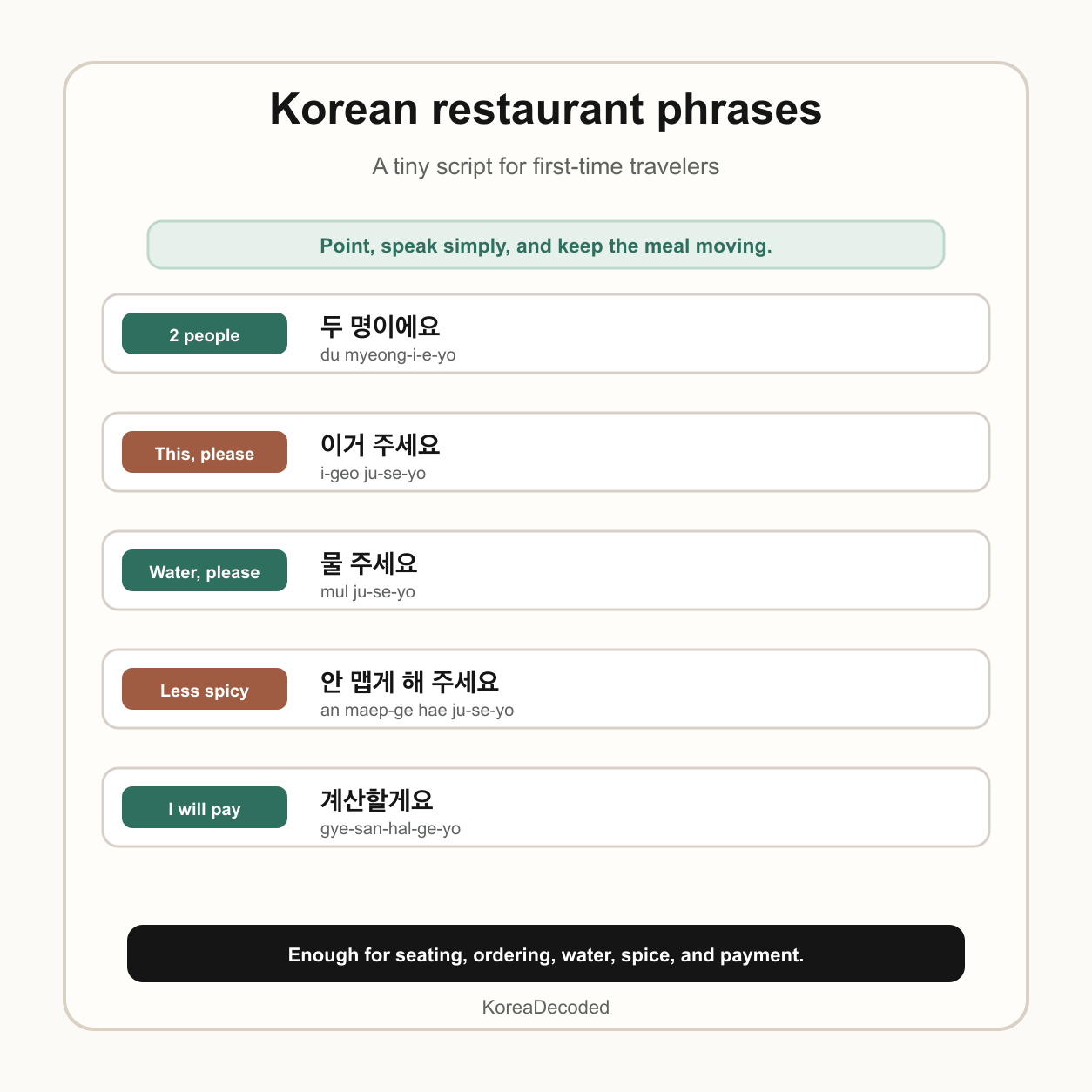
If you learn only a few Korean restaurant phrases before your trip, make them practical. You do not need to sound fluent. You need to get seated, point at the menu, ask for water, handle spice, and pay without freezing.
This guide is for sit-down restaurants, not food stalls or cafe drink orders. For those situations, use the street-food ordering guide and the Korea cafe ordering guide.
The short answer
| Moment | Phrase | Simple reading | Meaning |
|---|---|---|---|
| Party size | 두 명이에요 | du myeong-i-e-yo | We are two people |
| Get attention | 저기요 | jeo-gi-yo | Excuse me |
| Point at a menu item | 이거 주세요 | i-geo ju-se-yo | This, please |
| Order two | 이거 두 개 주세요 | i-geo du gae ju-se-yo | Two of this, please |
| Ask for water | 물 주세요 | mul ju-se-yo | Water, please |
| Ask for more side dishes | 반찬 더 주세요 | ban-chan deo ju-se-yo | More side dishes, please |
| Less spicy | 안 맵게 해 주세요 | an maep-ge hae ju-se-yo | Please make it not spicy |
| Pay | 계산할게요 | gye-san-hal-ge-yo | I will pay / please check me out |
The romanization is only a memory aid. If staff answer quickly in Korean, you can still point, show the menu, use a translation app, or smile and repeat the key word.
Start before you order: 두 명이에요
When staff ask how many people are in your group, you can answer with a number plus 명이에요. For two people, say 두 명이에요. For one person, 한 명이에요 works. For three, 세 명이에요.
If this feels like too much, hold up fingers and say the number. The phrase is useful, but clear communication matters more than perfect Korean.
Use 저기요 when you need attention
저기요 is a useful attention-getter, similar to “excuse me.” Use it softly before a request: 저기요, 물 주세요.
Do not overthink whether every restaurant expects the same style. Some places have table bells, tablets, counter ordering, or self-service stations. If there is a call button, press it. If staff are nearby, 저기요 is a useful fallback.
The phrase that does most of the work: 이거 주세요
이거 주세요 means “this, please.” It is the most useful restaurant phrase for travelers because you can point to a menu item, photo, or display. You do not need to pronounce the dish name perfectly.
To order two of something, say 이거 두 개 주세요. If you are ordering a dish that is normally counted by servings, staff may phrase it differently, but travelers can still use this as a simple starting point while pointing.
Ask for water or more banchan
For water, use 물 주세요. Some restaurants are self-service, so staff may point you to a water station instead of bringing it to the table.
For side dishes, 반찬 더 주세요 means “more side dishes, please.” Many Korean meals include banchan, but refill rules and self-service setups vary. Ask politely and follow what the restaurant does.
If you worry about spice
안 맵게 해 주세요 means “please make it not spicy.” This is useful, but it is not magic. Some dishes are spicy by design and cannot be changed much.
If spice is a serious problem for you, show the phrase on your phone and choose dishes that are not built around red pepper paste, chili oil, or spicy broth. A phrase helps, but menu choice matters too.
How to pay
계산할게요 is a simple way to signal that you are ready to pay. In many casual restaurants you pay at the front counter, not necessarily at the table. If staff point toward the register, follow them.
You may also hear or see 계산서, meaning a bill or check. For a beginner, do not worry about mastering every payment phrase. Stand up, take your card, and say 계산할게요 at the counter if needed.
A simple restaurant script
- At the entrance: 두 명이에요.
- When ready: press the bell or say 저기요.
- Point at the menu: 이거 주세요.
- If needed: 물 주세요 or 반찬 더 주세요.
- If spice matters: 안 맵게 해 주세요.
- After the meal: 계산할게요.
Use these with the KoreaDecoded food guides
Start from the basic Korean greetings hub, then add thank you and sorry for small service moments. If you are planning a popular restaurant, read the restaurant waitlist apps guide. If you are eating shared dishes, the shared-dishes guide will help you understand the table setup.
Sources checked
- National Institute of Korean Language Korean-English Learners’ Dictionary
- National Institute of Korean Language learner category search
- National Institute of Korean Language official site
If you are going to a meat restaurant, pair these phrases with the Korean BBQ etiquette guide so you know what to say at the grill.
Before you order, use the Korean restaurant menu words guide with these phrase scripts so the menu and the conversation match.
If you want to ask for a milder option, pair these phrases with the tteokbokki taste and spice guide.