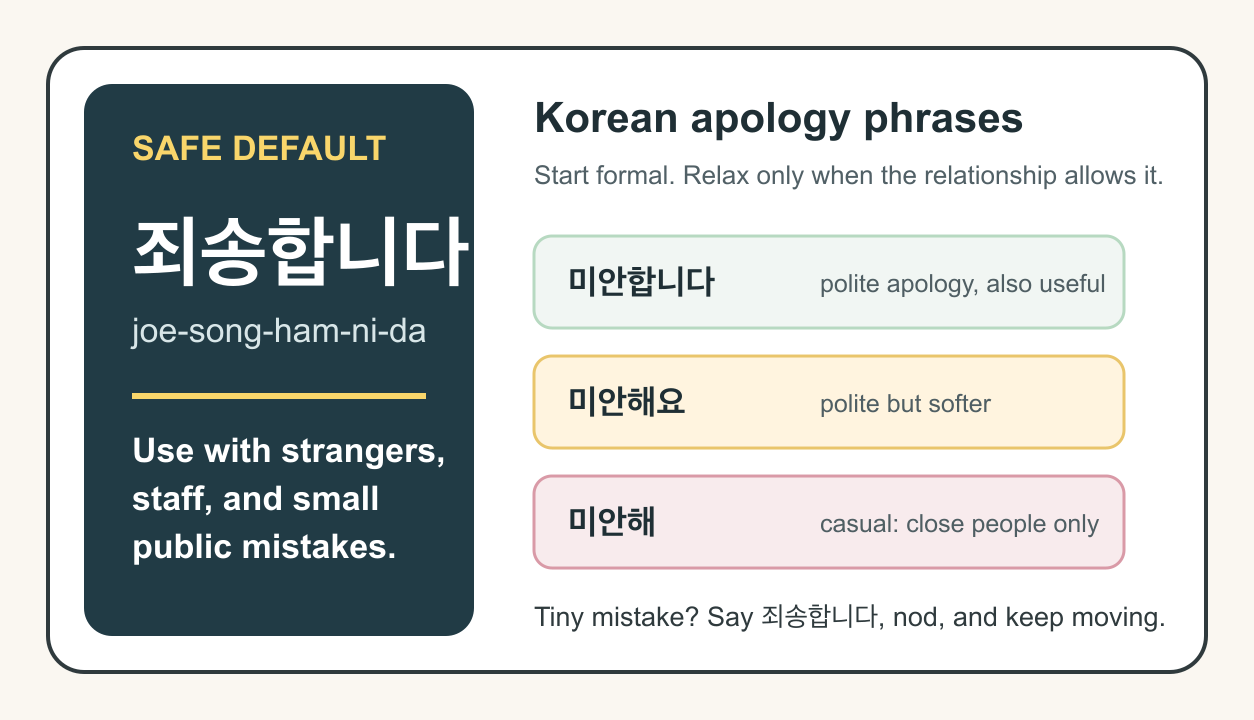
If you learn only one Korean apology phrase before a trip, make it 죄송합니다 (joe-song-ham-ni-da). It is polite, widely useful, and safe when you bump into someone, make a small mistake at a cafe, arrive late, or need to apologize to staff.
You will also hear 미안합니다, 미안해요, and 미안해. They all connect to apology, but they do not feel identical in every situation. For a nervous beginner, the goal is not to master every speech level. The goal is to avoid sounding too casual when the other person is a stranger.
The short answer
| Phrase | Simple reading | Beginner use |
|---|---|---|
| 죄송합니다 | joe-song-ham-ni-da | Safest public apology default |
| 미안합니다 | mi-an-ham-ni-da | Polite apology, also useful |
| 미안해요 | mi-an-hae-yo | Polite, softer, more conversational |
| 미안해 | mi-an-hae | Casual; use with close people |
Romanization is only a memory aid. If pronunciation matters for you, listen to native audio and copy the rhythm, but do not let pronunciation anxiety stop you from being polite.
Start with 죄송합니다
The National Institute of Korean Language Korean-English Learners’ Dictionary defines 죄송하다 as being very sorry, as if one had done something wrong, and includes the form 죄송합니다. Its examples include apologizing to people such as parents, teachers, and elders.
That makes 죄송합니다 a clean public default. Use it when you step on someone’s shoe in a crowded subway, interrupt staff by mistake, or need to say sorry before asking someone to repeat something.
What about 미안합니다?
미안합니다 is also polite. The learners’ dictionary entry for 미안하다 describes feeling uncomfortable and ashamed because one has wronged another person. It is a real apology word, not a fake or childish one.
Still, if you only want one phrase for public travel situations, 죄송합니다 is easier to rely on. It sounds more safely formal when you are talking to a stranger, shop worker, driver, hotel staff member, or older person.
Do not treat 죄송합니다 as just the “honorific 미안해”
A common beginner shortcut is to think that 죄송합니다 is simply the polite version of 미안해. That is too flat. National Institute of Korean Language guidance distinguishes the meanings of 미안하다 and 죄송하다 rather than treating one as a mechanical honorific form of the other.
For travelers, the practical result is simple: you do not need a perfect grammar theory, but you should avoid using the casual form 미안해 with strangers.
When 미안해요 feels natural
미안해요 is polite, but softer and more conversational than 죄송합니다. You may hear it between people who already have a warmer relationship, or in a situation that is polite but not very formal.
If you are unsure, especially with staff or a stranger, use 죄송합니다 first. It is better to sound a little formal than accidentally too casual.
Save 미안해 for close relationships
미안해 drops the polite ending. It can be normal with close friends, family, or people who have already agreed on casual speech. It is not a good default for someone helping you at a station, cafe, restaurant, hotel, or shop.
Real travel situations
| Situation | Easy phrase |
|---|---|
| You bump into someone on the subway | 죄송합니다 |
| You are late for a booking or appointment | 죄송합니다 |
| You interrupt staff by mistake | 죄송합니다 |
| You ask someone to repeat something | 죄송합니다. 다시 한 번 말씀해 주세요. |
| You apologize to a Korean friend | 미안해요 or 미안해, depending on your relationship |
A small apology is enough
In a quick public moment, you usually do not need a long explanation. Say 죄송합니다, make a small nod, and move on. Overexplaining in English can make a tiny accident feel more awkward than it needs to be.
If the problem is bigger, such as a missed reservation, lost item, or serious misunderstanding, use 죄송합니다 first and then explain slowly with a translation app or staff help.
Use it with the phrases you already know
Pair this with basic Korean greetings and how to say thank you in Korean. You can also use 죄송합니다 naturally when ordering coffee in Korea, asking staff for help with a restaurant waitlist, or recovering from a small mistake while ordering food.
Sources checked
- National Institute of Korean Language Korean-English Learners’ Dictionary: 죄송하다
- National Institute of Korean Language Korean-English Learners’ Dictionary: 미안하다
- National Institute of Korean Language Online Q&A: 미안하다 and 죄송하다
- National Institute of Korean Language Online Q&A: usage note on 미안하다 and 죄송하다