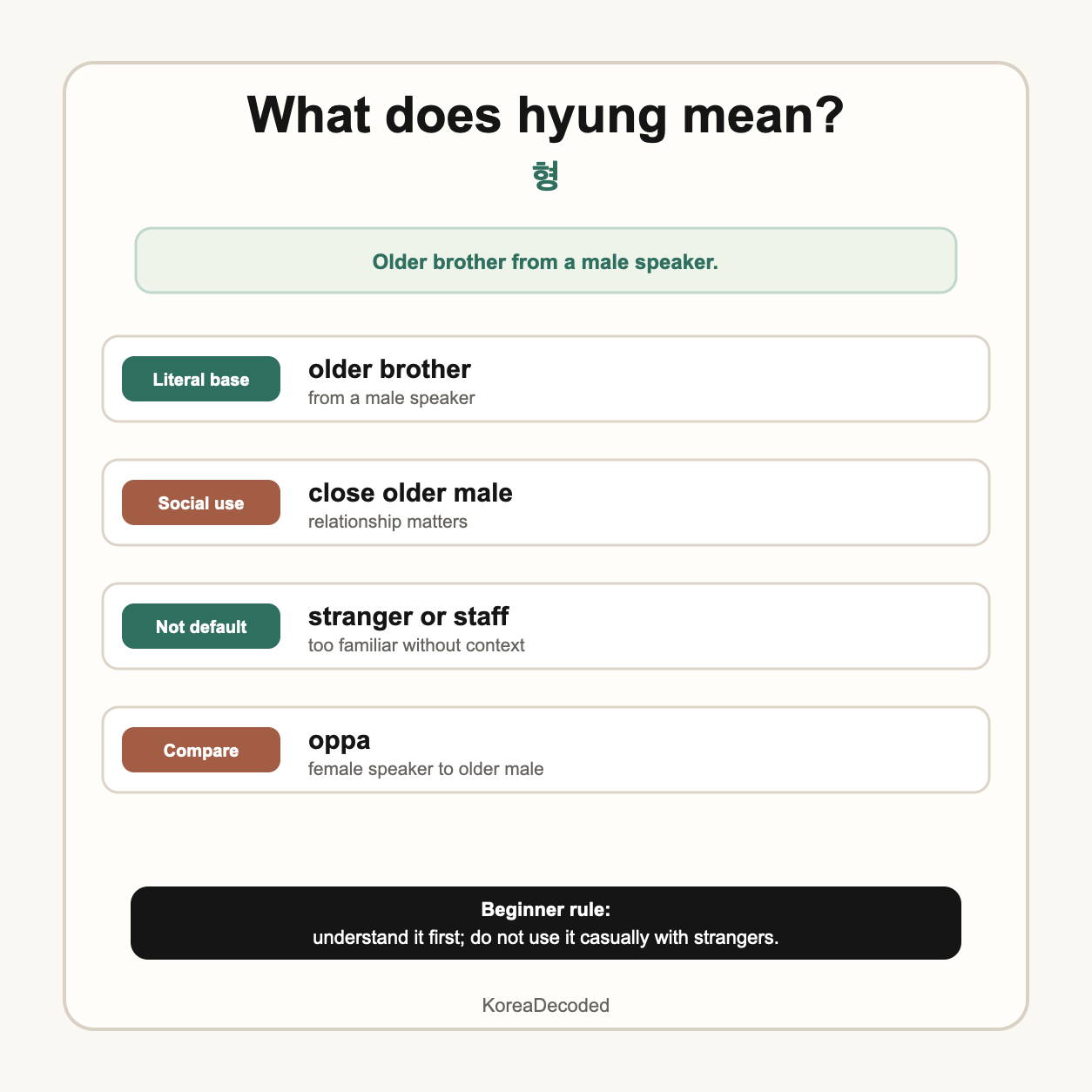
Hyung (형) means an older brother from a male speaker’s point of view. It can also be used for a close older male outside literal family, but the word still depends on age, gender, closeness, and the relationship between the speakers.
If you hear younger male idols or drama characters say hyung, it may sound like “bro.” That is a useful feeling, but it is not the whole meaning. Hyung is more specific than English “bro” because it points to an older male and a male speaker.
The short answer
| Question | Simple answer |
|---|---|
| What does hyung mean? | Older brother, said by a male speaker. |
| Can it mean an older male friend? | Yes, if the relationship is close enough. |
| Can women say hyung? | Usually no. Women normally use oppa for an older male in that family-like relationship. |
| Should travelers use it? | Usually no. Understand it first; do not use it casually with strangers or staff. |
Hyung or hyeong?
The Korean word is 형. In English fan writing, you will usually see it spelled hyung. A more romanization-style spelling is hyeong. KoreaDecoded uses hyung in the title because that is what most English searchers type after hearing the word in K-pop, K-drama, or subtitles.
The literal meaning of 형
The dictionary base is family language. 형 is the word a man or boy uses for his older brother. The speaker detail matters. Korean has different familiar older-sibling words depending on who is speaking and who is older.
| Speaker | Older male | Older female |
|---|---|---|
| Female speaker | 오빠 / oppa | 언니 / unnie |
| Male speaker | 형 / hyung | 누나 / noona |
That is why a woman copying a male idol and calling an older man hyung will usually sound wrong. The word is not just about the older person’s gender. It also depends on the speaker.
Why men use hyung outside family
Korean kinship words can extend beyond literal family. A younger man may call an older male friend hyung. Male students, teammates, coworkers, or hobby friends may use it when the relationship is friendly enough and the age difference is understood.
But that does not mean every older man is your hyung. The word can signal closeness, familiarity, group belonging, or a family-like relationship. In a formal or distant setting, a name, title, or polite phrase is usually safer.
Hyung vs oppa vs unnie vs noona
The four words are easier if you separate speaker and older person. Do not start from English “brother” or “sister” alone. Start with who is speaking.
| Word | Used by | For | Beginner note |
|---|---|---|---|
| 형 / hyung | Male speaker | Older male | Older brother or close older male. |
| 오빠 / oppa | Female speaker | Older male | Older brother or close older male; not simply boyfriend. |
| 언니 / unnie | Female speaker | Older female | Older sister or close older female. |
| 누나 / noona | Male speaker | Older female | Older sister or close older female from a male speaker. |
This is also why age matters in Korean conversation. These words are not random nicknames. They sit inside a broader system of age, closeness, speech style, and Korean honorifics.
Why K-pop makes hyung easy to notice
K-pop groups make hyung very visible because members often have clear birth-year order, group roles, and close team relationships. A younger male member may call an older male member hyung naturally, and fans start to hear the word as part of group chemistry.
That does not mean you should copy the word in every real-life setting. Idol members usually know each other, work together, and share a group culture. A visitor speaking to a shop worker or a stranger does not have that relationship.
What about hyungnim?
You may also hear 형님 (hyungnim). It can sound more respectful than hyung, but beginners should not treat it as a universal polite replacement. Depending on context, it can feel formal, old-fashioned, joking, group-specific, or tied to a particular relationship.
For travel Korean, hyungnim is usually not the word you need. If you are speaking with staff, a guide, a driver, or someone you just met, polite phrases are safer than trying to choose a family-like address term.
Can foreigners say hyung?
Yes, but only when the relationship makes sense. If you are a man with an older Korean male friend and he is comfortable with it, hyung may be natural. If the relationship is unclear, do not force it because you heard it in a drama.
Do not use hyung for restaurant staff, hotel staff, shop workers, taxi drivers, teachers, or someone you have just met. In public travel situations, you can usually speak politely without using any personal address word.
What to say instead
For travel, simple polite Korean will help more than familiar address words.
| Situation | Better beginner choice |
|---|---|
| Getting attention politely | Start with “excuse me” and a simple request. |
| Thanking someone | 감사합니다 / thank you. |
| Making a small mistake | 죄송합니다 / I am sorry. |
| Ordering food | Use restaurant phrases instead of personal address words. |
| Talking to a friend | Use the name or the term they say is comfortable. |
Common mistakes
- Mistake 1: thinking hyung means any older man. It begins as older-brother language from a male speaker.
- Mistake 2: using it with staff. A friendly older male worker is not automatically your hyung.
- Mistake 3: ignoring the speaker. A male speaker uses hyung for an older male. A female speaker normally uses oppa in the comparable relationship.
- Mistake 4: treating K-pop group language as public Korean. Team closeness does not transfer to strangers.
Useful next links
For the full address-term set, read what oppa really means and what unnie means in Korean. For the system behind these words, continue with why age matters in Korean conversation and Korean honorifics without grammar overwhelm.
A simple beginner rule
When you hear hyung, read it as “older brother or close older male from a male speaker’s point of view.” Then check the relationship. Family, close friendship, team, or trusted social circle? It may fit. Stranger, staff member, or formal acquaintance? It probably does not.
That rule helps you understand K-pop and K-drama speech without turning a close relationship word into a public shortcut.
Sources checked
- National Institute of Korean Language Korean-English Learners’ Dictionary: 형 search
- University of British Columbia Korean language notes: kinship terms
- KoreaDecoded: Korean honorifics explained without grammar overwhelm
For the older-female side of the male-speaker address system, read the noona meaning guide.