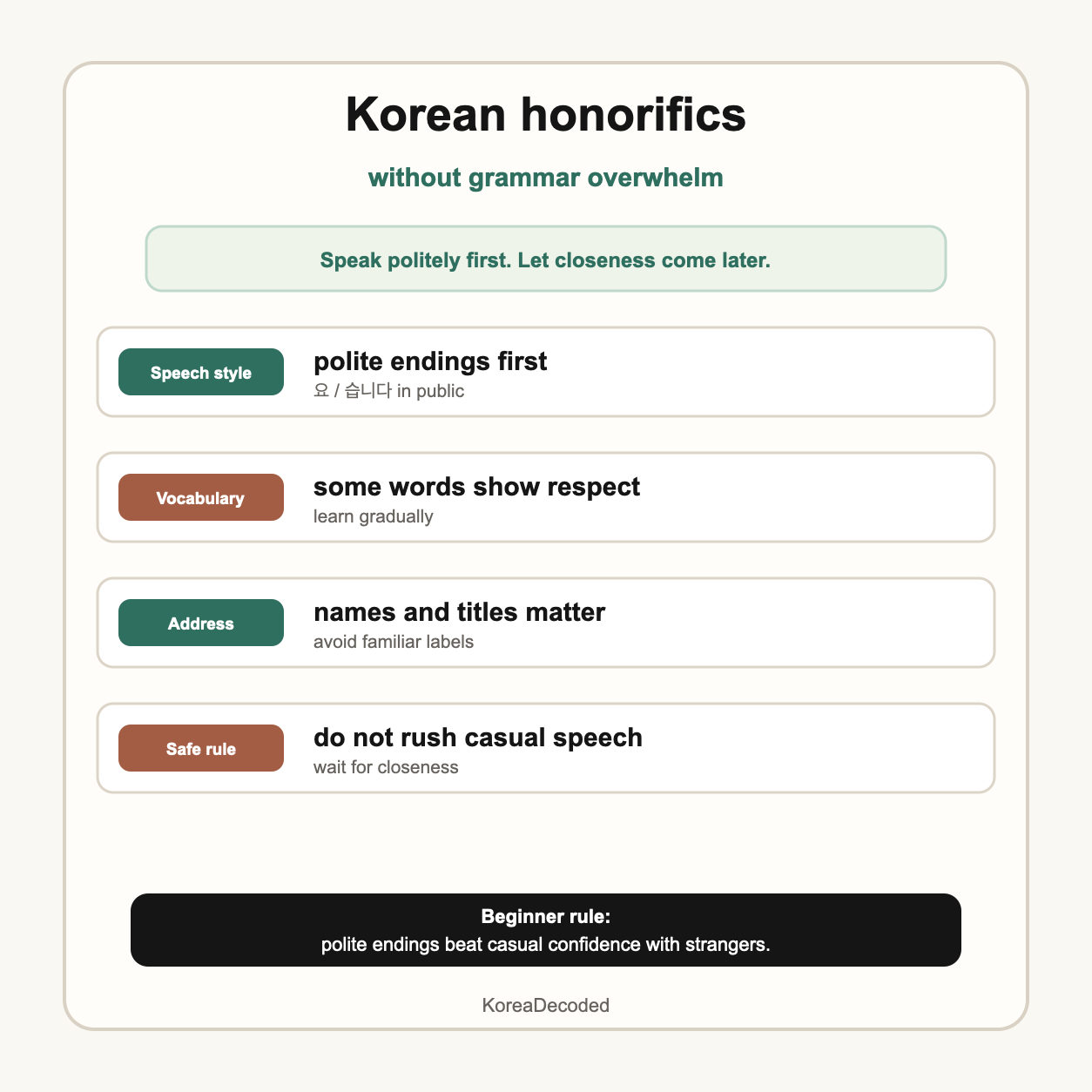
Korean honorifics can sound intimidating because learners hear many different words at once: jondaetmal, banmal, -yo, -nida, oppa, titles, age, and “respect.” The useful beginner answer is simpler: Korean changes depending on who you are speaking to, who you are speaking about, and how close the relationship is.
You do not need to master every grammar rule before visiting Korea. You do need one safe habit: use polite Korean first, especially with strangers, staff, older people, teachers, drivers, and anyone you do not know well.
The short answer
| Question | Simple beginner answer |
|---|---|
| What are Korean honorifics? | Language choices that show respect, distance, or relationship. |
| Is it only about age? | No. Age matters, but setting, role, closeness, and the relationship also matter. |
| What should travelers use? | Polite speech first. Do not rush into casual speech. |
| Can I just add -yo? | It helps with many beginner phrases, but it is not the whole system. |
Think of honorifics in three layers
For beginners, Korean honorifics are easiest to understand as three layers. You do not have to control all three perfectly at the start, but knowing that they exist prevents a lot of confusion.
| Layer | What changes | Beginner example |
|---|---|---|
| Speech style | How politely you speak to the listener. | Using polite endings such as 요 or formal endings such as 습니다. |
| Respectful vocabulary | Some words change when referring respectfully to someone. | Using respectful forms in set phrases or service situations. |
| Address terms | How you call or refer to a person. | Using a name, title, or neutral phrase instead of an overly familiar word. |
The mistake is trying to learn the whole system as one giant rule. Korean does not only ask “older or younger?” It also asks: are you close, are you in public, is this a service interaction, are you talking to the person or about the person, and what role does each person have?
Jondaetmal and banmal
Two words beginners hear early are 존댓말 (jondaetmal) and 반말 (banmal). A simple way to think about them is this: jondaetmal is respectful or polite speech, while banmal is casual or non-honorific speech used in close or lower-formality relationships.
That does not mean banmal is bad. Friends, family, and close people may use it naturally. The problem is using it before the relationship allows it. For a traveler or early learner, polite speech is not stiff; it is safe.
Where age fits in
Age can influence Korean speech, but it is not the only switch. If you read the Korean age guide, you already know the difference between official age and social context. In conversation, age or birth year can help people understand who is older, younger, or the same age.
Still, do not reduce Korean honorifics to “older person equals honorifics, younger person equals casual speech.” A younger employee may speak politely to a customer. Adults who are the same age may still speak politely at work. Close friends may speak casually after agreeing that the relationship allows it.
The safest travel rule
If you are not sure what to use, choose polite Korean. These existing KoreaDecoded phrase guides are built around that rule: basic Korean greetings, thank-you phrases, sorry phrases, and restaurant phrases.
For public situations, this is enough most of the time. You do not need to sound like a native speaker. You need to sound respectful, clear, and not overly familiar.
Do not overuse familiar address words
Words like oppa, unnie, hyung, and noona are tied to age, gender, speaker, and closeness. They are not universal respectful titles. They are also not what you normally use for restaurant staff, hotel staff, shop workers, taxi drivers, or someone you have just met.
If you are unsure, avoid intimate address words. Use a name, title, or a polite sentence without forcing a personal label.
Common mistakes
- Mistake 1: thinking honorifics are only grammar. They also involve relationship, setting, names, and titles.
- Mistake 2: using casual Korean because it sounds friendly. Casual speech can sound warm only when the relationship supports it.
- Mistake 3: using oppa or noona as staff titles. These words are relationship-sensitive and can sound too familiar with strangers.
- Mistake 4: panicking about every verb ending. Beginners can survive many situations with a small set of polite phrases.
A simple beginner map
| Situation | Safer choice | Why |
|---|---|---|
| Shop, cafe, restaurant, hotel | Polite speech | You are in a public/service setting. |
| Someone older you do not know | Polite speech | Distance and respect matter. |
| New Korean friend | Polite first, then follow the relationship | Closeness takes time. |
| Close friend who invites casual speech | Casual may be okay | The relationship has changed. |
Useful next links
To connect this with real phrases, start with basic Korean greetings, then read the Korean age guide and the oppa meaning guide. Together, they explain why Korean politeness is about relationship, not just dictionary translation.
Beginner rule to remember
When in doubt, speak politely and avoid overly familiar address words. That single habit will protect you from most beginner honorific mistakes while you keep learning the deeper grammar.
Korean honorifics are not a test you pass in one day. They are a social system you learn gradually. Start with safe public politeness, notice how people speak in different relationships, and let casual language come later.
Sources checked
- National Institute of Korean Language Korean-English Learners’ Dictionary: 존댓말 search
- National Institute of Korean Language Korean-English Learners’ Dictionary: 반말 search
- National Institute of Korean Language Korean-English Learners’ Dictionary: 높임말 search
- University of British Columbia Korean language learning materials
Address terms like oppa and unnie are relationship-sensitive; the unnie meaning guide shows why they are not default titles for strangers or staff.
Address terms like oppa, unnie, and hyung are relationship-sensitive; the hyung meaning guide shows why they are not default titles for strangers or staff.
Address terms like oppa, unnie, hyung, and noona are relationship-sensitive; the noona meaning guide shows why they are not default titles for strangers or staff.