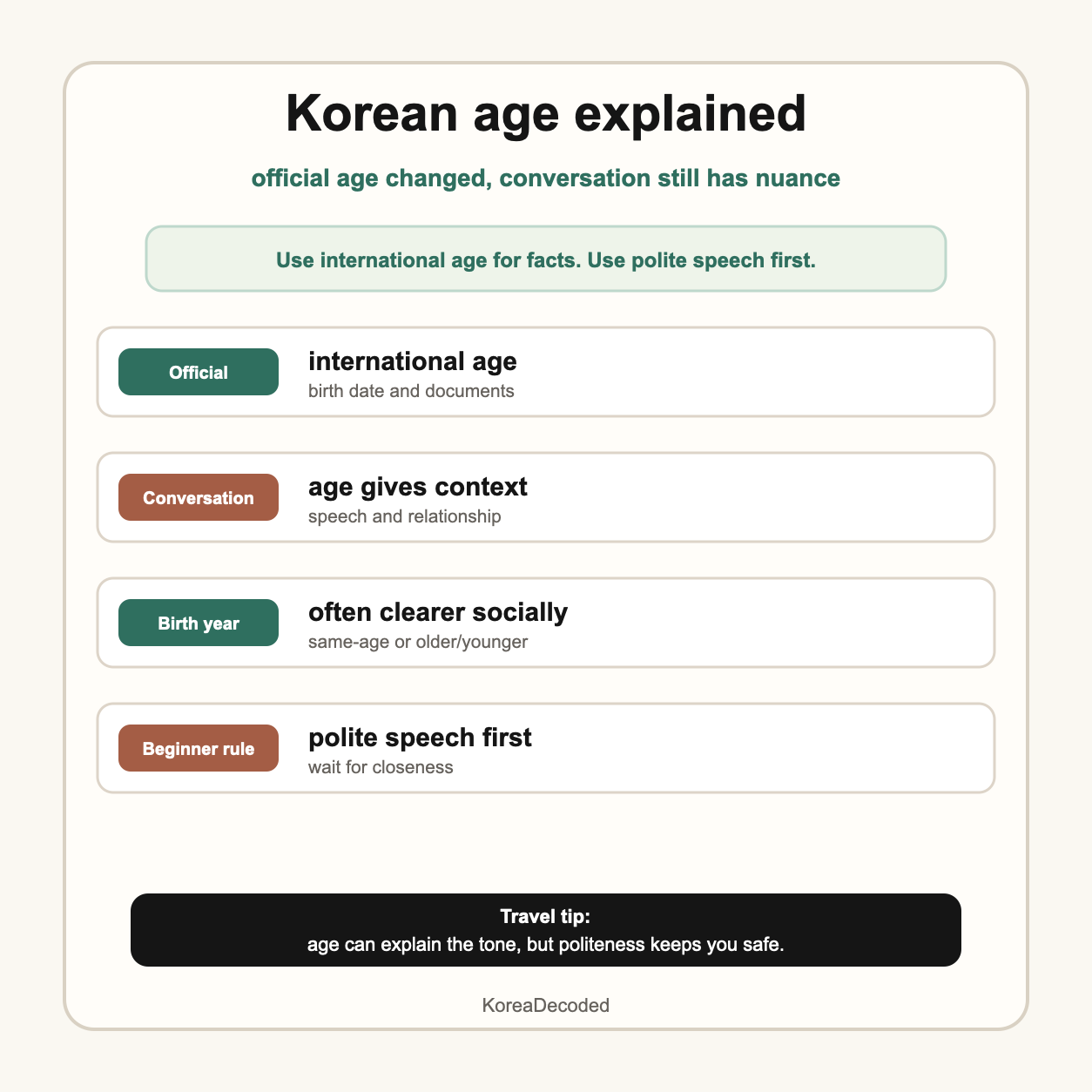
Korean age can be confusing because people use the phrase for two different things: the old way of counting age and the social habit of paying attention to age in conversation. Those are related, but they are not the same.
The short update is simple: for official and administrative purposes, Korea now uses international age. But in everyday Korean conversation, age and birth year can still matter because they help people understand relationship, speech style, and social comfort.
The short answer
| Question | Simple answer |
|---|---|
| Does Korea still use Korean age officially? | For most official purposes, Korea uses international age. |
| When did the change happen? | The international age system became the standard on June 28, 2023. |
| Does age still matter socially? | Often, yes. Age can affect speech level, address terms, and relationship expectations. |
| What should beginners do? | Use polite Korean first. Do not rush into casual speech. |
What changed in 2023
South Korea moved to the international age system for official and administrative use on June 28, 2023. In plain English, that means your age is counted from your actual birthday, the same way most English-speaking countries count it.
Before that change, Korea had several age-counting habits that could confuse foreigners. The most famous one was often called “Korean age,” where a baby could be counted as one at birth and everyone became one year older at the start of the year. That old explanation is still useful for understanding older articles, K-drama jokes, and why the topic became famous online. It is not the best rule for official documents now.
International age vs birth year vs Korean age
| Term | What it means | Where it matters |
|---|---|---|
| International age | Your age after your birthday has passed this year. | Official documents and most practical situations. |
| Birth year | The year you were born. | Social comparison, school-year style context, same-age friendship. |
| Korean age | The older counting style many foreigners learned about. | Older explanations, pop-culture references, casual confusion. |
For travelers, the safest habit is this: when a form asks your age, birth date, or passport information, use the official information exactly. When a person asks about age or birth year in conversation, they may be trying to understand social context, not to calculate a government form.
Why age still matters in Korean conversation
Korean has different levels of speech. A beginner does not need to master every level, but you should understand the basic social point: Korean speech often reflects distance, respect, age, familiarity, and setting.
This is why age can come up earlier than many English speakers expect. If two people are close in age, they may try to figure out whether they are the same age, whether one person is older, or whether the relationship should stay more formal. This does not mean every Korean conversation begins with an age question. It means age can be one useful piece of social information.
Polite speech is the safe default
If you are visiting Korea or learning Korean as a beginner, you do not need to solve every age relationship immediately. Start with polite speech. Use phrases like 안녕하세요, 감사합니다, and 죄송합니다.
Casual speech can be warm between close friends, but using it too early can sound rude, childish, or overly familiar. The simple rule is: let the relationship invite casual speech. Do not force it because you learned a few casual Korean phrases from a drama clip.
What about oppa, unnie, hyung, and noona?
Age also connects to Korean address terms. Words like oppa, unnie, hyung, and noona are not just cute labels. They depend on the speaker, the other person’s age, gender, closeness, and relationship style.
That is another reason birth year can matter socially. If someone is clearly older, younger, or the same age, it can change how people understand the relationship. But for travelers, these words are mostly words to understand before using. You usually do not need them for restaurants, hotels, taxis, shops, or casual travel interactions.
What if someone asks your age?
If it feels natural and friendly, you can answer with your birth year or your international age. If you prefer not to answer, you can keep it light. In English, something like “I usually just use international age now” is clear enough. In Korean, beginners can avoid overexplaining and stay polite.
The important thing is not to panic. In many cases, the question is not meant as an insult. It may be a way to understand whether you are the same age, older, younger, or in a relationship where casual speech might eventually be comfortable.
Common mistakes
- Mistake 1: using old Korean age for official forms. For official information, use your real birth date and international age.
- Mistake 2: thinking age no longer matters at all. The legal counting system changed, but social language habits did not disappear overnight.
- Mistake 3: asking strangers their age because you heard Koreans do it. As a visitor, you do not need to copy every social habit.
- Mistake 4: using casual Korean too quickly. Polite speech is safer until the relationship clearly changes.
Useful next links
If you are learning practical Korean for a trip, continue with basic Korean greetings, restaurant phrases, and the oppa meaning guide. Those explain how Korean language changes with setting, politeness, and relationship.
Beginner rule to remember
Use international age for official facts. Use polite speech for public conversation. Treat birth year and age as social context, not as a reason to rush into casual Korean.
That one rule will help more than memorizing every age-counting formula. Korea’s official age system is now simpler, but Korean conversation still pays attention to relationship. Those two truths can exist at the same time.
Sources checked
- Korea.net policy report on international age implementation
- Yonhap News Agency English report on Korea adopting international age
- National Institute of Korean Language Korean-English Learners’ Dictionary: 존댓말 search
- National Institute of Korean Language Korean-English Learners’ Dictionary: 반말 search
- National Institute of Korean Language Korean-English Learners’ Dictionary: 동갑 search
For the next layer after age and birth year, read the Korean honorifics beginner guide, which explains polite speech without turning it into a grammar wall.
The next address-term example is the unnie meaning guide, which explains how age, gender, and closeness shape one common Korean word.
For another example of age, speaker, and closeness shaping Korean words, read the hyung meaning guide.
For another example of age, speaker, and closeness shaping Korean words, read the noona meaning guide.