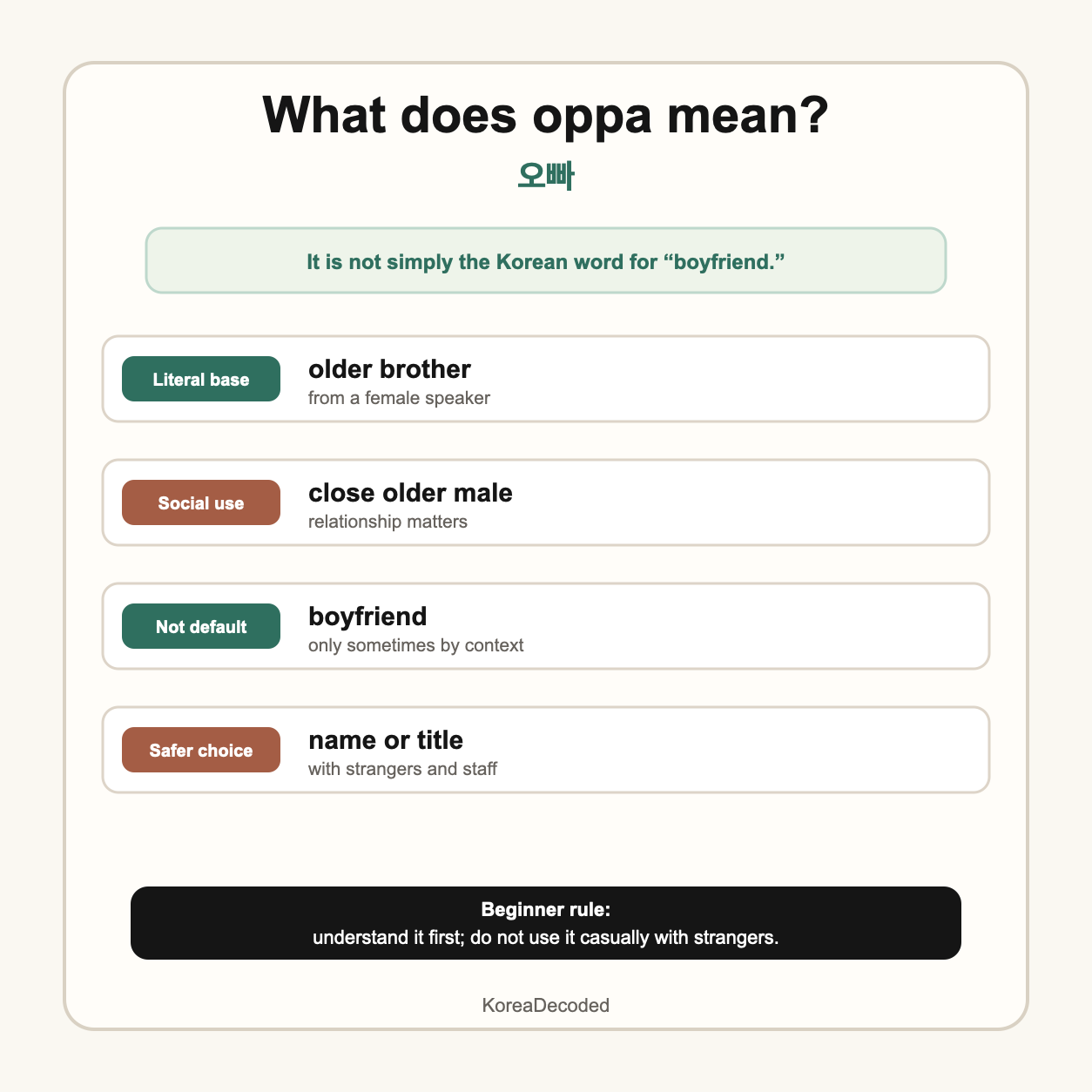
Oppa (오빠) means an older brother from a female speaker’s point of view. It can also be used for a close older male, such as an older male friend, senior, or sometimes a boyfriend, but the important word is close. It does not simply mean “boyfriend.”
If you have heard oppa in K-dramas, K-pop clips, or fan subtitles, it may sound romantic, cute, or dramatic. In real Korean, it is more practical and more relationship-sensitive than that. The wrong use can sound awkward because Korean address words are tied to age, gender, closeness, and social setting.
The short answer
| Question | Simple answer |
|---|---|
| What does oppa mean? | Older brother, said by a female speaker. |
| Can it mean boyfriend? | Sometimes in a relationship, but not as a direct translation. |
| Can men say oppa? | Not for older males. Men usually use hyung in that family-like relationship. |
| Should travelers use it? | Usually no, unless the relationship clearly invites it. |
The literal meaning of 오빠
The dictionary base is family language. 오빠 is the word a woman or girl uses for her older brother. This speaker detail matters. Korean has different familiar older-sibling words depending on the speaker and the person being addressed.
| Speaker | Older male | Older female |
|---|---|---|
| Female speaker | 오빠 / oppa | 언니 / unnie |
| Male speaker | 형 / hyung | 누나 / noona |
That is why a male foreign traveler copying a drama line and calling another man oppa will usually sound wrong. The word is not just about the older person’s gender. It also depends on the speaker.
Why oppa can sound romantic in dramas
Korean kinship words can extend beyond literal family. A woman may use oppa for an older male she is close to, and romantic partners sometimes use it too. K-dramas often place the word in emotional scenes, so English-speaking viewers can start to hear it as a romance word.
That is the trap. Oppa can appear in a romantic relationship, but it does not equal “boyfriend.” A boyfriend might be called oppa if he is older and the relationship style fits. A boyfriend can also simply be called by his name, nickname, or another term. Context decides.
Can foreigners say oppa?
Yes, but beginners should be careful. The safer rule is this: understand oppa before you try to use it. Do not call a random older man oppa. Do not use it for restaurant staff, hotel staff, shop workers, teachers, drivers, or someone you have just met.
It may be natural if you are a woman speaking to an older Korean male friend who has clearly invited that kind of closeness. It may also be natural in a relationship where both people already use that style. If you are unsure, use the person’s name, title, or a polite phrase instead.
What to say instead
For travel, you usually do not need oppa at all. Polite Korean phrases are more useful than intimate address words.
| Situation | Better beginner choice |
|---|---|
| Getting staff attention | Excuse me, then ask politely. Do not use oppa. |
| Thanking someone | 감사합니다 / thank you. |
| Small mistake | 죄송합니다 / I am sorry. |
| Ordering food | Use simple request phrases instead of personal address words. |
| Talking to a friend | Use the name or the address term they suggest. |
Useful next links
If your goal is travel survival Korean, start with basic Korean greetings, thank-you phrases, and restaurant phrases. Those will help you more often than trying to sound like a drama character.
Common mistakes
- Mistake 1: thinking oppa means boyfriend. It can be used with a boyfriend in some relationships, but it is not the dictionary word for boyfriend.
- Mistake 2: using oppa with strangers. It can feel too familiar or performative when there is no relationship.
- Mistake 3: ignoring the speaker. A female speaker uses oppa for an older male. A male speaker uses hyung in that familiar older-male relationship.
- Mistake 4: copying subtitles too literally. English subtitles often simplify social nuance because there is no perfect one-word equivalent.
Oppa and aegyo are not the same thing
Because both words appear in pop-culture conversations, some learners connect oppa with aegyo, or cute behavior. They can appear together, but they are not the same category. Oppa is an address term. Aegyo is a style of cute expression or behavior. A person can say oppa without doing aegyo, and aegyo can happen without the word oppa.
A simple beginner rule
When you hear oppa, read it as “older brother or close older male from a female speaker’s point of view.” Then ask one more question: what is the relationship between the speakers? If the relationship is family, close friendship, or romance, the word may make sense. If the people are strangers, staff, or formal acquaintances, it probably does not.
That single habit will keep you from the biggest misunderstanding: treating oppa as a cute universal Korean word for any attractive older man. It is more specific, more personal, and more Korean than that.
Sources checked
- National Institute of Korean Language Korean-English Learners’ Dictionary: 오빠 search
- University of British Columbia Korean language notes: kinship terms
- National Institute of Korean Language Online Q&A: 오빠 usage context
Age and birth year are part of why address terms can feel sensitive; the Korean age conversation guide explains the broader speech-level context.
Address terms are only one part of the system; the Korean honorifics beginner guide explains how speech style, age, and closeness fit together.
For the older-female side of the same address-term system, read the unnie meaning guide; it explains why the speaker matters as much as the older person.
For the male-speaker side of the older-male address system, read the hyung meaning guide, which explains why hyung and oppa are not interchangeable.
The full older-sibling address set also includes the noona meaning guide, which explains the male-speaker older-female side.