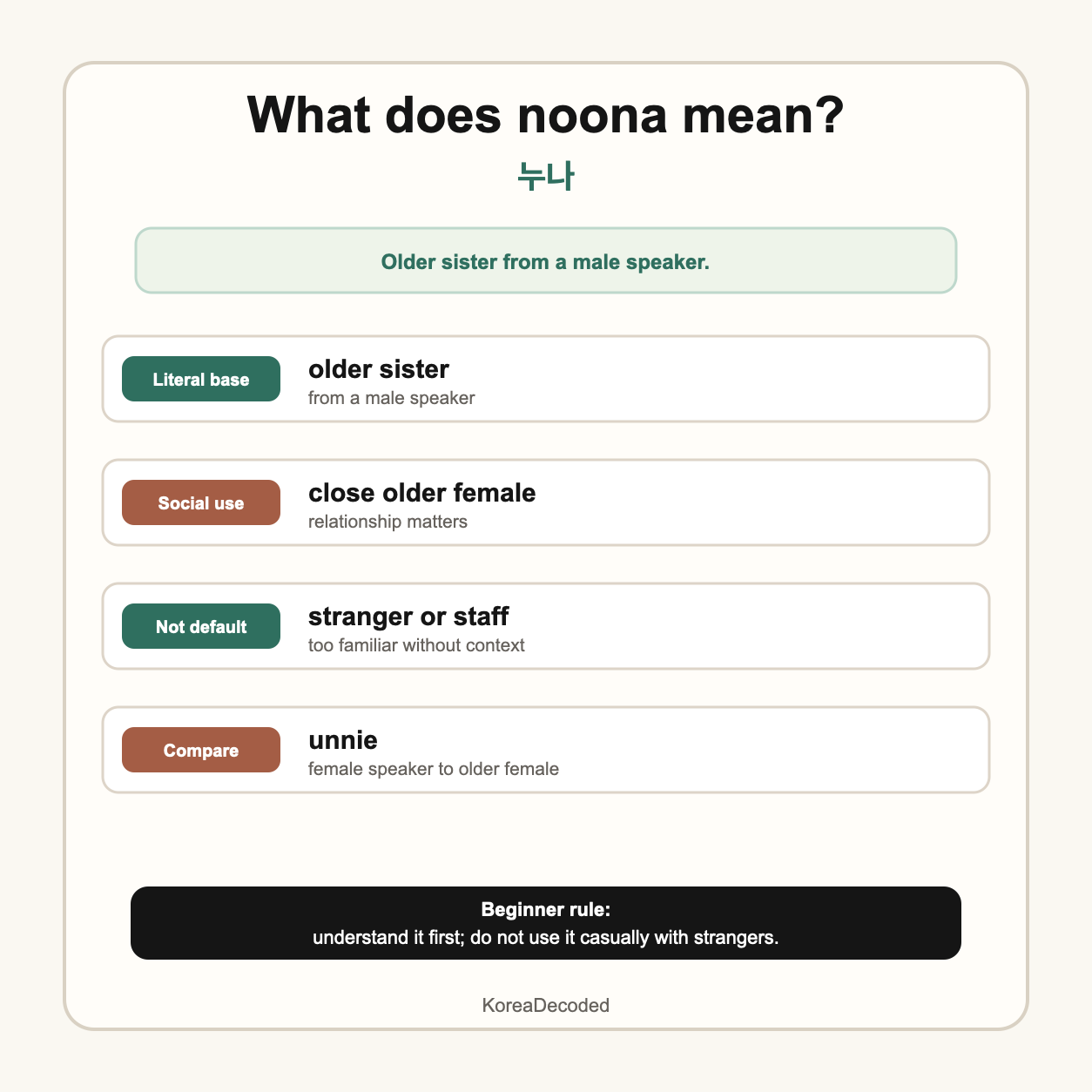
Noona (누나) is the word a male speaker uses for an older sister. It can also extend to an older female friend or another older woman in an established close relationship. The key is not “older woman” by itself. You need to check three things together: who is speaking, who is older, and whether the relationship is close enough.
This is why subtitles can make noona look more romantic than it really is. A younger man may say it to an older woman he likes, but romance comes from the relationship and the scene. It is not built into the dictionary meaning.
Decode noona in three checks
| Check | What to look for | If it does not fit |
|---|---|---|
| 1. Speaker | The speaker is male. | A female speaker normally uses unnie for an older female in a comparable close relationship. |
| 2. Age direction | The woman is older than the speaker. | A same-age or younger woman is not normally addressed as noona. |
| 3. Relationship | They are family or already have an accepted close, family-like, team, or friendship relationship. | A stranger, customer, or staff member is not automatically the speaker’s noona. |
If all three checks fit, noona may be natural. If only “older woman” fits, the English translation “older sister” can be misleading because Korean address terms carry information about the speaker and the social relationship.
Why the male speaker matters
Korean familiar older-sibling terms change with the speaker. A male speaker uses 형 (hyung) for an older male and 누나 (noona) for an older female. A female speaker uses 오빠 (oppa) for an older male and 언니 (unnie) for an older female.
| Speaker | Older male | Older female |
|---|---|---|
| Male | 형 / hyung | 누나 / noona |
| Female | 오빠 / oppa | 언니 / unnie |
The table is a decoder, not a license to use all four words. In real conversation, age, mutual comfort, titles, and speech level still matter.
Why dramas create a “noona romance” impression
A drama may pair a younger man with an older woman and let him call her noona. The word can then carry affection, teasing, dependence, or romantic tension because the characters already have history. Fans sometimes use “noona romance” as a convenient label for that age-direction story.
Do not reverse the logic. Noona does not mean “older girlfriend,” and saying the word does not automatically flirt. A man can use it for his actual sister, a long-time family friend, or a trusted older teammate without romance. Read the scene first: are they family, old friends, coworkers who became close, or a couple? The relationship supplies the emotional meaning.
Outside family: closeness must already exist
The word can move beyond literal siblings, but it usually follows a relationship rather than creating one. A younger man and an older female friend may settle into noona after they know each other well. Members of a familiar group may also use family-like terms when everyone understands the relationship.
That does not make it a general word for an older female stranger. Using noona too early can sound presumptuous because it claims familiarity. In a formal workplace, a service interaction, or a first meeting, a name with the appropriate title or a polite sentence is safer.
Noona, nuna, and noonim
The Hangul is 누나. English entertainment and fan spaces commonly spell it noona; nuna is another romanization you may see. Both point to the same Korean word.
누님 is often written noonim or nunim. It can add respect, but it is not a universal polite upgrade for tourists. Depending on the group and tone, it may sound formal, old-fashioned, playful, or strongly relationship-specific. Beginners should understand it when they hear it rather than deploy it as a safe default.
What a traveler should say instead
Most travel interactions do not require a personal address term. You can make a polite request without deciding whether someone is an unnie, noona, or anything similar.
| Situation | Low-risk approach |
|---|---|
| Restaurant or cafe | Use a polite greeting and the request itself. The restaurant phrase guide gives a short usable flow. |
| Shop | Ask the product or price question politely; do not assign a family-like label to the employee. |
| Hotel, taxi, or tour | Use the person’s professional title if you know it, or simply use a polite sentence. |
| Older female friend | Follow the term she uses or explicitly says is comfortable. Do not force noona from a drama script. |
A listening checklist for K-pop and K-drama
- Identify the speaker. Is the person saying noona male?
- Check the age direction. Is the woman older?
- Look for relationship history. Are they siblings, long-time friends, teammates, coworkers who became close, or romantic partners?
- Read the tone separately. Warm, irritated, joking, dependent, and romantic uses all remain possible; the surrounding scene decides which one.
That four-step reading is more accurate than replacing every noona with “older girlfriend” or every older woman with “sis.” It lets the Korean relationship word keep its social information.
The short rule to remember
Noona means older sister or a close older female from a male speaker’s point of view. It helps you interpret a relationship that already exists. It is not a shortcut for addressing an older woman you have just met.