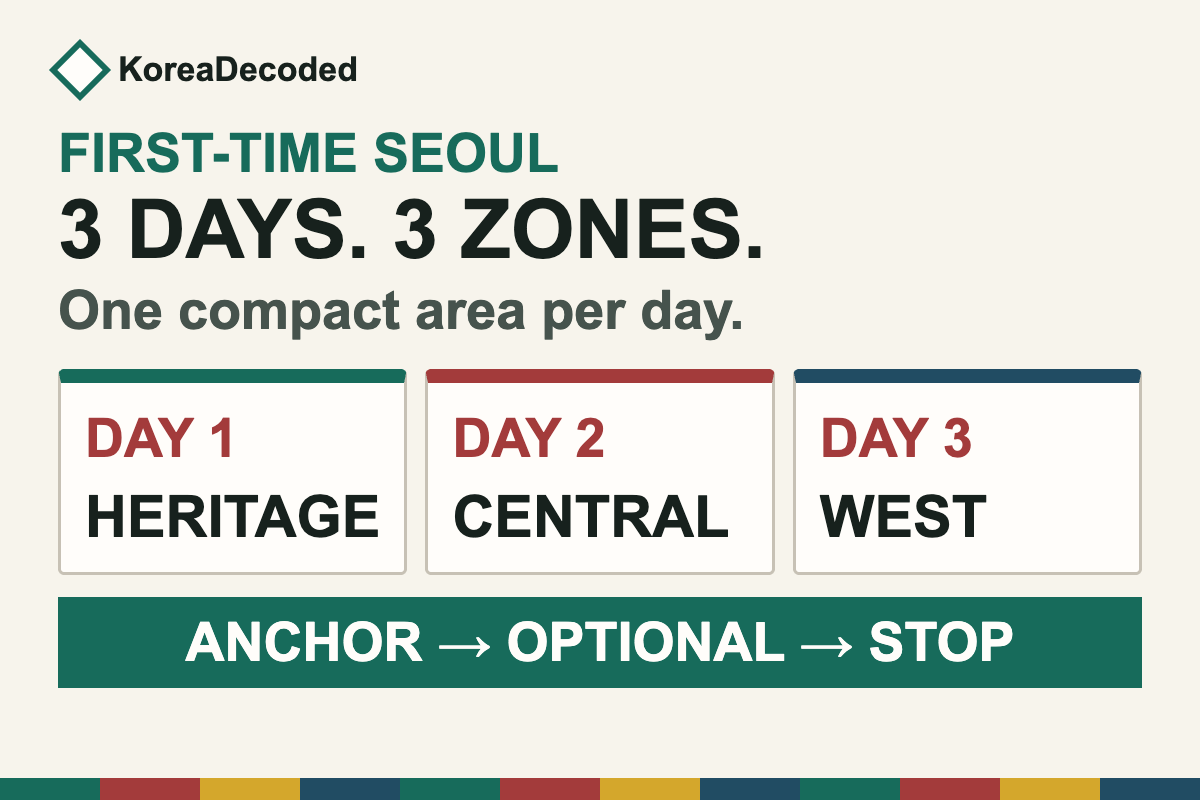
Quick answer: split your first three Seoul days into three compact zones. Use Day 1 for the heritage core around Gwanghwamun, Gyeongbokgung, and Insa-dong; Day 2 for central Seoul around Namdaemun, Myeongdong, and optional Namsan; and Day 3 for west Seoul around Mangwon, Yeonnam, and Hongdae. Give each day one anchor, one optional stop, and a clear point where you will stop adding places.
This is a route-planning guide, not a list of everything worth seeing. Seoul is too large for a useful three-day plan to behave like a scavenger hunt. The goal is to spend more time in each area and less time crossing the city because a saved map had one more pin.
Current-rules note: this plan was rechecked on July 13, 2026. Seoul’s current Bukchon guidance lists a 10:00 a.m.-5:00 p.m. visitor window and identifies Sunday as a rest day for the alleyways; this itinerary therefore uses Bukchon only Monday through Saturday and removes it on Sundays or an officially announced closure day. Separately, tourist visits in the designated red zone around Bukchon-ro 11-gil are prohibited from 5:00 p.m. to 10:00 a.m., and Seoul’s notice states a KRW 100,000 fine for violations of those restricted hours, with enforcement from March 1, 2025. The checked sources do not say that this fine is the penalty for the separate Sunday closure. The official Seoul page also lists Gyeongbokgung as closed on Tuesdays. Recheck current Bukchon notices, posted signs, the palace operator, and live transit disruptions for your dates.
The 3-Day Seoul Plan at a Glance
| Day | Geographic shape | Keep | Optional | Stop rule |
|---|---|---|---|---|
| Day 1 | Heritage core | Gwanghwamun, Gyeongbokgung, Insa-dong | Bukchon, Monday-Saturday only after checking closure notices | On Sunday or an official closure day, keep the same heritage zone and omit Bukchon |
| Day 2 | Central Seoul | Namdaemun and Myeongdong | Namsan | If weather, visibility, or energy is poor, end in Myeongdong |
| Day 3 | Modern west | Yeonnam and Hongdae | Mangwon before them | If you start late, begin in Yeonnam and drop Mangwon |
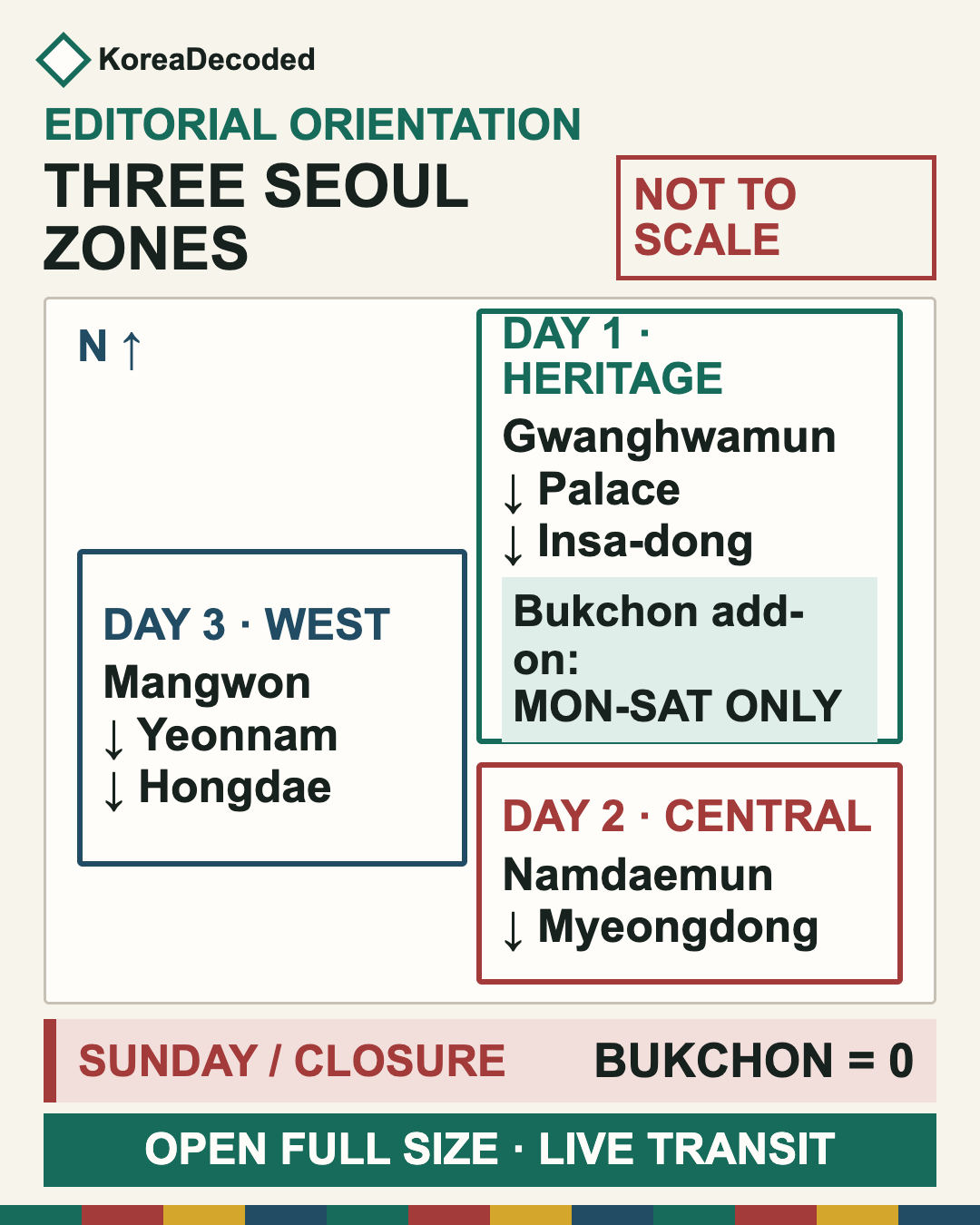
Map and current-rules note: open the image for the full-size version. It is an editorial orientation schematic, not a navigation map and not to scale. Day 1 groups Gwanghwamun, Gyeongbokgung, and Insa-dong in the heritage zone; Day 2 groups Namdaemun and Myeongdong in central Seoul; Day 3 moves through Mangwon, Yeonnam, and Hongdae in west Seoul. Bukchon is optional only Monday through Saturday after checking the current 10:00 a.m.-5:00 p.m. visitor guidance and any official closure notice; on Sunday or an official closure day, set Bukchon to zero and stay in the heritage zone or rest. The KRW 100,000 amount in Seoul’s notice is stated for violations of the designated red-zone restricted hours, not as a Sunday-closure penalty. Use a live transit app for the actual route and check current service suspensions or station closures before leaving.
A Working Time Budget, Not a Transit-Time Promise
| Day | Core-zone budget | Protected movement and rest reserve | Optional block | Working envelope |
|---|---|---|---|---|
| Day 1 | 5.5 hours | 90 minutes | Bukchon 1-1.5 hours, Monday-Saturday only | 7-8.5 hours |
| Day 2 | 5 hours | 90 minutes | Namsan up to 2 hours | 6.5-8.5 hours |
| Day 3 | 5 hours | 90 minutes | Mangwon about 1.5 hours | 6.5-8 hours |
These are KoreaDecoded planning allocations, not venue hours or measured journey times. In each working envelope, the lower number is the core-zone budget plus the 90-minute reserve; the upper number also includes the optional block. The reserve belongs to the whole day: station exits, wayfinding, queues, short transfers, bathroom stops, and sitting down all draw from it. On Sunday or an officially announced Bukchon closure day, the Day 1 optional block becomes zero; leave that time in Gwanghwamun or Insa-dong, take a longer meal, or rest instead of adding a distant district.
The order assumes three full sightseeing days and a hotel base with reasonable access to central Seoul. If you still need to choose a base, use the Hongdae, Myeongdong, and Gangnam comparison and the separate Seoul hotel-area guide. This article will not repeat those decisions.
Before Day 1: Use Four Planning Rules
- Protect the anchor. Each day has one area that makes the day worthwhile even if everything else is removed.
- Choose the optional stop before leaving the hotel. It is easier to drop a stop in the morning than to admit exhaustion after crossing the city for it.
- Protect the 90-minute daily reserve. Finding exits, waiting, eating, short transfers, and resting are part of the day; the reserve is not an estimate for one ride.
- Check live operations that morning. Closure days, tickets, weather, service suspensions, station closures, and temporary restrictions are not permanent article facts.
For the mechanics, keep the first-time Seoul subway guide and the T-money guide open. This itinerary decides where to spend time; those articles explain how to execute the ride.
Day 1: Heritage Core Without the Checklist Rush
Morning anchor: Gwanghwamun and Gyeongbokgung
Begin with the part of the day that is least flexible: the palace area. Gwanghwamun Square and Gyeongbokgung belong in the same morning block, so you do not need a separate cross-city journey between two headline sights. Check the Royal Palaces and Tombs Center before leaving for the current closure, admission, and visitor information.
If this day is Tuesday: do not build the morning around Gyeongbokgung. The official Seoul page currently lists the palace as closed on Tuesdays. Swap Day 1 with Day 2, then recheck the palace’s official site in case the operating notice has changed.
Midday and afternoon: Insa-dong
Use Insa-dong as the slower second half of the heritage day. It gives you time for lunch, tea, crafts, or simply an unhurried walk without adding another distant district. You do not need to preselect every store. Decide what kind of break you want and leave room for it.
Optional add-on: Bukchon, with a real stop rule
Add Bukchon only on Monday through Saturday, inside the checked 10:00 a.m.-5:00 p.m. visitor window, after confirming that no official closure notice applies to your date, and only if you still have energy. It is a residential area, not an after-hours photo set. In the designated red zone around Bukchon-ro 11-gil, tourist access is prohibited from 5:00 p.m. to 10:00 a.m. Keep your group small, lower your voice, follow local signs, and do not treat private homes as attractions.
If Day 1 is Sunday or an official Bukchon closure day: do not substitute another Bukchon alley or treat the day as a failure. Keep Gwanghwamun, Gyeongbokgung, and Insa-dong, then use the former Bukchon block for an unhurried meal, a rest, or more time in the same heritage zone. The KRW 100,000 red-zone fine is not described here as a Sunday-closure penalty because the checked official sources do not make that connection.
Skip Bukchon when: it is Sunday or an officially announced closure day, your route would reach the area outside the checked visitor window, the palace visit ran long, someone in the group needs a simpler walking day, or you are only adding it because it appears on a must-see list. Keeping Insa-dong and deleting Bukchon is a complete Day 1, not a failed one.
Day 1 reservation checkpoint
Ask one question: do you specifically want a guided palace or city walk, a timed cultural activity, or a special program? If yes, check the responsible official page and fit the day around that commitment. If no, keep the route flexible. Do not create a reservation merely to make the itinerary look organized.
Day 2: Central Seoul With an Optional Skyline Finish
Morning and lunch: Namdaemun
Start Day 2 in the Namdaemun area and let the market or surrounding streets supply the morning’s texture. The purpose is not to inspect every aisle. Give yourself one shopping or food objective, then move on before market browsing consumes the entire central-Seoul day.
Afternoon anchor: Myeongdong
Myeongdong is the Day 2 anchor because it can absorb a flexible afternoon: shopping, a cafe break, a meal, or recovery time at the hotel if your base is nearby. If you want context before choosing where to pause, the Korean cafe dessert guide explains common menu categories without directing you to one commercial shop.
Optional capstone: Namsan
Treat Namsan as a capstone, not a debt. Before committing, check the official page for current access, operating information, and any ticketed experience you actually want. Then look at the day’s weather and your group’s energy.
Skip Namsan when: conditions make the view unimportant to you, the ascent or transfer is a poor fit for the group, shopping ran long, or the day already feels complete. A relaxed dinner in central Seoul is a better use of time than forcing a final landmark while tired.
Day 2 reservation checkpoint
Decide whether Namsan includes a specific paid or timed activity for you. If it does, verify the official operator and current terms before building the evening around it. If the answer is simply “we would like to see the area if the day goes well,” keep it optional.
Day 3: Modern West Seoul From Mangwon to Hongdae
Morning option: Mangwon
Use Mangwon as the optional beginning of the west-Seoul day. It works when you want a market or neighborhood morning before moving toward Yeonnam and Hongdae. It does not work when the day starts late and you are trying to recover lost time by rushing through three districts.
Afternoon anchor: Yeonnam and Gyeongui Line Forest Park
Shift the pace in Yeonnam. The official Seoul guide groups Gyeongui Line Forest Park with the Hongdae and Yeonnam area, which supports treating this as one continuous afternoon rather than another separate attraction transfer. Walk, rest, browse, or use the park as a transition into the evening.
Evening anchor: Hongdae
Let Hongdae own the evening instead of treating it as one more daytime pin. If this is also your first meal in the area, use the first-night Hongdae food guide to choose a food shape before you arrive.
Skip Mangwon when: you leave the hotel late, the group mainly wants Yeonnam cafes and Hongdae at night, or another booked activity already occupies the morning. Begin in Yeonnam and keep the strongest part of the day intact.
Day 3 reservation checkpoint
Decide whether you have one specific restaurant, performance, or activity that truly needs advance action. If the commitment is a restaurant, the separate Catchtable and Tabling guide explains the waitlist and booking workflow. Otherwise, preserve the west-Seoul day as the most flexible day of the trip.
How to Change the Plan Without Breaking It
| What changed | Keep | Move or drop |
|---|---|---|
| Your first usable day starts after 3:00 p.m. | A soft central-Seoul arrival near your hotel | Move the heritage core to the next full morning; remove one lower-priority district |
| Day 1 is Tuesday | The three geographic day shapes | Swap the heritage day with central Seoul after checking the current palace notice |
| Day 1 is Sunday or an official Bukchon closure day | Gwanghwamun, Gyeongbokgung, Insa-dong, and the movement/rest reserve | Set the Bukchon block to zero; stay in the same heritage zone or rest |
| Heavy rain, heat, or cold changes the day | The day’s central zone and meal plan | Cut the least important outdoor add-on; do not replace it with a distant indoor pin |
| Someone is tired or sore | The anchor and a proper meal or rest | Drop Bukchon, Namsan, or Mangwon according to the day |
| A booked activity is fixed | The activity and nearby part of the same zone | Remove the stop that causes the largest detour |
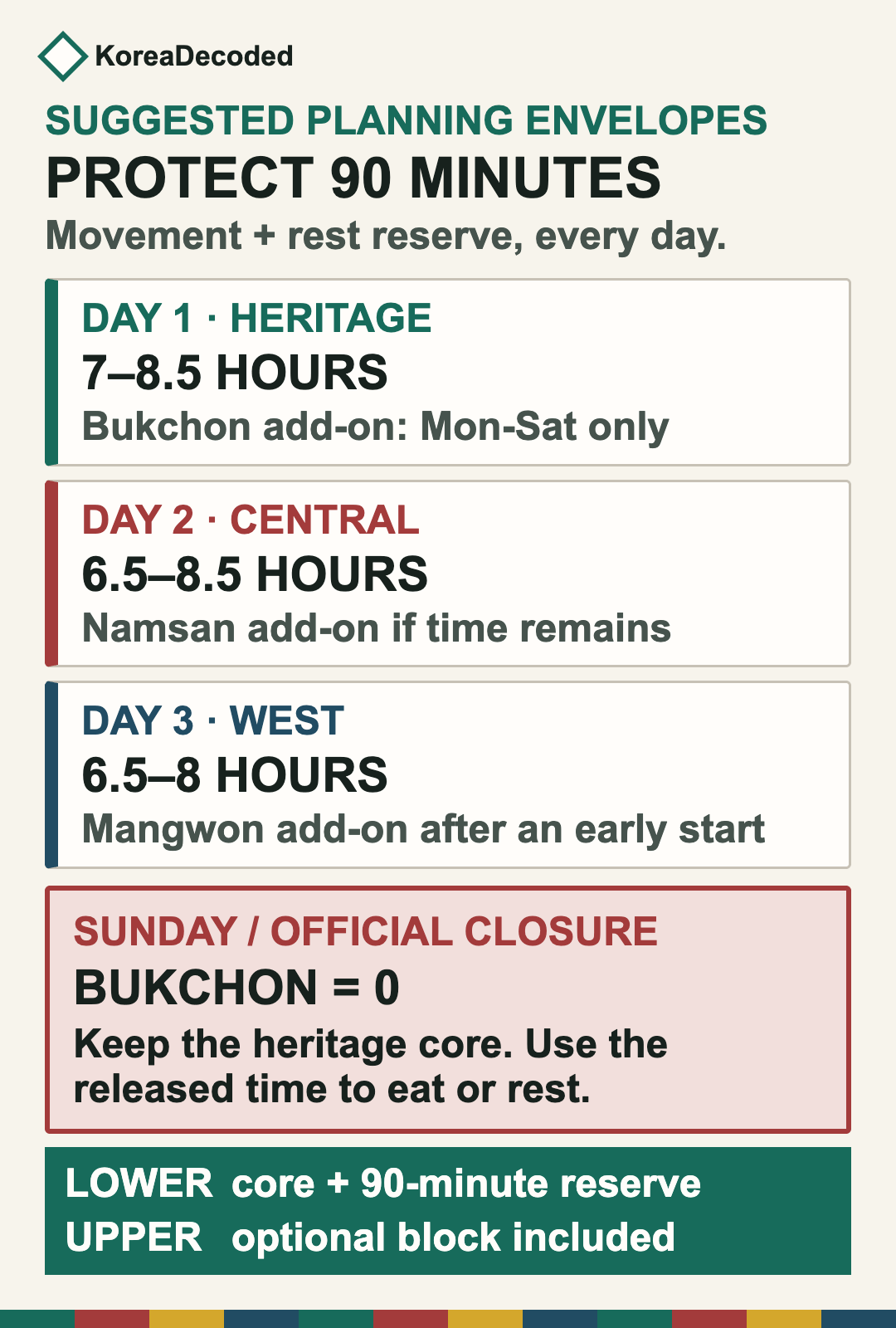
How to use this card: open it for the full-size version. The suggested working envelopes are 7-8.5 hours for Day 1, 6.5-8.5 hours for Day 2, and 6.5-8 hours for Day 3. The lower number for each day is the core-zone budget plus the protected 90-minute movement/rest reserve; the upper number adds the optional block. The optional blocks are Bukchon on Monday-Saturday only, Namsan if time remains, and Mangwon after an early start. On Sunday or an official Bukchon closure day, Day 1 stays at the lower envelope and Bukchon is zero; keep the heritage core and use the released time for a meal or rest. Before leaving, recheck official closure notices, posted signs, weather, and live transit disruptions. The separate KRW 100,000 red-zone restricted-hours fine is explained in the current-rules note above and is not a Sunday-closure penalty.
If You Land on Day 1
Do not count an airport arrival day as a full sightseeing day unless the arrival, immigration, luggage, transfer, and hotel check-in actually leave you a usable block. The Incheon Airport to Seoul transfer guide owns that logistics decision.
If your usable first day begins after 3:00 p.m., make it a soft arrival near your hotel or in central Seoul. Eat, walk one compact area, and prepare for the next morning. Put the heritage core on the first full morning, then remove one optional stop from the remaining plan. Do not compress three full days into two and a half.
Common 3-Day Itinerary Mistakes
- Mixing opposite sides of Seoul because both places are famous. A good pin can still be wrong for that day.
- Treating Bukchon as an evening or Sunday photo stop. The designated red zone has restricted visiting hours, Sunday is a rest day in the checked Seoul guidance, and the area is residential.
- Discovering the Tuesday palace closure at the gate. Check the official palace notice and swap days before leaving.
- Making every optional stop mandatory. Bukchon, Namsan, and Mangwon are the first cuts in this plan, not tests of commitment.
- Using transit minutes as the complete schedule. Station exits, waits, meals, shopping, and rest all consume real time; keep the 90-minute shared reserve.
- Booking every meal. Reserve only a place that matters enough to organize the surrounding day.
- Changing both the route and the hotel base at once. Settle the base with the existing neighborhood guides, then use this plan for daily sequencing.
What to Save on Your Phone
- The three day shapes, suggested time budgets, and each day’s stop rule
- The official palace page and the Bukchon restriction notice, including the Sunday/closure-day branch
- Your live transit app, current disruption notices, and the Seoul subway guide
- Your hotel address in Korean and English
- One confirmed reservation per day at most, unless the trip has a special purpose
- A short note naming the first stop you will drop when the day changes
For a broader mental map before saving routes, read the first-time Seoul neighborhood guide. Then return to this article and keep only the three zones that fit the actual trip.
FAQ
Is three days enough for Seoul?
Three days are enough for a focused first visit to three parts of Seoul. They are not enough to complete the city. This plan protects a heritage day, a central-Seoul day, and a modern west-Seoul day while leaving obvious reasons to return.
Should I add Gangnam to this itinerary?
Add Gangnam only by replacing a full day shape, not by attaching it to an already-full day. If Gangnam is a major K-pop, shopping, work, or personal priority, use the district comparison and replace the west-Seoul day or central-Seoul day deliberately.
Can I visit Bukchon at night?
Do not plan a nighttime tourist visit to the designated red zone around Bukchon-ro 11-gil. Seoul’s current official notice prohibits tourist visits there from 5:00 p.m. to 10:00 a.m. and states a KRW 100,000 fine. Follow current signs because the legal restriction applies to a designated zone, while Bukchon more broadly remains a residential area requiring respectful behavior.
What if my heritage day falls on Sunday or an official Bukchon closure day?
Remove Bukchon from the day. Keep Gwanghwamun, Gyeongbokgung, and Insa-dong, then use the former optional block for more time in that same heritage zone, a longer meal, or rest. Seoul’s current notice separately calls Sunday a rest day for the alleyways. Do not interpret the KRW 100,000 red-zone restricted-hours fine as a Sunday-closure penalty; the checked sources do not state that connection. Recheck any official holiday or special-closure notice for your date.
What should I cut first if I am tired?
Keep the day’s anchor and cut the optional stop: Bukchon on Day 1, Namsan on Day 2, or Mangwon on Day 3. The plan is designed so that each day still works after that deletion.
Do I need restaurant reservations for all three days?
No general rule supports booking every meal. Reserve or join a waitlist only when a specific place matters enough to organize the nearby route around it. Keep the other meals flexible and check the restaurant’s current official channel.
Sources Checked
- Seoul Metropolitan Government: Bukchon Special Management Area visitor restrictions – red-zone location, restricted hours, enforcement date, fine, residential-area notice, and the separate Sunday rest-day statement.
- Official Seoul Tourist Guide, data updated July 2024 and published August 2024 – Bukchon entry listing 10:00 a.m.-5:00 p.m. and closed Sundays; the cover itself has no year, so the upload path is not used as an edition label.
- Seoul Metropolitan Government: Gyeongbokgung Palace – Tuesday closure reference; recheck the current palace operator before visiting.
- Royal Palaces and Tombs Center – official publication-day and trip-day recheck destination.
- Visit Seoul: If You Visit Seoul for the First Time – official evidence for grouping representative areas into daily courses.
- Official 2025 Seoul Tourist Guide (as of July 2025; published August 2025) – recommended-route and district-grouping evidence; this edition is taken from the rendered publication page, not inferred from its 2026 upload path.
- Visit Seoul: Gyeongui Line Forest Park – Yeonnam and Hongdae area relationship.
- Visit Seoul: Hongdae and Mangwon Village Tour – official geographic grouping evidence.
- Visit Seoul: Namsan Seoul Tower – official page for current access and operating rechecks.
Official-source observation window: July 13, 2026, 11:43:59-13:34:35 UTC. The two guide editions were verified from their rendered covers/publication pages rather than their upload-path years. Publication-day checks must repeat the unstable items: Bukchon visitor/rest-day and official closure notices, palace notices, Namsan access if used, and live transit disruptions.
Editorial method: the route, broad spatial schematic, time budgets, movement reserve, and stop rules are KoreaDecoded’s independent planning synthesis. The map is not to scale, and the numbers are suggested allocations rather than measured transit times or operating hours. No official map, itinerary artwork, fixed price, commercial link, or paid recommendation is reproduced here.