Korean numbers can feel inconsistent when the same digit appears in a price, a party size, a floor, and a time. The digit is not the problem. Korean has two numeral sets; for the traveler situations checked here, the unit and the job of the number point to the source-backed pattern to practice.
This guide is deliberately practical. It covers source-checked patterns for won prices, small party and item counts, numbered floors, ordinary clock time, age expressions, and assigned order or queue numbers. It does not try to turn every Korean number expression into one universal rule.
The 20-second answer
| Traveler situation | Practical pattern for this situation | Example |
|---|---|---|
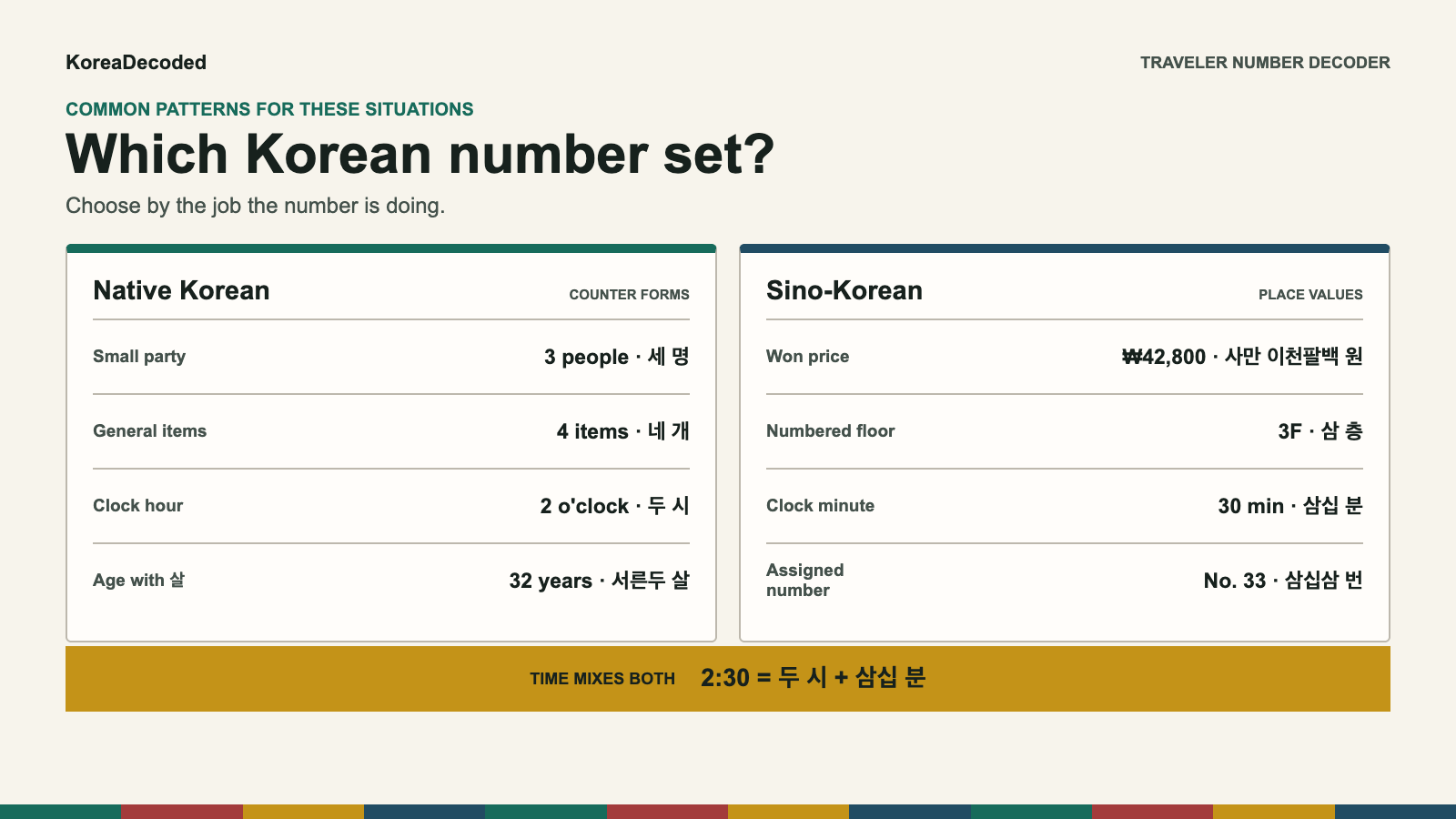
| Won price | Sino-Korean place values | 42,800원 → 사만 이천팔백 원 |
| Small party | Attested native forms + 명 | 3 people → 세 명 |
| General items | Attested native forms + 개 | 4 items → 네 개 |
| Numbered floor | Sino-Korean + 층 | 3층 → 삼 층 |
| Ordinary clock time | Native hour + 시; Sino minute + 분 | 2:30 → 두 시 삼십 분 |
| Age with 살 | Mainly native Korean + 살 | 32 years old → 서른두 살 |
| Age with 세 | Sino-Korean + 세 | 32 years old → 삼십이 세 |
| Assigned number | Chiefly Sino-Korean + 번 | No. 33 → 삼십삼 번 |
Treat this table as a traveler selector, not a complete theory of Korean. The cited official sources support these scoped patterns. Some drills combine a verified numeral pattern with a verified unit or context; those are teaching applications, not verbatim official examples. The sources do not support shortcuts such as “all counters are native” or “every use of 번 is Sino-Korean.”
First recognize the two sets
For prices, floors, minutes, and assigned numbers in this guide, the core Sino-Korean building blocks are:
| Digit or unit | Korean | Digit or unit | Korean |
|---|---|---|---|
| 1 | 일 | 6 | 육 |
| 2 | 이 | 7 | 칠 |
| 3 | 삼 | 8 | 팔 |
| 4 | 사 | 9 | 구 |
| 5 | 오 | 10 | 십 |
| 100 | 백 | 1,000 | 천 |
| 10,000 | 만 | 1,000,000 | 백만 |
For the assigned-number example 33번, this guide applies the verified Sino-Korean assigned-번 pattern and practices it as 삼십삼 번. This is a teaching application, not a verbatim official example, and the article does not extend it to phone numbers or every identifier.
For the small native-number forms used before 명, 개, 시, and 살 in this guide, learn the form beside the unit, not only the standalone dictionary form:
| Number | Standalone numeral | Form in the cited unit patterns | Example |
|---|---|---|---|
| 1 | 하나 | 한 | 한 명 |
| 2 | 둘 | 두 | 두 개 |
| 3 | 셋 | 세 | 세 시 |
| 4 | 넷 | 네 | 네 살 |
| 20 | 스물 | 스무 before 살 at exactly 20 | 스무 살 |
At 23, 스물 returns inside the compound: 스물세 살. These are forms to recognize as complete chunks. Calling them universal sound contractions before every Korean counter would go beyond the evidence.
Hear the difference before you answer
The bracketed pronunciations below are copied from the linked National Institute of Korean Language dictionary entries. Each Audio link is the external MP3 called by that entry’s speaker button, initially checked on 2026-07-13 and rechecked on 2026-07-14. These are official dictionary headword clips, not recordings of the complete traveler phrases. This draft links to those external files only; it does not download, rehost, embed, or upload them. No custom recording or independent human-review claim is made.
| What to hear | Official notation | Official dictionary |
|---|---|---|
| Sino-Korean one: 일5 | [일] | Entry · Audio |
| Native standalone one: 하나2 | [하나] | Entry · Audio |
| Native form before a unit: 한1 | [한] | Entry · Audio |
| Native form before a unit: 세1 | [세ː] | Entry · Audio |
| People counter: 명4 | [명] | Entry · Audio |
| General-item counter: 개3 | [개] | Entry · Audio |
Use this short listening loop:
- Play 일, then 하나. Label the first Sino-Korean and the second standalone native Korean before looking back at the table.
- Play 하나, then 한. The second clip is the shorter form used before the cited units; compare the two before practicing 한 명.
- Play 세, 명, and 개 separately. Then practice the source-attested chunks 세 명 and 세 개. The combined chunks are your practice prompts; only the individual headwords are recorded in the linked clips.
Prices: find 만 before anything else
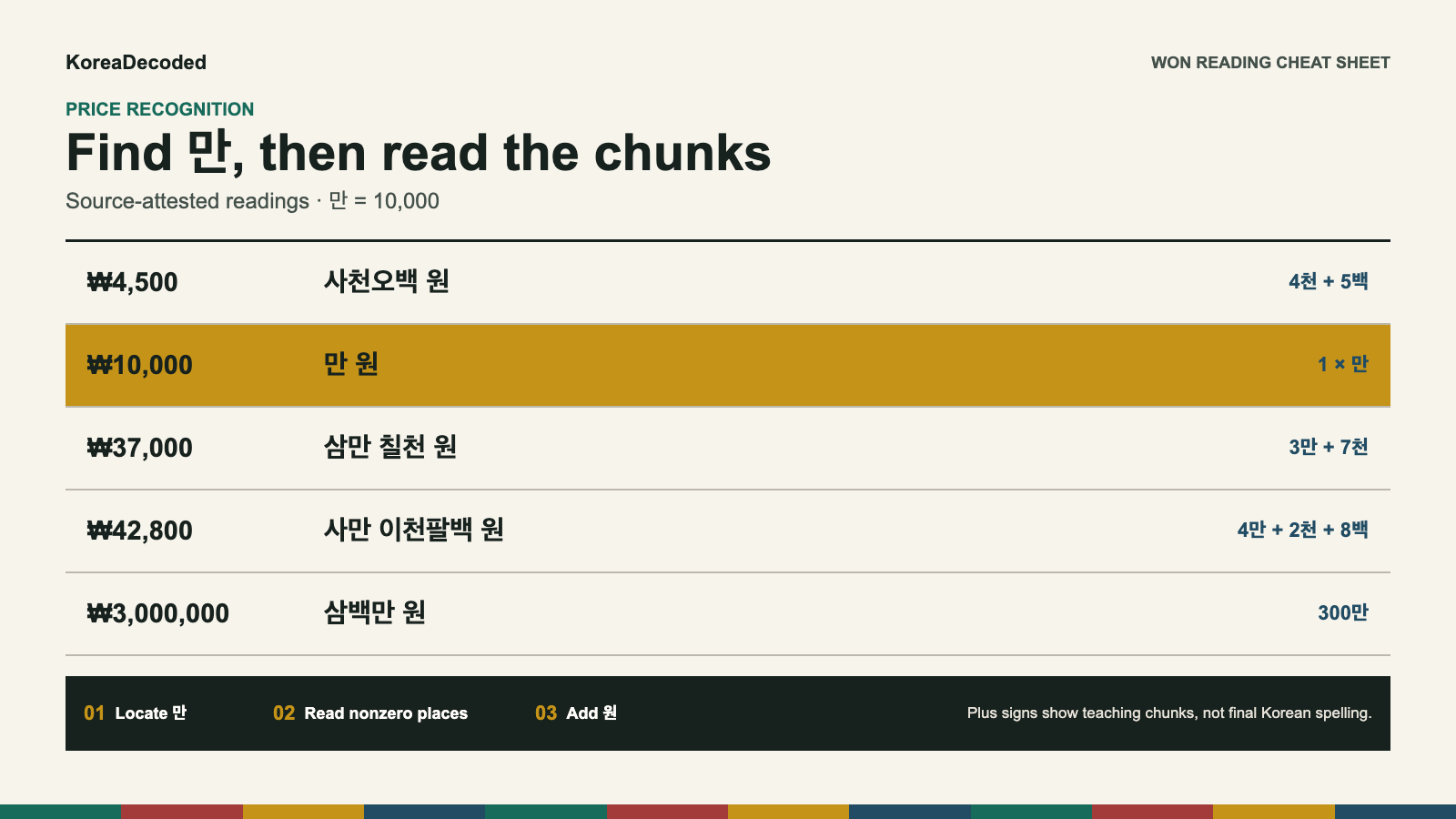
In the checked won examples, 만 marks the 10,000 block. Finding that boundary first makes the displayed amounts in this section easier to parse.
| Displayed amount | Source-attested Korean reading | Useful chunk |
|---|---|---|
| ₩4,500 | 사천오백 원 | 4천 + 5백 |
| ₩10,000 | 만 원 | 1 × 만 |
| ₩37,000 | 삼만 칠천 원 | 3만 + 7천 |
| ₩42,800 | 사만 이천팔백 원 | 4만 + 2천 + 8백 |
| ₩50,000 | 오만 원 | 5만 |
| ₩3,000,000 | 삼백만 원 | 300만 |
Use this three-step reading method:
- Locate the 10,000 block: 만.
- Read the nonzero place-value chunks on each side of it.
- Add 원, the won unit.
The plus signs above are teaching marks, not the final Korean spelling. Under the Korean spelling rule cited by the National Institute of Korean Language, number words are spaced at 만 units, and 원 is spaced from the number: 사만 이천팔백 원.
For ₩17,000 specifically, a 2026 National Institute of Korean Language answer accepted both 일만 칠천 원 and 만 칠천 원. This guide uses 만 without claiming that the version with 일 is wrong or less common.
People and items: learn the whole counter chunk
For a small travel group, the useful person-counter set is 한 명, 두 명, 세 명, 네 명. For general items, learn 한 개, 두 개, 세 개, 네 개. The dictionary also attests larger native examples such as 스무 명, 서른세 명, 다섯 개, and 열 개.
| What you mean | Korean chunk | What to notice |
|---|---|---|
| One person | 한 명 | Not 하나 명 |
| Two people | 두 명 | Not 둘 명 |
| Three items | 세 개 | Not 셋 개 |
| Four items | 네 개 | Not 넷 개 |
These are the practical small-group forms this article asks you to produce. They are not a claim that every possible magnitude before 명 or 개 has only one numeral choice. Also, 개 is a generic object counter; Korean has more specific counters for other categories.
Once you can recognize the quantity chunk, plug it into the full interaction taught in the Korean restaurant phrases guide or the Korea cafe ordering guide. This article stops at the number pattern instead of duplicating those scripts.
Floors and assigned order numbers use a different job
For numbered building floors, the learner dictionary gives Sino-Korean examples such as 일 층, 이 층, 삼 층, 십이 층, and 지하 일 층. So a displayed 3층 is read 삼 층 in this numbered-floor pattern.
Assigned identifiers use a separate meaning of 번. The dictionary gives examples including 4번, 33번, and 100번 and says this meaning chiefly follows Sino-Korean numerals. Applying that verified pattern, this guide uses 삼십삼 번 as a teaching application for No. 33; it is not presented as a verbatim source example.
Do not turn that into “번 always takes Sino-Korean numbers.” The frequency meaning uses chiefly native forms: 한 번 means one time, and 두 번 means two times. The same written unit is doing two different jobs.
The dictionary entry for 번호표 confirms the context of taking a queue or receipt number and waiting for it to be called. It does not prove that every restaurant, hospital, kiosk, or public counter uses the same screen or announcement.
Time mixes the two systems
For the ordinary beginner clock pattern taught in the official NIKL guide, the hour before 시 uses native Korean and the minutes before 분 use Sino-Korean:
2:30 = 두 시 + 삼십 분
The same guide gives 한 시 이십오 분 for 1:25. Separate what you hear into two chunks: hour + 시, then minutes + 분. This article keeps to that beginner clock pattern and does not extend the rule to every specialized time environment, duration, date, or 24-hour expression.
Age: pair the numeral with the unit
The official grammar information says 살 is used mainly after native Korean numerals, while 세(歲) is used after Sino-Korean numerals. A NIKL language article directly pairs these two ways to express age 32:
| Age unit | Number system | Verified example |
|---|---|---|
| 살 | Native Korean in the cited pattern | 서른두 살 |
| 세 | Sino-Korean | 삼십이 세 |
For the checked age examples in this guide, practice native + 살 first. At exactly 20, use 스무 살; in a compound such as 23, use 스물세 살. Do not convert this into the stronger claim that 살 is always spoken and 세 is always formal. The checked sources establish the numeral pairings, not a universal register divide.
This guide uses completed age. Current Civil Act Article 158 calculates age from the birth date as full age and expresses completed years; the administrative default follows that method unless another rule provides otherwise. There is no obsolete Korean-age formula here. For the separate social and conversation context, use the Korean age explained guide.
Six recognition drills
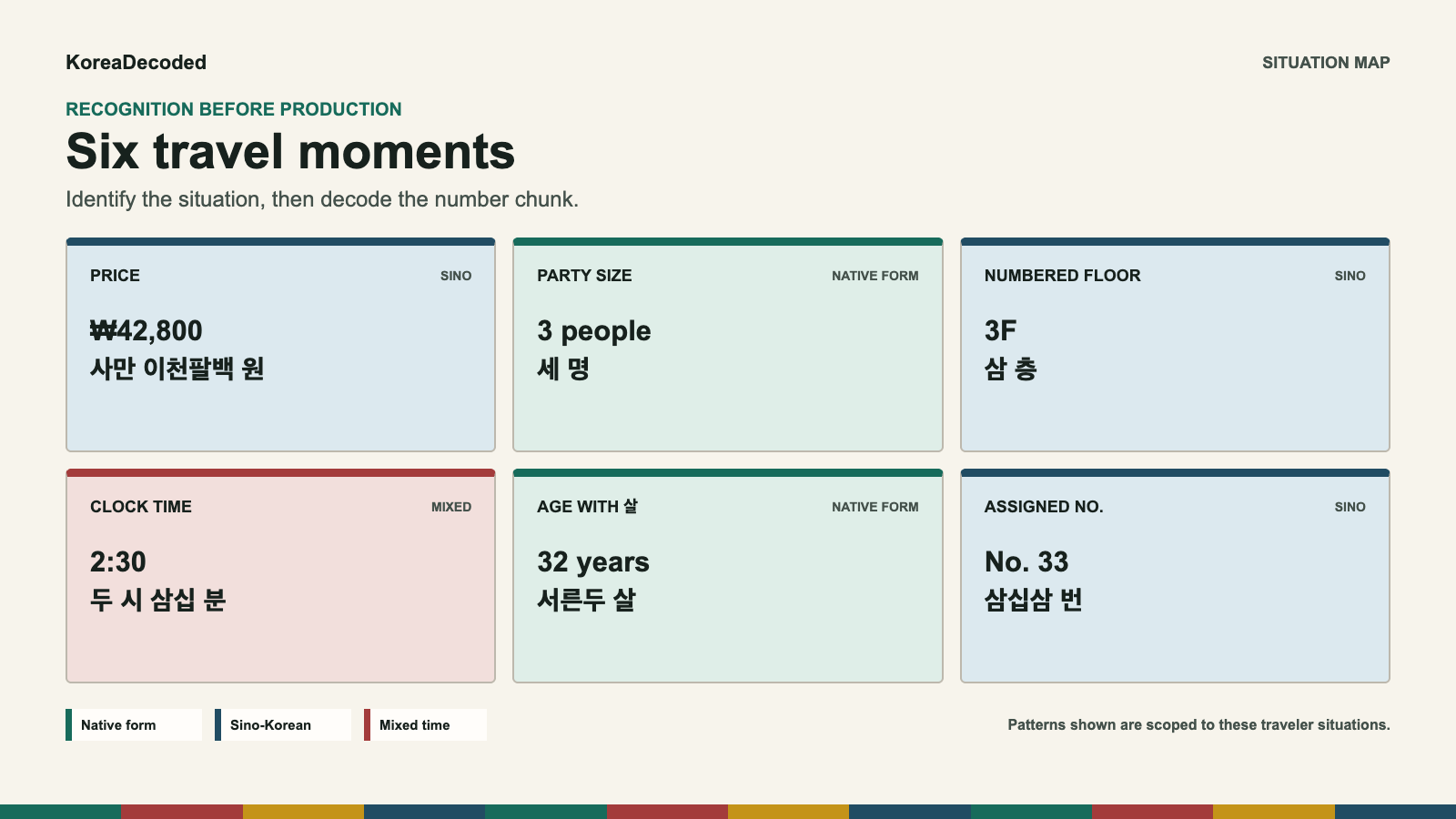
Look at the digits first. Say which pattern you need, then reveal the Korean chunk.
1. A screen shows ₩37,000
Price pattern: 삼만 칠천 원.
2. Your party has three people
Small party pattern: 세 명.
3. The destination is 3층
Numbered-floor pattern: 삼 층.
4. The time is 2:30
Mixed clock pattern: 두 시 삼십 분.
5. The age is 32 with 살
Native age pattern: 서른두 살.
6. The assigned number is 33번
Assigned-number pattern: 삼십삼 번. This is an application of the dictionary’s assigned-번 rule.
Mistakes to avoid
- Memorizing only 하나, 둘, 셋, 넷: also learn 한, 두, 세, 네 inside the cited unit chunks.
- Reading won in English three-digit groups: find the 10,000 unit 만 first.
- Using one system for all of clock time: the beginner pattern mixes native hours with Sino minutes.
- Treating every 번 alike: assigned 33번 and frequency 한 번 use different patterns.
- Calling every alternative wrong: official guidance accepts both 일만 칠천 원 and 만 칠천 원 for 17,000 won.
- Learning an obsolete age formula: use your completed age; check a specific rule when a regulated activity has its own age provision.
What to learn next
Use the number chunks here with the Korean shopping phrases guide for price questions and the Korean restaurant menu words guide for serving and menu context. For pointing-based orders, continue with the Korean street-food ordering guide.
The useful goal is not to recite every number. It is to recognize the job the number is doing, find the important unit, and decode the chunk in front of you.
Sources checked
- The six NIKL entries linked in “Hear the difference before you answer” were initially checked on 2026-07-13 and rechecked on 2026-07-14 for matching headword, superscript entry number, part of speech, official pronunciation notation, and speaker-button MP3 URL. The MP3s remain external links only; they are not downloaded, rehosted, embedded, or uploaded by this draft.
- NIKL Online Q&A: 하나/둘/셋/넷 before unit nouns, answer dated 2026-06-10 and rechecked 2026-07-14.
- NIKL 2025 everyday-conversation corpus report, pp. 116-118, accessed 2026-07-13.
- NIKL Online Q&A: Korean price writing, Hangul Orthography Article 44, and NIKL Online Q&A: 17,000 won, accessed 2026-07-13.
- NIKL dictionary: 층, 번, and 번호표, accessed 2026-07-13.
- NIKL beginner Korean teacher guide, pp. 71-72, and NIKL Online Q&A: minute and person units, accessed 2026-07-13.
- NIKL Online Q&A: 살 and 세, NIKL Online Q&A: 스무 살 and compounds, and NIKL language article, p. 222, accessed 2026-07-13.
- Current Civil Act, Article 158, and Current Framework Act on Administrative Affairs, Article 7-2, accessed 2026-07-13.