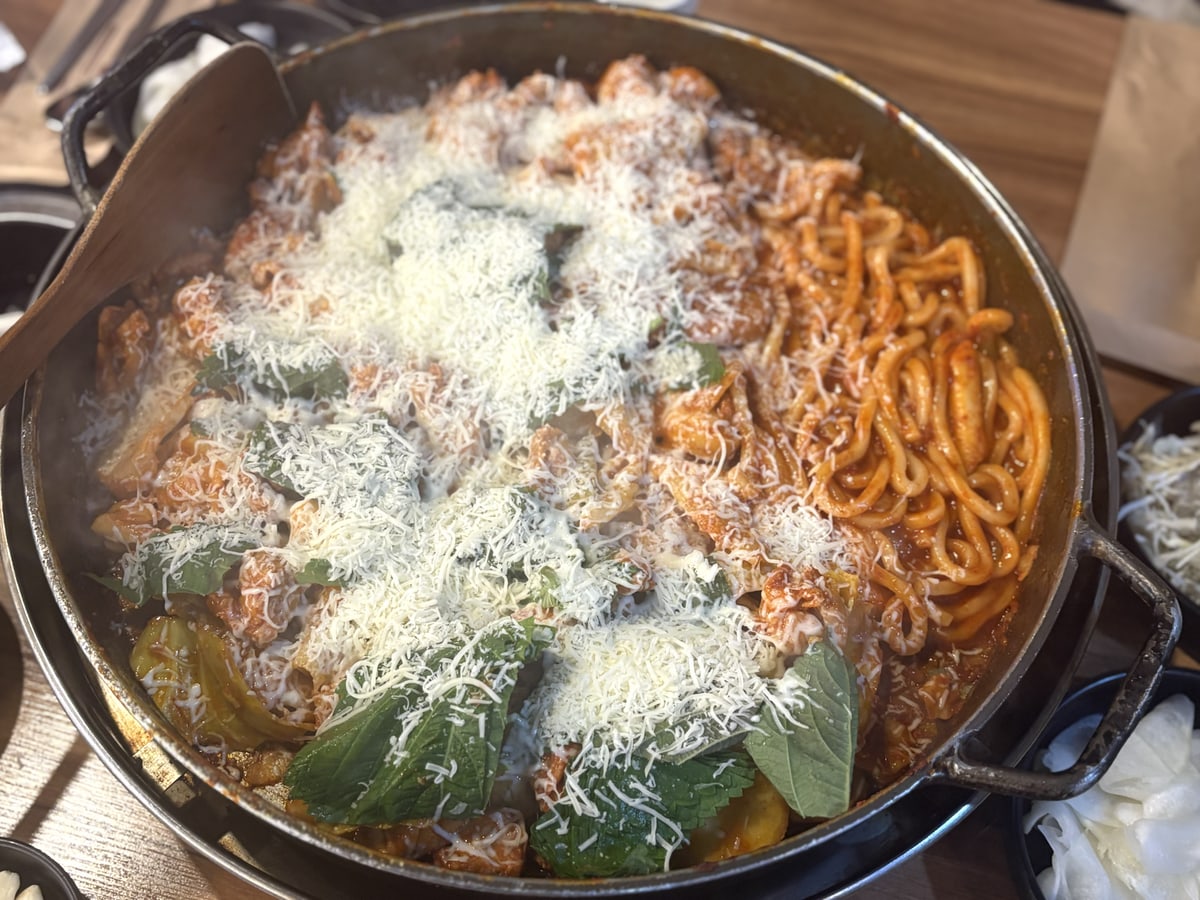
Some meals in Korea are not meant to be ordered like one plate per person. The food arrives in the middle of the table, everyone eats from the same pan or platter, and the best part may come later with noodles, rice, cheese, or fried rice.
If you are visiting Korea for the first time, shared dishes can feel confusing because the menu may not explain the social rules. The good news is that you do not need perfect Korean. You just need to understand how portion counts, shared utensils, add-ons, and staff help usually work.
What counts as a shared dish?
A shared dish is any meal where the main food is placed in the center of the table instead of being served as a personal bowl. It might be a hot pan, stew pot, grill plate, stir-fried dish, or large platter. In Korean restaurants, these dishes are often ordered by serving count instead of by individual plate.
Common examples include Korean barbecue, dakgalbi, jeongol hot pots, budae jjigae, large seafood or spicy stir-fry dishes, and some modern fusion pans. The exact style changes by restaurant, but the basic idea is the same: order together, eat together, and share the middle of the table.
Look for the minimum order
The first thing to check is whether the dish has a minimum order. If the menu says something like “2 servings minimum,” it means the restaurant expects at least two portions of that dish. This does not always mean two separate plates. It usually means one shared pan sized for two people or more.
This matters when you travel solo. Some restaurants may not accept a shared-pan order for one person, especially during busy hours. If you are alone, look for single-serving dishes, lunch sets, noodles, rice bowls, or restaurants that clearly allow one-person dining.
Do not rush to stir everything yourself
At many Korean restaurants, staff may start the cooking, stir the pan, cut meat or noodles with scissors, or tell you when the food is ready. If the dish is still cooking, wait a moment and watch what the staff does. This is especially true for grilled meat, hot pots, dakgalbi-style pans, and dishes that need finishing at the table.
If you are unsure, a simple question works: “Can we eat now?” Staff may answer with gestures even if English is limited.
Use serving tools when they are provided
Shared dishes often come with tongs, scissors, a ladle, or a large spoon. Use those tools to move food from the shared pan to your own plate or bowl. It is more comfortable for the table and helps avoid reaching into the middle with personal chopsticks too much.
If there are no serving tools, follow what your group is doing. In casual restaurants, people may use their own chopsticks more freely, but visitors should start politely and keep the shared area clean.
Understand add-ons: noodles, cheese, rice, and fried rice
Many shared dishes have add-ons. You may see extra noodles, rice cakes, cheese, vegetables, rice, or fried rice at the end. These are not random extras; they can be part of the best eating sequence.
For example, a spicy pan may start with meat and vegetables, then noodles may be mixed in, and fried rice may be added after most of the main food is gone. Cheese can soften the spice and make the dish feel more familiar if you are not used to Korean heat.
A simple ordering script
If the menu is confusing, keep the order simple. Point to the shared dish, show the number of people, and ask whether it is okay.
- “For two people?” Use this when the menu has a shared dish and you want to confirm portion size.
- “Not too spicy, please.” This may not always be possible, but it is worth asking for spicy pans.
- “Can we add noodles?” Ask this if you see noodle add-ons on the menu.
- “Fried rice at the end?” Useful for hot pot or stir-fry restaurants where rice is added after the main dish.
What to do if you do not know the dish
If the food looks good but you do not know the name, focus on the practical questions: Is it spicy? Is it for two or more people? Does it include meat or seafood? Is rice included? Do you cook it yourself or does staff help?
This is better than trying to translate every word perfectly. Korean menus often use dish names, ingredient names, and add-on names together, so the ordering logic matters as much as the vocabulary.
Good manners for a shared Korean meal
- Let everyone at the table reach the main dish comfortably.
- Use serving tools when they are provided.
- Take a reasonable amount first, then go back for more.
- Do not move all the best pieces to your own plate immediately.
- Ask before adding noodles, cheese, or fried rice if the whole table is sharing.
How this connects to restaurant planning
Shared dishes are easiest when you travel with at least one other person and have a small backup plan. If a restaurant is famous, check whether it uses a reservation or waitlist app before crossing town. For that part, read the CatchTable, Tabling, and restaurant waitlist guide.
If you want simpler meals first, start with individual foods such as donkatsu, naengmyeon, or street food. Once you are comfortable ordering, shared pans become one of the most enjoyable ways to eat in Korea.
Sources checked
- Korea.net: Korean-style sharing
- VisitKorea: About Korean food
- Korea.net: Soban and Korean table culture
For another shared-table meal format, read the Korean BBQ etiquette guide for first-time visitors.
For shared dishes, the Korean restaurant menu words guide helps you spot servings, add-ons, stews, hot pots, and cooking styles.
Some tteokbokki restaurants serve larger shared pots, so the tteokbokki guide is useful before ordering with a group.