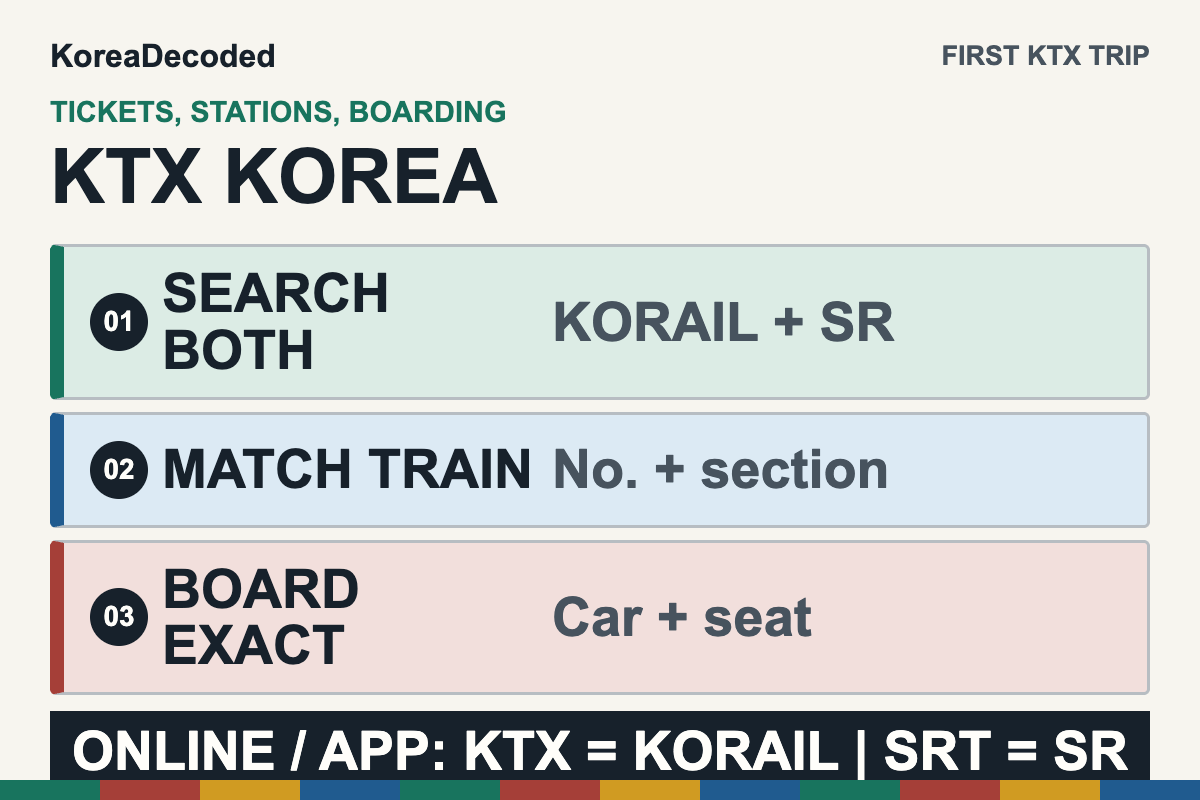
Quick answer: for an online or app purchase, buy a ticket labeled KTX through KORAIL and a ticket labeled SRT through SR. Because current KTX-SRT cross-operation and coupled operation can place relevant high-speed services in separate systems, first run the same origin, destination, and date in both official KORAIL and SR searches. Compare the operator label, train number, exact operating section, and ticketed car before you board. At station counters and automatic ticket machines, KORAIL’s current coupled-operation notice says either train type can be sold. A T-money card is for local transit; it is not your high-speed-train ticket.
For a first KTX trip, the important decisions happen before boarding: KTX or SRT, the operator and exact station, the valid issued ticket, the live platform, and the ticketed car. That operator check matters in 2026 because a limited KTX service now uses Suseo, a limited SRT service uses Seoul Station, and a pilot also connects KTX and SRT formations on some services. Once those fields are separated, riding the KTX is a straightforward station-to-seat process.
Current-rules note: KORAIL booking windows, refund penalties, holiday sales, payment support, routes, train assignments, and the KORAIL-SR integration process can change. The official sources in this guide were checked again on July 16, 2026. Search your exact trip in both KORAIL and SR, then recheck the issued ticket and live station board before travel.
KTX in One Minute: Ticket, Station, Train, Seat
| Question | What controls | First-time rule |
|---|---|---|
| Where do I buy? | The official KORAIL website, KorailTalk app, a KORAIL ticket machine, or a KORAIL station ticket office | An ordinary subway station is not automatically a KTX ticket office |
| Which Seoul station? | The exact departure station in the search result and on the ticket | Do not treat “Seoul” as one rail terminal |
| Which train? | Train type and train number, plus departure time | The final destination on the board may be beyond your stop |
| Where do I board? | The live platform assignment at the station | Do not save an old platform number as a plan |
| Where do I sit? | Car number first, seat number second | Car 8, Seat 3A does not mean Platform 8 |
| What ticket do I show? | The actual issued mobile/home ticket | KORAIL says a photographed or captured ticket is invalid |
If you are arriving from Incheon Airport, plan the airport-to-station leg separately. The Incheon Airport to Seoul transfer guide helps you reach the city; this guide starts with the intercity ticket.
Where Should You Book a KTX Ticket?
For the cleanest first booking, start on KORAIL’s English reservation site or in the official KorailTalk app. KORAIL also lists ticket vending machines and train-station ticket offices as purchase channels. Its English guide specifically says the station option does not include subway stations, so do not expect every metro customer center to sell an intercity ticket.
KORAIL’s current English guide says ordinary ticket sales open at 7:00 a.m. Korea time one month before departure. It currently lists a website cutoff 20 minutes before departure, a vending-machine cutoff 10 minutes before departure, and station sales until departure. Those are sales cutoffs, not sensible arrival targets. Major-holiday tickets can use a separate schedule and payment window, so check KORAIL notices if you travel around Seollal or Chuseok.
What if your card does not work online?
KORAIL’s English guide says online payment is available by credit card, but that wording does not guarantee that every foreign-issued card will authorize. The Korea Tourism Organization’s currently served transportation reference says foreign-issued cards are accepted in the KTX ticket-machine and counter category and notes that KTX is available at new ticket machines. If online payment fails, use a current KTX-capable machine or a KORAIL ticket office and keep another payment card available. Do not wait until the sales cutoff to discover that your issuer blocked the transaction.
Search both official systems before you choose. Current KORAIL and SR notices cover both cross-operation and pilot coupled/combined operation. KORAIL specifically says online users should search both KTX and SRT because connected formations can be different train types. Run the same exact stations and date in KORAIL and SR, then compare the KTX or SRT label, train number, and exact operating section shown for that service. For online or app booking, buy KTX in KORAIL and SRT in SR. For an on-site purchase during the pilot, KORAIL says station counters and automatic ticket machines can sell either train type; still verify the label, train number, operating section, and car on the issued ticket. A shared departure or connected train does not replace those ticket fields. Do not rely on a fixed pilot timetable, fare, formation, or seat-availability pattern.
How to Book the KTX Step by Step
- Search both official systems. Run the same origin, destination, and date in KORAIL and SR. For online or app booking, use KORAIL for a result labeled KTX and SR for one labeled SRT; do not infer the operator from Suseo or Seoul Station alone. At a station counter or automatic ticket machine, either train type can be sold during the pilot, but the issued ticket fields still control.
- Choose exact stations. Enter the station names, not only the cities you have in mind. Check where each station sits relative to your hotel and destination.
- Choose the date and passenger count. Use the local Korea date and review age categories in the live booking flow when children are traveling.
- Compare the actual results. Check operator, train type, train number, the exact origin-to-destination operating section, departure and arrival times, and whether a transfer appears.
- Select a class and seat. A reserved standard-class seat is a simple starting point for a first ride. Follow the live options rather than assuming every train has the same seat layout.
- Enter retrieval details carefully. KORAIL tells buyers to enter the email and password accurately, including uppercase and lowercase letters, because those details are used to find the ticket later.
- Pay and open the issued ticket. Confirm that the purchase appears in My Ticket or the app, then check the operating section, car number, and seat number before closing the booking flow.
- Check both directions. A return ride is a separate train decision. Make sure each ticket has the intended operator, station, date, time, train number, section, car, and seat.
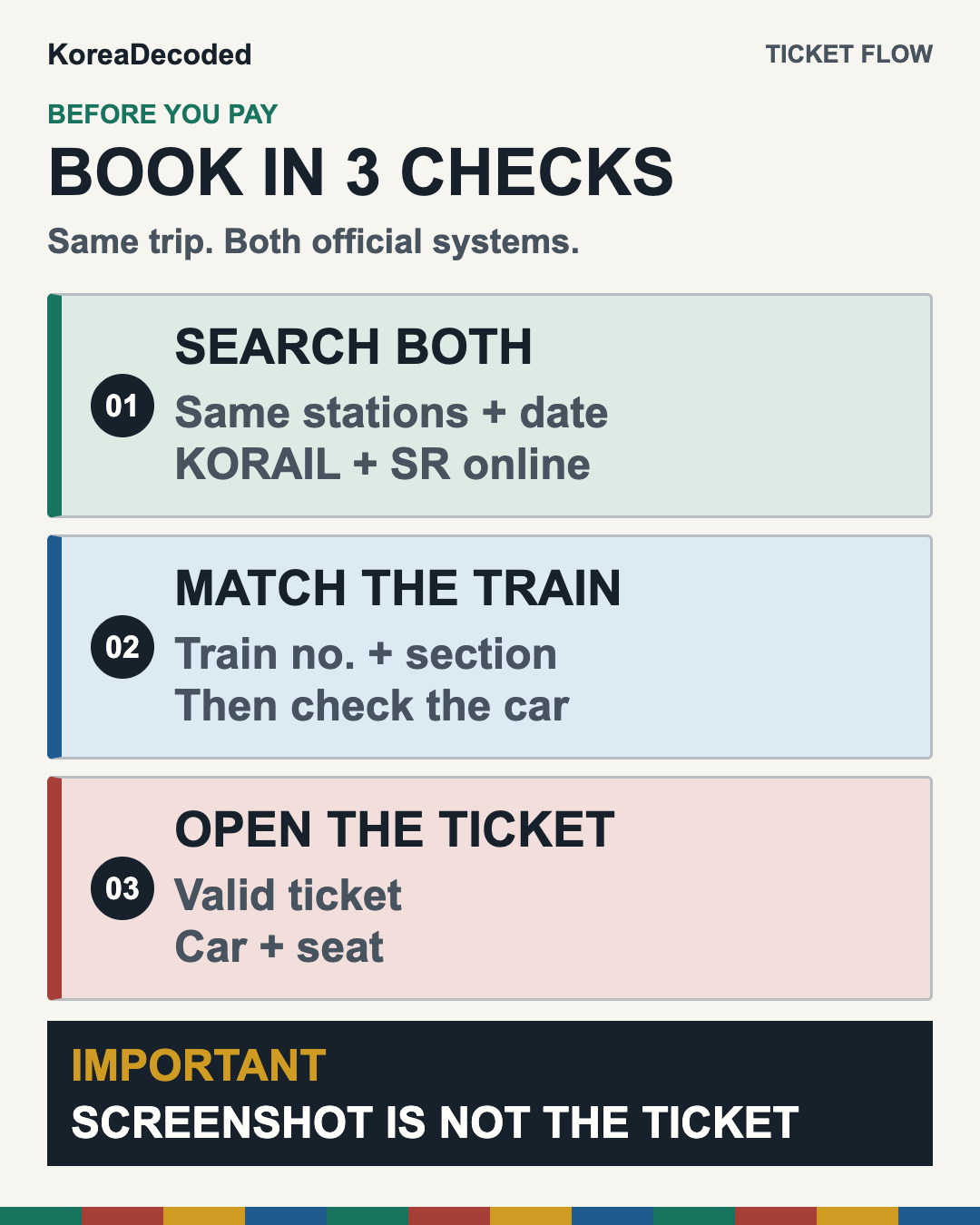
A T-money balance does not complete any of those steps. T-money is useful for local buses and subways before and after the intercity ride, but the KTX needs its own valid ticket. The T-money card guide owns the local-transit part of the trip.
Seoul Station, Yongsan, Cheongnyangni, or Suseo?
Seoul has more than one long-distance rail terminal. The table below is an orientation tool, not a substitute for the KORAIL search result.
| Station | Useful orientation | Do not assume |
|---|---|---|
| Seoul Station | Start here when searching the main Gyeongbu corridor toward cities such as Daejeon, Dongdaegu, Gyeongju, and Busan | That every train here is KTX; a limited SRT cross-service now uses Seoul Station |
| Yongsan Station | Start here when searching the Honam side toward places such as Iksan, Gwangju-Songjeong, or Mokpo | That the route pattern removes the need to read your ticket |
| Cheongnyangni Station | Check this station for KTX routes toward Gangwon and the Jungang corridor, including Gangneung or Andong searches | That Seoul Station and Cheongnyangni are interchangeable |
| Suseo Station | Search the live train: Suseo has SRT service and a limited KTX cross-service to and from Busan in 2026 | That the station name alone tells you the operator or booking channel |
Your ticket wins. Routes and stopping patterns can change, and some corridors have more than one Seoul-area option. Use the station printed on the ticket even if an old guide or a friend’s memory points somewhere else.
After choosing the station, plan the local ride to its entrance and allow for walking inside a large terminal. The Seoul subway guide for first-time visitors covers lines, exits, transfers, and local station navigation without mixing them into the KTX ticket.
How to Read the KTX Ticket Before Travel Day
Open the ticket before leaving your hotel and make a six-field check:
- Origin: the exact station where this ticket begins.
- Departure: the Korea date and departure time.
- Train: KTX type and train number.
- Operating section: the origin and destination covered by this ticket and service.
- Car: the coach you must board.
- Seat: the assigned place inside that car.
Then check the arrival station and scheduled arrival time. A departure board may show the train’s final destination rather than your intermediate stop, which is why the train number matters.
Do not use a screenshot as the ticket. KORAIL’s current train-etiquette page says a ticket photographed or captured on a phone is invalid. Open the actual issued mobile ticket in the official flow or use the issued home ticket. If you want a battery or data backup, print the home ticket rather than relying on a screen capture. Keep the valid ticket available until you have exited at your destination.
If travel-day connectivity is still unresolved, the Korea eSIM guide for tourists explains what to check before depending on mobile data. Connectivity helps you retrieve live information, but it does not turn a screenshot into a valid ticket.
How Early Should You Arrive for the KTX?
KoreaDecoded planning buffer: be inside the correct station about 30 minutes before departure. Use about 45 minutes if it is your first visit to that terminal, you have a large suitcase, you need a ticket office, or you are transferring from an unfamiliar subway line. This is practical advice, not a KORAIL check-in rule.
KTX is not an airline, but a last-minute sprint can still fail because the station is large, the platform is downstairs, the train has many cars, or your payment/ticket problem needs a staffed counter. The official sales cutoff is not a safe arrival plan.
How to Board the Right KTX Car and Seat
- Start in the correct station hall. Compare the station name around you with the origin on your ticket.
- Read the live departure board. Match the train number and departure time, then confirm the destination/direction and platform.
- Go to the announced platform. Platform information is live; do not use a platform number from an old screenshot or blog.
- Find your car marker. Use the platform’s car-number signs to wait near the door for the car printed on your ticket.
- Board that car. Move luggage out of the doorway and find the seat number inside.
- Sit in the assigned seat. Keep the valid ticket available in case staff need to check it.
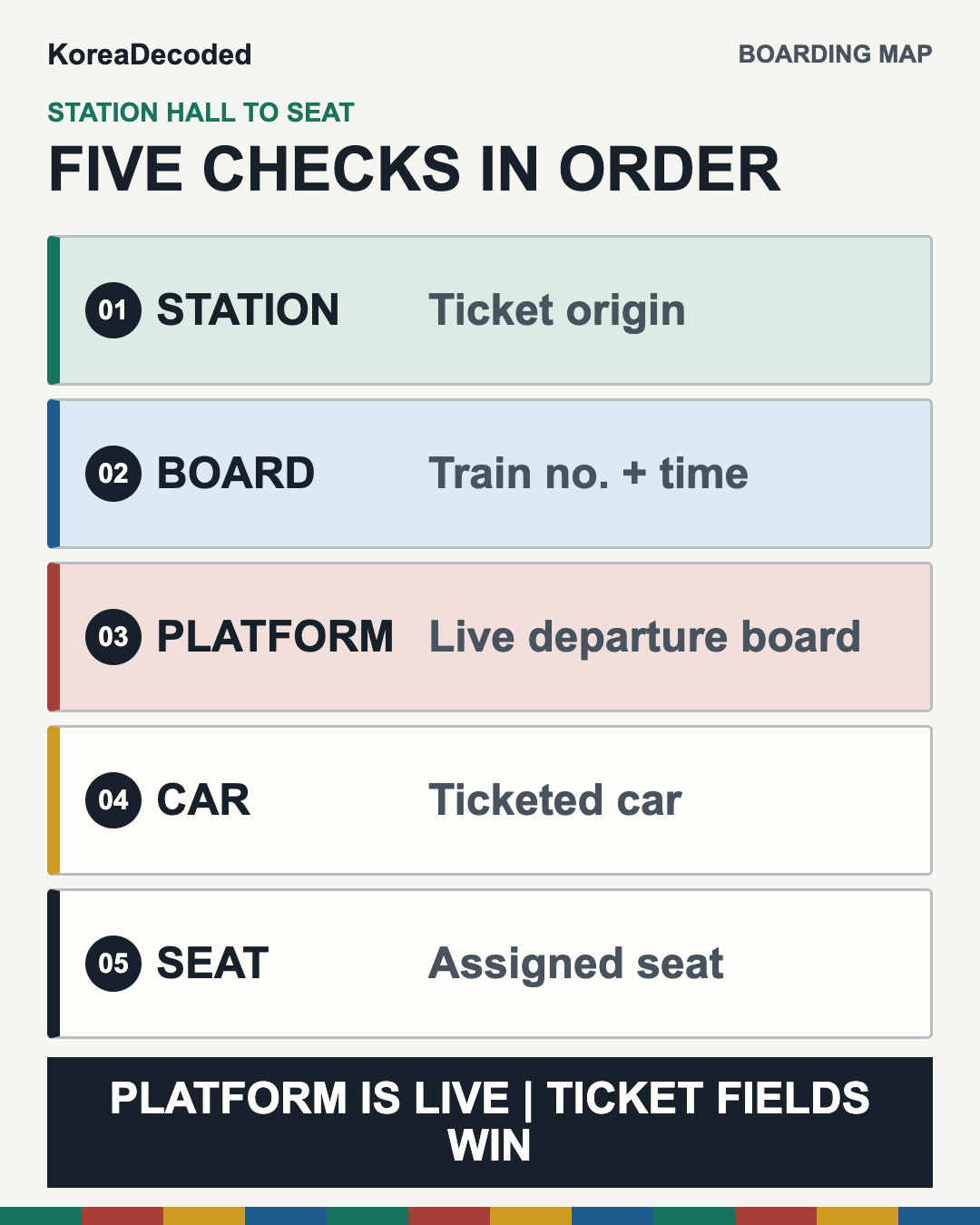
Keep three numbers separate: train number identifies the departure, car number identifies the coach, and seat number identifies your place inside it. The platform is a fourth, live station assignment.
Where Does Luggage Go on the KTX?
KORAIL’s current carry-on standard allows up to two items that do not occupy a seat or aisle. It tells passengers to store them in the luggage area between cars or on the shelf inside the passenger cabin, and says the passenger must be able to carry the items.
- Pack for self-carry. Bring only what you can lift onto the train and move without blocking other passengers.
- Use the proper storage area. Do not place a suitcase in a seat, aisle, or doorway.
- Keep valuables with you. Store travel documents, wallet, phone, medication, and fragile electronics where you can monitor them.
- Do not assume space is reserved. The official rule names storage locations but does not guarantee a dedicated bay for your bag.
- Prepare before boarding. Close loose straps and have the handle ready so you can clear the door efficiently.
For the rest of the trip, use the broader first-trip Korea packing checklist. The KTX-specific lesson is simpler: two manageable items, no blocked seat or aisle, and no expectation that staff will lift or watch them.
What to Do During the Ride and Before Your Stop
- Keep conversations and device audio quiet.
- Watch the onboard information and announcements as the train approaches your station.
- Collect small items before standing up and check the seat pocket, shelf, and luggage area.
- Move toward the door only when it is safe; do not block the aisle long before your stop.
- Keep the valid ticket available until you have left the destination station’s passenger area.
If you need to travel beyond the destination printed on your ticket, tell the train attendant before the train passes that original destination. KORAIL’s current English Ticketing Guide directs the passenger to notify staff before passing the printed destination, pay the required additional fare, and purchase a new ticket. Its Korean guide also says the original ticket cannot be extended onboard: it is valid only to the printed destination, and travel beyond that point is subject to additional fare. You must purchase a new ticket for the onward section and pay the fare and any additional fare the employee requires. Do not remain onboard past the original destination without that new valid ticket, and do not assume the original car and seat continue.
What If Your Plans Change or You Miss the KTX?
Before departure
Handle the change as early as possible. KORAIL says a website home ticket or KorailTalk mobile ticket can be submitted for refund before the departure time through the relevant online/app flow. Refund penalties vary by timing and by weekday, weekend, public-holiday, or special-transport treatment. Check the current table before confirming.
If you need a different train, secure a valid ticket for that departure. Do not assume the original seat transfers, and do not cancel a hard-to-replace seat until you understand the live availability and refund result.
After departure
Use the 10-minute app exception only when all of these conditions are true: the ticket is for KTX, it was purchased in KorailTalk, no more than 10 minutes have passed since departure, and the system confirms that you are not aboard. Only then can the refund request be submitted in KorailTalk. If any condition is not met or the option is absent, do not wait: go immediately to a KORAIL station ticket office, or contact the official KORAIL Customer Center at +82-1599-7777 for instructions and check its current service hours. A call does not replace any station-only refund requirement. No refund can be requested after the scheduled arrival time printed for the ticket’s destination, and the original ticket is not permission to board the next train.
If your phone fails, the ticket will not open, or you cannot retrieve the purchase, take the exact purchase details to KORAIL staff. Do not solve a retrieval problem by showing a screenshot that KORAIL says is invalid.
Do You Need a KORAIL Pass?
Not for a single KTX ride by default. A KORAIL Pass is a separate product for eligible foreign visitors, and whether it makes financial sense depends on the exact trains you will take. Compare the current pass terms with the live ordinary-ticket total for your real itinerary; do not rely on an old pass price table.
A pass also does not remove the seat step. KORAIL provides a separate seat-reservation process for pass users. Its current instructions require the valid pass and passport, plus the seat-reservation ticket when a seat is reserved, and say screenshots are invalid. KORAIL Pass does not cover SRT, so check the operator and current pass eligibility even when KTX and SRT use the same station.
Common First-Time KTX Mistakes
- Going to the wrong Seoul terminal. Check Seoul Station, Yongsan, Cheongnyangni, or Suseo as exact names.
- Searching only one operator system. Current cross/coupled operation means the complete high-speed choice may require the same search in both KORAIL and SR.
- Using an old Suseo-equals-SRT shortcut. Limited cross-operation means the train label and operator now matter more than the station stereotype.
- Treating T-money as the train ticket. Local transit and intercity rail are separate purchases.
- Saving only a screenshot. Keep the actual issued ticket available or print the home ticket.
- Matching only the destination. Use train number, operating section, and departure time because the displayed final destination can be beyond your stop.
- Confusing platform, car, and seat. They are three different locations in the boarding sequence.
- Arriving at the sales cutoff. A purchase deadline is not enough time to navigate the station.
- Blocking the aisle with luggage. KORAIL limits carry-ons to two manageable items that fit designated storage without taking a seat or aisle.
- Assuming the next train will accept a missed ticket. Get a valid replacement through KORAIL.
Your Five-Minute KTX Check
- Search: the same exact stations and date checked in both KORAIL and SR.
- Operator: online/app KTX in KORAIL or SRT in SR; on site, verify the train type sold by the counter or machine rather than inferring it from the station name.
- Station: exact origin and a realistic local route to it.
- Ticket: correct Korea date, departure time, train number, operating section, car, and seat.
- Validity: actual mobile/home ticket available; no screenshot-only plan.
- Board: live platform matched to train number and time.
- Luggage: no more than two self-carried items, with nothing in a seat or aisle.
- Recovery: the exact KorailTalk exception only when all conditions apply; otherwise the KORAIL station office or official Customer Center immediately.
FAQ
Can a foreign tourist book KTX online?
Yes. KORAIL operates an English reservation site and My Ticket retrieval flow, and its English guide lists credit-card payment. Enter the email and password exactly and confirm that the issued ticket opens. The official wording does not guarantee every foreign card authorization, so keep an on-site KORAIL machine or ticket office as a fallback.
Can a KTX train leave from Suseo?
Yes, on a limited cross-service as of July 14, 2026. KORAIL says a Suseo-Busan KTX trial began on February 25, while SRT also began a limited Seoul Station-Busan service. Search the same exact trip in both KORAIL and SR, then use KORAIL for an online or app result labeled KTX. At a station counter or automatic ticket machine, either train type can be sold during the pilot. Check the train number, operating section, and car on the issued ticket; do not assume every Suseo result is KTX or that the pilot pattern is permanent.
How far ahead can I book the KTX?
KORAIL’s current English guide says ordinary sales open at 7:00 a.m. Korea time one month before departure. Special holiday sales can follow separate notices, so recheck KORAIL for your travel date.
Can I use T-money for the KTX?
A T-money balance is not a KTX reservation. Buy a separate KTX ticket through KORAIL, then use T-money only for eligible local transit before or after the intercity ride.
Do I need to print my KTX ticket?
KORAIL supports issued mobile tickets and home tickets. Use the actual issued ticket in the official flow. KORAIL says a photographed or captured ticket is invalid, so print the issued home ticket if you want a non-phone backup.
How early should I get to the KTX station?
A practical first-time buffer is 30 minutes inside the correct station, or about 45 minutes with large luggage, an unfamiliar transfer, or a ticket-office problem. That is KoreaDecoded advice, not an airline-style KORAIL check-in rule.
Can I take large luggage on the KTX?
KORAIL’s current rule permits up to two items that do not occupy a seat or aisle. Store them in the between-car luggage area or the cabin shelf and bring only what you can carry yourself. The rule does not guarantee a reserved luggage space.
What should I do if I miss my KTX?
The KorailTalk exception applies only to a KTX ticket purchased in KorailTalk, no later than 10 minutes after departure, when the system confirms that you are not aboard. If every condition is true, submit the request in KorailTalk. Otherwise, go to a KORAIL station ticket office immediately or contact the official KORAIL Customer Center at +82-1599-7777 for instructions; check the current service hours. Do not board a later train until you have a valid ticket for it.
Sources Checked
- KORAIL, English Ticketing Guide, accessed July 14, 2026, for purchase channels, ordinary booking window, credit-card payment, retrieval details, refunds, and the required staff notice, additional fare, and new ticket before travel beyond the printed destination.
- KORAIL, English Ticket Reservation and My Ticket, accessed July 14, 2026, for the current official search and retrieval surfaces.
- KORAIL, purchase, refund, and lost-ticket guide, accessed July 14, 2026, for mobile/home ticket issuance, the exact KorailTalk-purchased KTX/non-boarding/10-minute conditions, station handling otherwise, and the rule against onboard extension past the ticketed destination.
- KORAIL, passenger terms and appendices, accessed July 14, 2026. The official page identifies the current text as amended May 29, 2026; Articles 9, 11, and 12 support the valid-ticket, fare, and additional-fare boundary used for travel past the printed destination.
- KORAIL, train etiquette and carry-on standard, accessed July 14, 2026, for the two-item rule, storage locations, self-carry requirement, ticket screenshot restriction, and quiet-cabin guidance.
- KORAIL, 2026 Seollal reservation notice, posted January 13, 2026, as evidence that major-holiday tickets can use special sales and payment windows.
- KORAIL, Suseo-origin KTX and Seoul-origin SRT cross-operation notice, posted February 10, 2026 and accessed July 14, 2026, for the changed station/operator boundary.
- KORAIL, cross-operation booking-channel notice, posted February 23, 2026 and accessed July 14, 2026, for the operator-specific online/app channels.
- KORAIL with the Ministry of Land, Infrastructure and Transport and SR, KTX-SRT coupled-operation announcement, posted April 14, 2026 and accessed July 14, 2026, for the May 15 pilot, the instruction to search both systems online, and the statement that station counters and automatic ticket machines can sell either train type. Static times, fares, consists, and seat figures are not reproduced here.
- SR, SRT-KTX pilot coupled and combined-operation notice, posted April 14, 2026 and accessed July 14, 2026, for the date-sensitive train-type, train-number, and operating-section changes. Its static timetable and fare examples are not used.
- Korea Tourism Organization / VISITKOREA, Traveling Between Cities by Train, last updated September 19, 2025 and accessed July 14, 2026, for general station/line orientation. Its warning that details may differ is important: the 2026 KORAIL cross-operation notices override its older operator shorthand.
- Korea Tourism Organization, International Visitors’ Transportation and Booking/Payment Services, canonical English PDF accessed July 14, 2026, for current ticket-machine/counter and foreign-issued-card context. The file prints no publication/update date; its HTTP last-modified header and embedded PDF metadata are June 1, 2026 technical metadata, not a publication date.
- Korea Tourism Organization / VISITKOREA, Andong Travel Guide, published June 16, 2026 and accessed July 14, 2026, for current KTX-Eum station orientation toward Andong.
- KORAIL, the July 13, 2026 integrated-member transition release, checked July 16, 2026, for the July 14 member-transition start and the separate August integrated-app timeline. This guide does not claim that the integrated app is already available.
- SR, Suseo Station, accessed July 14, 2026, for station orientation, and the July 9, 2026 passenger-contract transition notice, confirming that operator-specific rules still apply before full integration.
- KORAIL, KORAIL Pass information, accessed July 14, 2026, for pass seat reservations, required documents, screenshot restriction, and SRT exclusion.
- KORAIL, English Contact Us, accessed July 14, 2026, for the official international Customer Center number; travelers should check the page’s current service hours.